

The most effective online marketing strategy is the one that brings in customers you can serve profitably—and gives you enough evidence to repeat the result. A busy Instagram account, a higher ranking or a cheaper click can help, but none is the business outcome.
For a Seattle business with limited time, start with three jobs: capture existing demand, build confidence before the sale, and give satisfied customers a reason to return. Choose the channels after you understand those jobs.
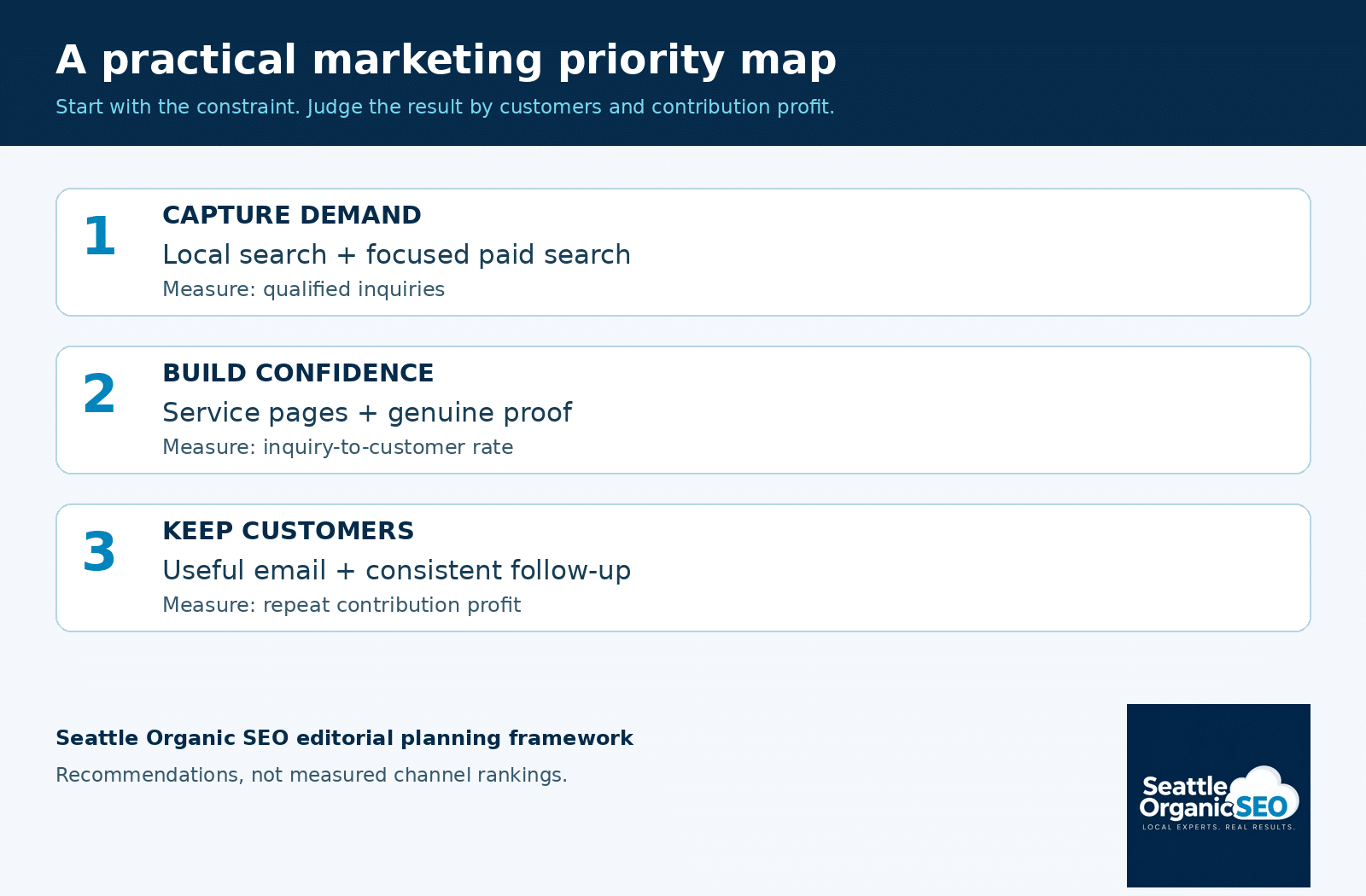
Start with the constraint, not the channel Ask where growth currently breaks. Do too few qualified prospects find you? Do visitors leave without contacting you? Do inquiries go unanswered? Do customers buy once and disappear? More traffic only solves the first problem.
A Ballard contractor turning away work needs a different plan from a new Capitol Hill retailer. A B2B consultant selling a six-month engagement needs a different measurement window from a café selling lunch. The Seattle examples here are planning scenarios, not client case studies or local performance benchmarks.
| Your constraint | First strategy to test | Business measure |
|---|---|---|
| Not enough high-intent inquiries | Local SEO and a focused paid-search test | Qualified inquiries and acquisition cost |
| Visitors do not trust the offer | Better service pages, proof and clear next steps | Qualified inquiry rate |
| Leads arrive but rarely close | Faster response and consistent qualification | Lead-to-customer rate |
| Too few repeat purchases | Permission-based email and useful follow-up | Repeat contribution profit |
| Customers do not know the category | Demonstrations, educational content and partnerships | Assisted pipeline and new customers |
1. Capture demand with local search For an eligible local business, maintain a complete Google Business Profile, accurate hours, useful categories and current photos. Google identifies relevance, distance and prominence as local ranking factors; a profile cannot make geography irrelevant. See Google’s local ranking guidance.
Build useful pages around the services you actually provide. Explain who the service suits, what happens next, what changes the price and where you genuinely work. A West Seattle service page should contain real operating information, rather than the same generic text with a neighborhood swapped in.
Ask customers for honest feedback consistently. Do not offer rewards for Google reviews or selectively ask only happy customers; Google’s review policy prohibits those practices. Address recurring complaints in operations, not just in replies.
2. Use paid search to test a specific offer Paid search is useful when someone is actively looking for what you sell and the economics leave room for acquisition costs. Start with one service, one realistic geography and a matching landing page. Review actual search terms and exclude irrelevant demand.
Separate branded searches from new-customer discovery. Report media spend and management costs separately, then combine them when assessing total acquisition cost. Count completed jobs or sales alongside leads. A cheap form submission from outside your service area is not a win.
Do not scale while the phone goes unanswered or the calendar is full. Track missed calls and response time before buying more volume. Keep enough budget and observation time for your normal sales cycle; a seven-day result is weak evidence for a three-month purchase decision.
3. Improve conversion before multiplying traffic Make the next step obvious on mobile. Show your service area, availability, relevant proof, a working contact method and what the visitor can expect after submitting. Test forms yourself and confirm that confirmation messages and notifications arrive.
Publish genuine examples with permission. Describe the situation, work performed, time period and limitations. Distinguish revenue from profit and measured results from estimates. An honest specific example usually gives buyers more decision support than a page of unsupported superlatives.
4. Build retention with useful email Create a reason to subscribe: a maintenance reminder, a relevant buying guide, a restock notice or an event invitation. Segment by customer needs and purchase history where you have permission and reliable data. Let people unsubscribe easily.
Evaluate purchases and contribution profit, not just opens. Some customers would have returned without the campaign. Where the list is large enough, compare a randomly selected holdout group; where it is small, treat attribution as directional and monitor unsubscribes and complaints. Email delivery is never guaranteed.
5. Turn expertise into reusable content Choose questions your sales team actually hears. A Seattle remodeler could explain what changes a project estimate; a professional service firm could show how to compare providers. Use your own photos, process explanations and documented experience.
Create one substantial answer, then adapt it into a short video, an email and a social post. Keep the full explanation on a page you maintain. AI-assisted drafting can speed production, but a knowledgeable person should check facts, examples and claims before publication.
Make the economics visible Illustrative example: a completed job contributes $600 after variable delivery costs, before acquisition and overhead. If you reserve $300 for overhead and profit, the acquisition allowance is $300. At a 25% close rate on qualified leads, the planning ceiling is $300 × 25% = $75 per qualified lead.
Spending $1,200 to acquire 20 qualified leads produces a $60 lead cost. At five customers, acquisition cost is $240 each. Their $3,000 contribution leaves $1,800 after that marketing spend, before fixed overhead. These are invented inputs to demonstrate the calculation, not promised results. Include labor, creative and agency costs consistently.
Use campaign tags on external campaign links and join those records to your inquiry log. Do not put customer names or private details in URLs. Avoid campaign tags on internal navigation, which can confuse attribution.
A 90-day implementation plan Days 1–14: choose one growth constraint, define a qualified lead, test tracking and record your baseline. Review recent customers to identify the service and geography worth pursuing.
Days 15–45: improve the matching service page, update the business profile and launch one bounded acquisition experiment. Start a consistent review request and follow-up process. Record spend, qualified leads, booked sales and capacity each week.
Days 46–90: compare results with the original economics and sales cycle. Fix the largest bottleneck before adding another channel. Expand when profitable performance is repeatable; pause when tracking fails or acquisition costs exceed the allowance without a credible explanation.
What to do this week Write down the one service you want more customers for, the contribution it produces, who can buy it and how those buyers currently find you. Then improve one page or one follow-up step. A focused improvement with reliable measurement gives you a stronger next decision than launching five channels together.
Sources, scope and corrections
Research checked October 28, 2026. Linked sources support factual statements; channel recommendations and planning examples are Seattle Organic SEO’s interpretation. Examples are illustrative, not client results or performance guarantees. Platform features and external estimates may change. Contact us to flag an error or discuss a measurable plan for your business.
Written by the Seattle Organic SEO Team
The Seattle Organic SEO team combines more than 30 years of hands-on client experience across SEO, paid media, email marketing and affiliate marketing. Our team has worked for leading technology companies, including Amazon, Expedia and Google-acquired DoubleClick. We bring that experience to source-based research, transparent analysis and practical guidance for Seattle businesses. Learn more about our team and approach.