
A citation in an AI answer is exposure. A qualified inquiry is an opportunity. A signed client is revenue. Your reporting needs to distinguish all three. Otherwise, a dashboard can celebrate growing AI mentions while the business quietly loses its best leads.
AI search deserves attention because it can help people research, compare and narrow their options before visiting a business website. But the decision to change your marketing budget should start with evidence about your customers, your pages and your sales process. Global chatbot traffic totals cannot tell a Seattle accountant whether prospective clients can find its business-tax services.
This guide separates the research from our recommended tests. It also gives you a service-page brief, a measurement worksheet and a 30-day plan. Research and platform guidance checked October 30, 2026. The examples are illustrative; they are not client results.
What the research shows
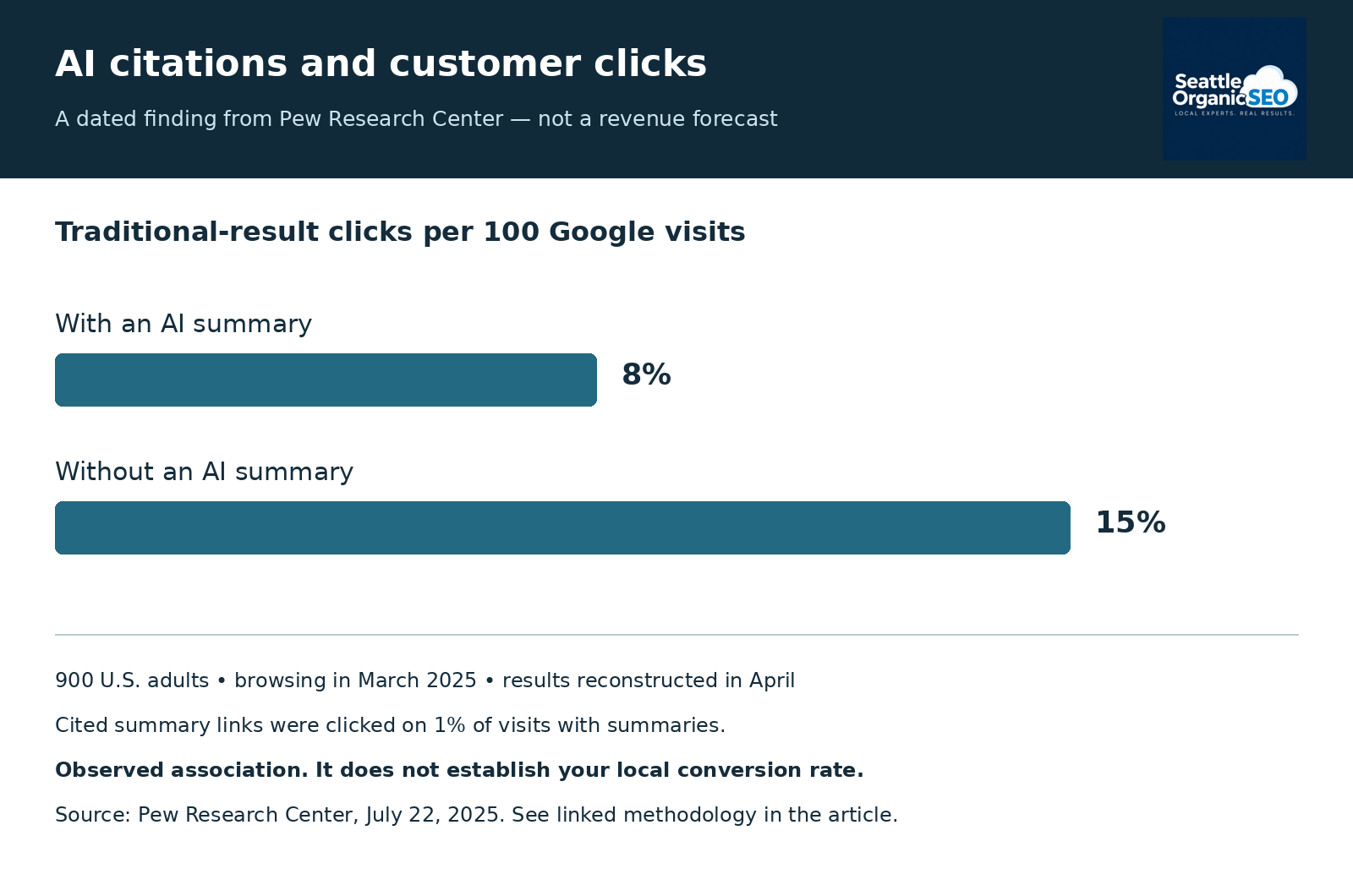
In its July 2025 analysis, Pew Research Center found traditional-result clicks on 8% of Google visits with an AI summary, compared with 15% without one. A click on a cited summary link occurred on 1% of visits with summaries. The research used browsing from 900 U.S. adults in March 2025; search results were reconstructed in April. Those are observed associations within that dataset, not an experiment proving the summary caused the difference.
“The AI summary for any given search may change over time.”
Pew Research Center, methodology
That matters when someone sells you a permanent ranking based on a screenshot. The answer, its links and even the presence of an AI summary can change. This study does not establish the share of Seattle customers using AI, your likely conversion rate or a forecast for your industry.
A different question—what people do inside a chatbot—is addressed by How People Use ChatGPT, NBER Working Paper 34255. Its authors, including OpenAI researchers and Harvard economist David Deming, identify practical guidance, information seeking and writing as the dominant topic groups. This is a working paper about consumer ChatGPT use, not an independent census of every AI service or a study of local-business purchases. Its useful implication for marketers is narrower: some usage is decision support, while much usage serves other purposes.
| Evidence | What it measures | Useful business question |
|---|---|---|
| Pew browsing analysis | Actions following Google searches in a dated U.S. sample | Are important informational pages losing clicks while inquiries change differently? |
| NBER working paper | Categories of consumer ChatGPT conversations | Does our content help someone make a decision, rather than merely define a term? |
| Google Search documentation | Eligibility and practices for Google AI features | Can our important pages be indexed, understood and shown with a snippet? |
Traffic is only one signal
A website visit, a person and a customer are different units. Someone can visit an AI service repeatedly to write emails without shopping for anything. Someone else can read a business recommendation, search the business name later and call from a map listing. Neither journey fits neatly into a report counting AI referral sessions.
For your business, build a monthly scorecard around three questions: Are qualified prospects finding us? Are they receiving accurate information? Are more of them becoming profitable customers? Keep traffic as a diagnostic underneath those questions. A fall in visits to broad definitions may matter less than a decline in inquiries about your highest-margin service.
Start with a service-level baseline. For an accounting firm, separate bookkeeping, business tax preparation and advisory engagements. For a restaurant, separate ordinary reservations, private dining and catering. Combine everything into one conversion total and you can miss the loss of a valuable service behind growth in low-value activity.
Give prospects a decision page
Imagine an owner asking, “Which Seattle accountant can clean up overdue books before preparing an S corporation return?” A page saying “trusted financial solutions for businesses of all sizes” barely helps that owner. They need to know whether cleanup is offered, who performs it, what records are required and how the engagement starts.
Build the page around the decision, using facts your team can verify. Name the service and intended client. Explain what is included, what is excluded, how fees are determined, the intake process and the next available step. If you cannot publish a fixed price, explain the inputs that change the estimate. A useful explanation beats an invented starting price.
| Decision | What to publish | Who verifies it |
|---|---|---|
| Can you handle my situation? | Services, client types, exclusions and referral boundaries | Service lead |
| What will this cost? | Actual fee structure, scope assumptions and additional charges | Owner or finance lead |
| What happens next? | Required documents, consultation steps and response expectations | Intake team |
| Why should I trust you? | Named professionals, verifiable credentials and evidence with context | Responsible professional |
Illustrative opening: “We help Seattle business owners bring overdue bookkeeping up to date before tax preparation. Cleanup and tax preparation are scoped separately after we review your records. Start by telling us your entity type, the months outstanding and your filing deadline. We will confirm whether we can accept the work before requesting financial documents through our secure intake process.” Replace every detail with your actual practice.
This opening is useful because it answers a real suitability question. It also prevents a poor-fit inquiry: someone expecting tax preparation to include unlimited cleanup can see the distinction before booking. That is a conversion improvement you can investigate even if no AI tool ever cites the page.
Keep important facts accessible
Google’s documentation for AI features says supporting pages must be indexed and eligible to appear in Search with a snippet. It describes the continued relevance of foundational SEO. Its guidance does not support selling a special schema type or an AI text file as a guaranteed route into answers.
Ask your developer to inspect the actual service URL in Search Console. Check whether Google can access it, whether a noindex directive is present and whether the selected canonical points to the intended page. Then read the page on a phone. Service details that exist only in an image, an inaccessible PDF or a broken booking overlay can be difficult for customers to use as well.
Technical eligibility and editorial usefulness are separate checks. An indexable page can still omit the information a buyer needs. A thorough page can still be unavailable to Search. Have the developer own access problems and the service lead own factual gaps; assigning everything to “SEO” often leaves both unresolved.
Check accuracy before chasing mentions
An AI answer that names your firm but invents a fee, service or qualification is a problem to investigate. NIST’s Generative AI Profile, AI 600-1 identifies confabulation as a risk of generative systems. This government risk framework is not a search-ranking study. It explains why a fluent answer should be checked against evidence.
Create a simple error log: exact prompt, platform, date, answer, cited URL, incorrect statement, correct fact and person responsible for the source. Open the citation. Does it actually support the sentence? If an old directory lists a service you no longer offer, correct that directory and your own page. If the answer supplies no traceable source, record that uncertainty rather than claiming you have located its cause.
Prioritize errors by consequence. A wrong phone number or false statement about accepting new patients can block a sale immediately. A mildly awkward brand description may be less urgent. Your first corrections should help a prospect make a sound decision or reach the right team.
Measure the path to revenue
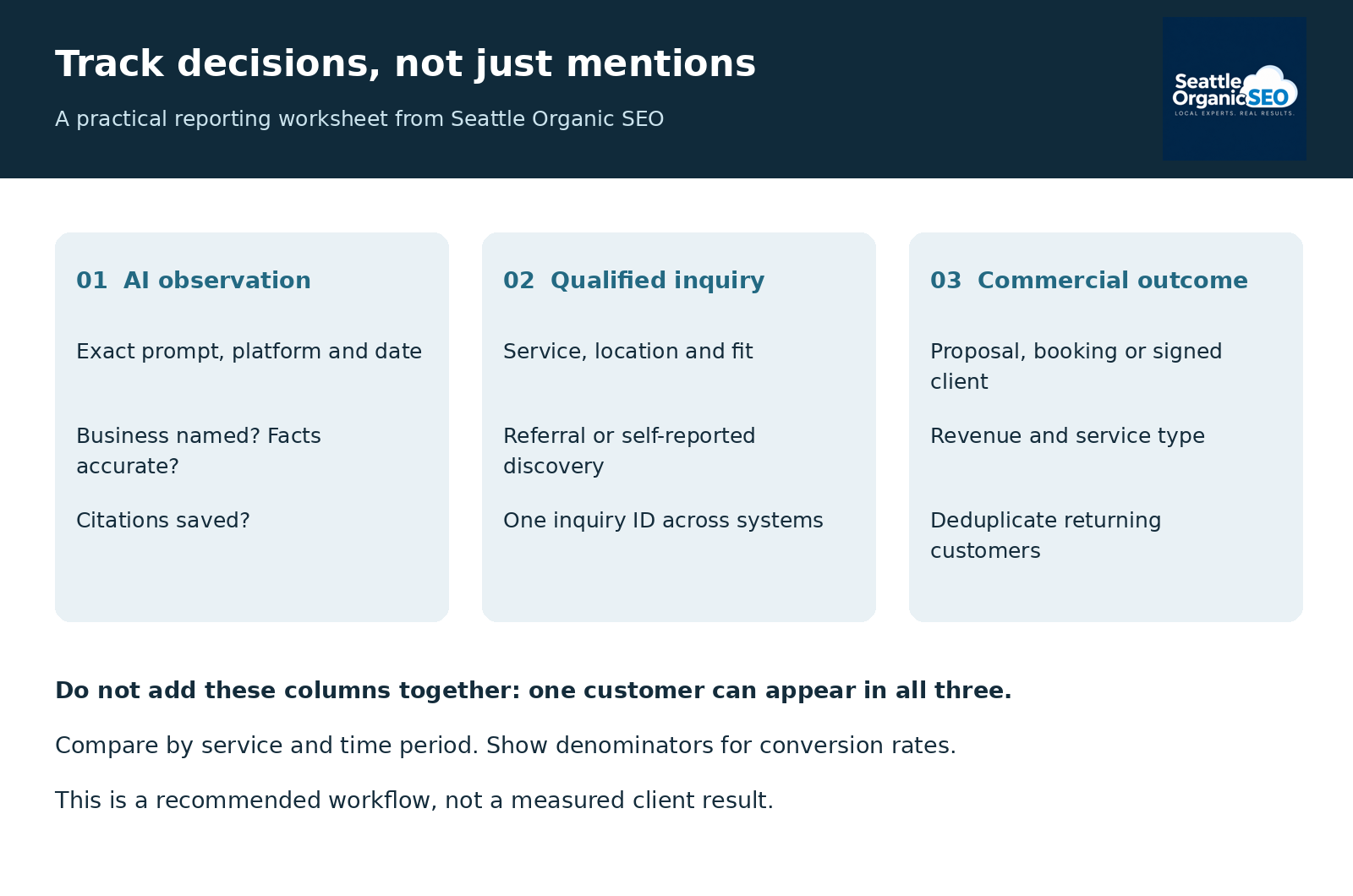
Keep direct AI referrals, self-reported AI discovery and observed AI mentions in separate columns. These are different kinds of evidence and may overlap. A customer who first learned about you in ChatGPT might return through Google; counting both as separate customers inflates the result.
| Field | How to collect it | How to use it |
|---|---|---|
| Direct AI referral | Available referring source in analytics | Inspect landing pages and completed actions; acknowledge missing attribution |
| Reported discovery | Optional intake question: “Where did you first hear about us?” | Record the answer verbatim, including “not sure” |
| Qualified inquiry | Sales team applies a written service, location and fit definition | Compare lead quality by service, not just form volume |
| Commercial result | CRM records proposal, sale and revenue against the same inquiry | Deduplicate customers and evaluate business outcomes |
Use inquiry IDs to connect forms, calls and sales records. Decide in advance what “qualified” means. For private dining, it might require an event date, a party size within capacity and a budget compatible with the actual minimum spend. A reservation question and a private-event lead should not be interchangeable conversions.
If you compare conversion rates, show their denominators. Four bookings from ten AI-referred inquiries is interesting but too small to support a sweeping channel claim. Review the actual inquiries, the time period and the sales lag before moving budget.
Run a focused 30-day test
Week 1: establish the baseline. Choose one valuable service. Export its recent inquiries and landing-page performance. Interview the person answering calls: which questions recur, which misunderstandings waste time and which details close a sale? Select ten prompts from those questions, covering discovery, comparison, price, suitability and booking.
Week 2: improve one decision page. Publish the missing facts, an honest explanation of fees and a clear next step. Add named responsibility for reviewing the information. Correct a conflicting profile if you find one. Save the original page and log precisely what changed so the next review has something concrete to compare.
Week 3: test the journey. Ask a colleague unfamiliar with the service to find the price explanation and complete an inquiry on mobile. Confirm the lead reaches the right person. Repeat the prompt set under recorded conditions, preserving responses and citations. Several observations per prompt are more useful than one favorable screenshot; this is still a diagnostic sample, not a population estimate.
Week 4: review outcomes. Examine factual errors, recurring citations, qualified inquiries and sales progress. Thirty days may reveal a broken form or clearer intake; it may be too short to establish revenue impact in a long sales cycle. Continue tracking open opportunities and label inconclusive results honestly.
Choose the next action
If the page cannot be indexed, resolve access first. If prospects cannot tell whether the service fits, fix the explanation. If inquiries arrive but do not qualify, review the offer and intake questions. If qualified prospects disappear after receiving an estimate, examine scope, pricing and follow-up before blaming AI visibility.
These choices turn AI search from a vague publishing mandate into a business investigation. The deliverable is a better answer to a customer’s decision, supported by evidence and connected to a working sales process. More blog posts are useful only when they solve an additional problem.
Sources and editorial changes
Primary references: Pew Research Center, July 22, 2025; NBER Working Paper 34255, September 2025; Google Search Central, AI features and your website; NIST AI 600-1, July 2024. Recommendations and illustrative workflows are Seattle Organic SEO’s analysis, not findings attributed to those institutions.
Updated October 30, 2026: shortened headings, replaced the platform-traffic roundup with decision-focused evidence, removed the previous traffic graphic and added practical measurement and page-planning tools. The original URL is unchanged.
Written by the Seattle Organic SEO Team
The Seattle Organic SEO team combines more than 30 years of hands-on client experience across SEO, paid media, email marketing and affiliate marketing. Our team has worked for leading technology companies, including Amazon, Expedia and Google-acquired DoubleClick. We bring that experience to source-based research, transparent analysis and practical guidance for Seattle businesses. Learn more about our team and approach.
Want a useful AI visibility audit?
We can examine one profitable service, verify what search and AI tools say about it, and identify the page, profile or intake changes worth making first. Explore our AI visibility services or tell us which service needs more qualified inquiries.