
AI visibility planning series · Research checked October 29, 2026
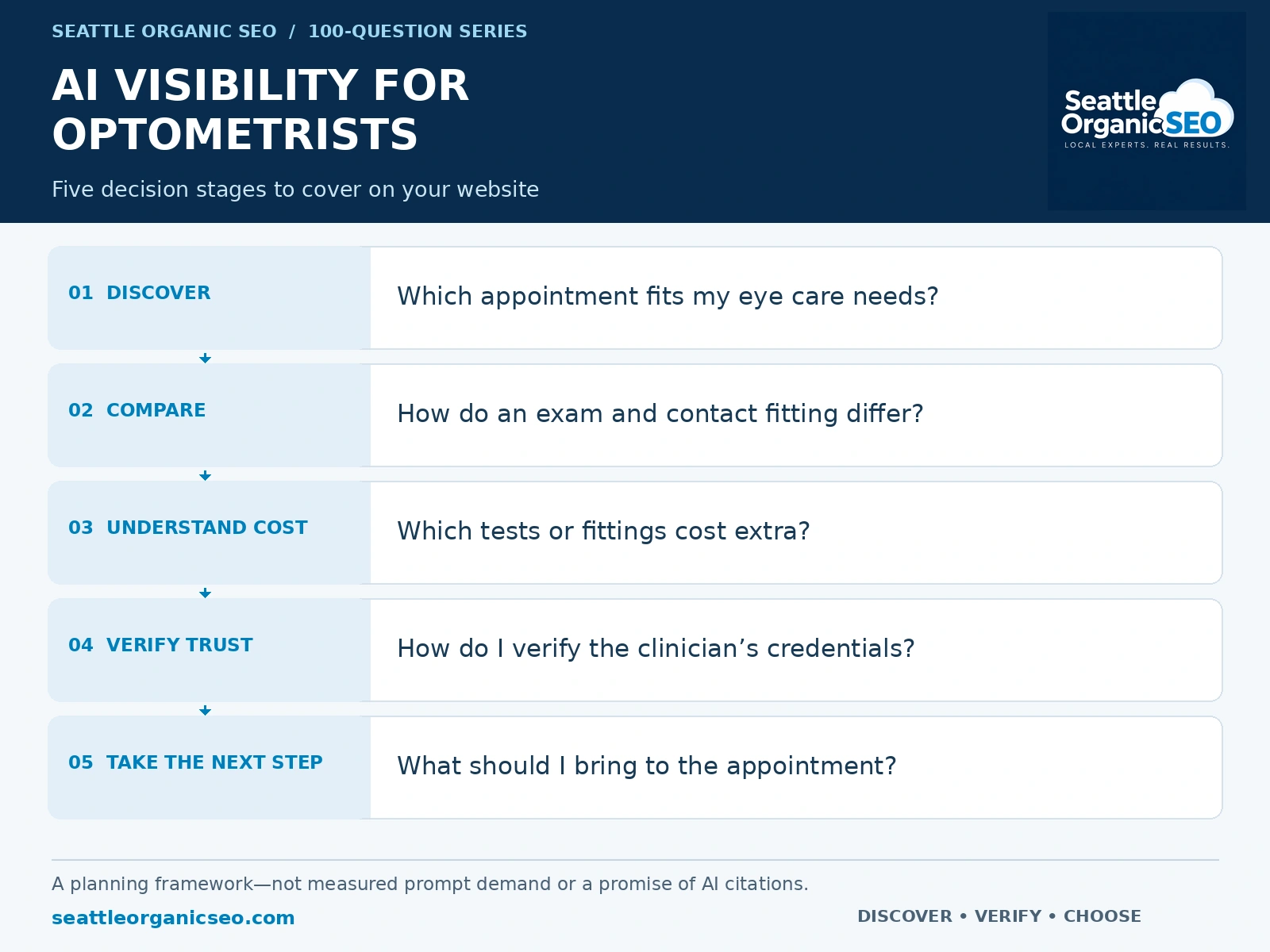
Someone comparing eye care providers may be looking for glasses, a contact lens fitting, ongoing eye health care or an urgent referral.
An eye care website should help people select the right appointment before it asks them to buy eyewear. An examination, a contact lens fitting and an urgent concern have different requirements. Clear explanations of those pathways can reduce confusion for patients and reception teams while giving search systems more precise information to retrieve.
What this list is: 100 editorially selected questions a optometrist should be prepared to answer. It combines professional consumer guidance with our proposed customer-journey prompts. It is not a measured ranking, a search-volume report or a dataset of observed AI conversations. No format guarantees an AI recommendation.
Start with the questions that can change a decision
Start with the 12 questions below if they match the services you actually offer. This is our proposed pilot shortlist, not a claim about which questions receive the most searches. Validate it against anonymized inquiry themes, front-desk questions and sales or consultation objections.
- Question 2: How is an optometrist different from an ophthalmologist?
- Question 10: When would you refer me to an ophthalmologist?
- Question 11: What is included in a comprehensive eye exam?
- Question 14: Will my eyes need to be dilated?
- Question 15: Can retinal imaging replace dilation in every case?
- Question 21: Who should I contact about sudden vision changes?
- Question 28: What should I do if a contact lens causes pain?
- Question 31: How do you determine my glasses prescription?
- Question 41: Why is a contact lens fitting separate from an eye exam?
- Question 51: How much is an eye exam without insurance?
- Question 54: Which vision plans do you accept?
- Question 100: What happens after I submit an appointment request?
What AI search research changes—and what remains an experiment
Toth’s HAR observations illuminate research steps, not proven ranking factors. Google documents query fan-out; Ahrefs observed many non-search answers. Seer reports fan-out variability.
Our working hypothesis is that a business is easier to evaluate when its own pages explain its services, suitability, prices, limitations and next steps accurately. That is the rationale for this guide. Whether a particular answer format changes citations, recommendations or inquiries must be tested. A simulated prompt expansion is a planning aid, not a record of what an AI system searched.
The presentation approach to test: Appointment pathway comparison
Create a booking explainer that distinguishes comprehensive examinations, contact fittings and urgent concerns. Keep dry-eye and other clinical services on reviewed service pages. Do not represent an optometry practice as offering every ophthalmology procedure.
| Appointment need | What to verify | Booking route |
|---|---|---|
| Routine examination | Exam inclusions, duration and possible dilation | Exam booking |
| Contact lens interest | Fitting requirements, trial process and extra fees | Fitting inquiry |
| Urgent concern | Clinician-approved triage and staffed contact hours | Appropriate urgent-care route |
The table illustrates how to organize the information. The underlying facts must come from the business and, where relevant, a qualified professional. Keep essential text visible and readable on mobile. A visitor should not have to open dozens of accordion panels to learn the basic service, cost and eligibility facts.
The 100-question planning bank
Each section includes an answer brief that applies to its ten questions. Draft the answers using your actual facts, add supporting evidence where a claim needs it, explain exceptions and give the reader an appropriate next step. Publish related answers together; the numbering is for planning and tracking, not priority.
1–10. Provider selection
Decision stage: Discovery. How to answer: Distinguish optometry services from ophthalmology referrals and optical retail. Verify scope against the actual practice and applicable state rules.
- How do I choose an optometrist near me?
- How is an optometrist different from an ophthalmologist?
- Which eye care services does your practice provide?
- How can I verify your optometry license?
- Do you see children and adults?
- Are you accepting new patients?
- Which languages are available?
- Can you accommodate mobility needs?
- Do you offer evening appointments?
- When would you refer me to an ophthalmologist?
11–20. Examinations
Decision stage: Assessment. How to answer: Describe exam components and optional tests separately. Have the optometrist explain why recommendations depend on the individual.
- What is included in a comprehensive eye exam?
- How is a vision screening different from an eye exam?
- How long does an eye exam take?
- Will my eyes need to be dilated?
- Can retinal imaging replace dilation in every case?
- How do you decide which tests I need?
- Can an eye exam detect problems beyond blurry vision?
- What should I bring to an eye exam?
- Should I bring my current glasses and contact lenses?
- Will you explain my results in plain language?
21–30. Symptoms and triage
Decision stage: Urgency. How to answer: Use a clinician-approved route for urgent symptoms and avoid a booking funnel that delays urgent care. Publish staffed hours and after-hours instructions.
- Who should I contact about sudden vision changes?
- Can you assess new flashes or floaters?
- What should I do about a painful red eye?
- How do you handle eye injuries?
- Can you offer a same-day assessment?
- When should I seek emergency medical care instead?
- Can you assess blurry vision that comes and goes?
- What should I do if a contact lens causes pain?
- How do you handle after-hours eye concerns?
- Will online booking be monitored for urgent symptoms?
31–40. Glasses and prescriptions
Decision stage: Comparison. How to answer: Explain what the prescription means, purchase options and adjustment policies. Keep clinical recommendations independent of product upselling.
- How do you determine my glasses prescription?
- Why might my prescription change?
- Can I use my prescription to buy glasses elsewhere?
- How do single-vision and progressive lenses compare?
- What are the tradeoffs of different lens materials?
- How do you evaluate computer glasses needs?
- Are all lens coatings necessary for everyone?
- How do you help with difficulty adapting to new glasses?
- What is your lens remake policy?
- Can you adjust glasses bought elsewhere?
41–50. Contact lenses
Decision stage: Comparison. How to answer: Separate fitting fees, lens costs and follow-up care. Discuss hygiene and suitability through reviewed guidance rather than blanket product claims.
- Why is a contact lens fitting separate from an eye exam?
- Can I wear contacts if I have astigmatism?
- How do daily and reusable lenses compare?
- What are the options for presbyopia with contacts?
- Can dry eyes affect contact lens suitability?
- Do you fit specialty or scleral lenses?
- What training do first-time wearers receive?
- How are trial lenses and follow-up visits handled?
- What should I do if a lens feels uncomfortable?
- How often is a contact lens prescription reviewed?
51–60. Costs and coverage
Decision stage: Cost. How to answer: List exam, fitting, imaging and product charges separately. Explain medical versus vision billing as practice-specific processes, subject to plan verification.
- How much is an eye exam without insurance?
- What does your contact lens fitting fee include?
- Is retinal imaging an additional charge?
- Which vision plans do you accept?
- When might an appointment be billed to medical insurance?
- Can you estimate my out-of-pocket cost?
- What happens if my plan does not cover a test?
- Do you offer itemized quotes for glasses?
- What payment options are available?
- Can I receive a receipt for eligible benefit reimbursement?
61–70. Conditions and coordination
Decision stage: Suitability. How to answer: Create reviewed pages for services actually offered and specify when care is coordinated with other clinicians. Do not imply universal treatment capability.
- Do you provide diabetic eye examinations?
- How do you monitor patients at risk of glaucoma?
- Can you assess persistent dry eye symptoms?
- Do you manage eye allergies?
- How do you coordinate with my primary care clinician?
- Can you monitor changes after cataract surgery?
- Do you provide preoperative or postoperative co-management?
- When is a specialist referral necessary?
- Can medications affect eye examination findings?
- How are test results shared with other clinicians?
71–80. Children and life stages
Decision stage: Suitability. How to answer: Explain age ranges and appointment adaptations. Discuss myopia options with balanced evidence and clinician assessment.
- At what age do you see children?
- How is a child’s eye exam different?
- What if my child cannot read an eye chart?
- Can you assess concerns about my child’s school vision?
- What myopia management services do you offer?
- How do you explain the limits of myopia management?
- Can pregnancy affect the timing or findings of an exam?
- How do you support older adults with changing vision?
- Can a caregiver join an appointment?
- Do you refer for low-vision services?
81–90. Access and preparation
Decision stage: Conversion. How to answer: Treat logistics as decision information. Publish concrete access details rather than relying on a map pin.
- Where is the accessible entrance?
- Is parking available?
- How should I prepare if dilation is planned?
- Should I arrange transportation after dilation?
- Can I complete forms before arriving?
- How do I transfer records from another practice?
- What is your cancellation policy?
- How do I request an interpreter?
- Can I book only an examination without buying eyewear?
- How do I request a copy of my prescription and records?
91–100. Follow-up and trust
Decision stage: Retention. How to answer: Make follow-up instructions, clinician identity and revision policies easy to locate. Measure completed exams and appropriate referrals.
- When should I schedule my next eye exam?
- Who explains unexpected test results?
- What if my new prescription does not feel right?
- How do you handle concerns about a bill?
- Where can I verify independent feedback about the practice?
- Who will review my eye health history?
- How do you protect patient information?
- Can I get a second opinion?
- How do I book an appointment for a specific concern?
- What happens after I submit an appointment request?
How to turn a question into a useful answer
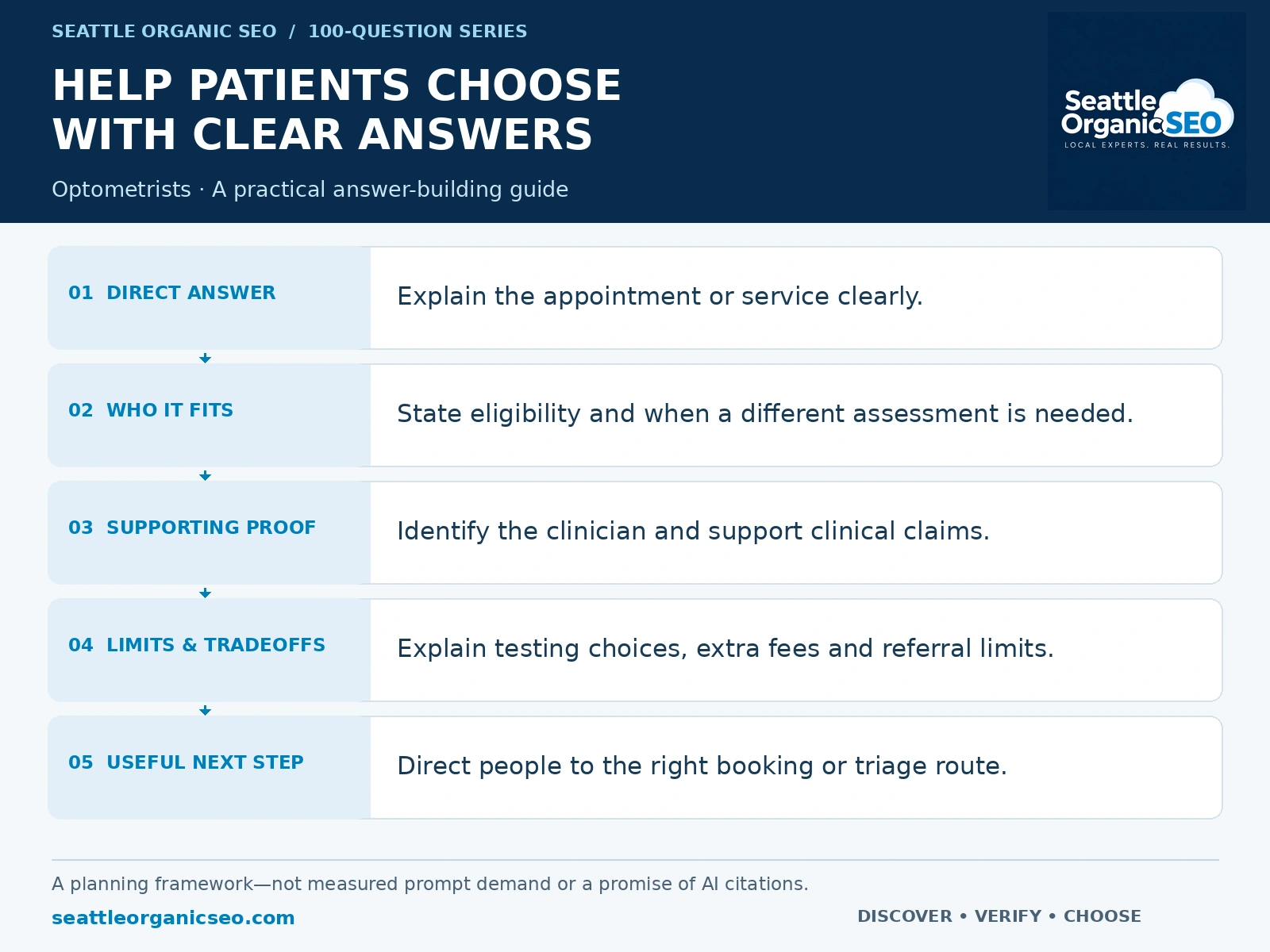
Use this editorial sequence: give the direct answer; explain who it applies to; name the evidence or factual basis; disclose relevant limits; then offer the next step. Use as much space as the topic needs. Do not pad an answer to a target word count or repeat the business name in every sentence. Keep general education distinct from advice that requires an individual assessment.
Why is a contact lens fitting separate from an eye exam?
Illustrative answer draft—not a verified business policy: Explain the additional assessment, lens selection, training and follow-up included in this practice’s fitting service. State whether a separate appointment is needed and which fees are additional to the examination.
Before using it: The optometrist should approve the clinical explanation and the team should confirm the actual fee policy.
Can retinal imaging replace dilation in every case?
Illustrative answer draft—not a verified business policy: Do not promise that a particular device eliminates dilation for everyone. Explain that the clinician selects appropriate testing after considering the person’s eye health and circumstances.
Before using it: Provide the practice’s real explanation of imaging, possible additional charges and preparation instructions.
Example AI conversation to use for research
This conversation is a proposed test, not a transcript or a claim about prompt popularity. Replace Seattle with a genuine service location and use hypothetical circumstances. Never put identifiable patient, client, legal or financial records into a public AI test.
| Turn | Proposed prompt | What to record |
|---|---|---|
| 1 · Explore | I need an eye exam in Seattle and may want contacts. I want to understand the exam, fitting fees and whether I need a separate appointment. | Which needs the answer identifies and whether web search occurs |
| 2 · Compare | Which appointment type should I ask about, and how can I verify costs and insurance before booking? | Named providers, stated tradeoffs, cited URLs and missing facts |
| 3 · Verify | For each provider you mentioned, separate facts you can verify from assumptions. Link to official pages for services, costs, eligibility and booking. Say when information is unavailable. | Accuracy and source quality; do not reward confident unsupported claims |
| 4 · Decide | What should I confirm directly before contacting a provider, and what would make an option unsuitable? | Remaining objections and a safe, appropriate next step |
Also test the first two prompts separately in fresh conversations: follow-ups inherit the previous answer and are not independent observations. Keep branded checks (“What does [Business] offer?”) separate from unbranded discovery checks. A branded mention is not evidence that the system would recommend the business without being prompted.
Build a website people and AI can verify
We’ve created thousands of websites that immediately rank for the client’s targeted terms because they start SEO- and GEO-friendly, with our customizations built in.
Proof to prioritize: Verified optometrist credentials, specific exam inclusions, separate fitting charges and clinician-reviewed triage.
Assign one person to maintain core facts: legal or trading name, location, services, credentials, pricing method, availability and contact routes. Reconcile discrepancies on legitimate third-party profiles. Seek relevant editorial coverage through useful expertise and accurate information; avoid purchased endorsements or fabricated reviews. Follow profession-specific testimonial rules and protect client privacy. A process explanation or fictional sample can demonstrate competence without a client case study.
Before adding new pages, check whether the answer already has a sensible home. Improve that page, link to it from relevant service content and remove conflicting versions. Review rendered text, indexing settings, canonicals, redirects and access restrictions. Use accurate structured data where appropriate; do not treat markup or a special AI file as proof of improved visibility. Do not turn the question bank into thin pages for every city and wording variation.
Want a website built for your targeted terms?
Let’s discuss an SEO- and GEO-friendly website customized for your business and the customers you want to reach.
A 30-day pilot with a measurable next step
| Period | Action | Record |
|---|---|---|
| Days 1–7 | Select 12 relevant questions, verify business facts and capture a baseline before editing. | Exact prompts, model or product, mode, date, location, sources and complete answers. |
| Days 8–14 | Add an exam-versus-contact-fitting-versus-urgent-assessment comparison to the booking page. | URLs changed, exact change date, professional or operational sign-off where needed. |
| Days 15–21 | Check that updated pages render correctly; reconcile relevant public profile errors. | Indexing status, stale facts, broken booking routes and unrelated site changes. |
| Days 22–30 | Repeat the baseline tests and review conversion quality. | Counts and rates alongside sample sizes; no automatic winner declaration. |
Primary business measure: Completed bookings for the appropriate appointment type per booking-page visit. Quality check: Track misbooked visits and urgent messages sent to unmonitored forms.
For the first pilot, run the same 12 prompts three times per platform in a baseline window and again after the change, using fresh sessions for standalone tests. At three platforms that is 108 responses per window. Keep location, language, search mode and account conditions as comparable as possible; record the model or product version available at the time. Compare each platform separately. Missing or failed runs belong in the log, and “no web search” is a result, not a failure to discard.
Report brand mentions, explicit recommendations, citations to the business’s own domain, factual errors and qualified business outcomes as separate measures. Show numerators and denominators—for example, recommended in 4 of 36 completed runs—rather than an unsupported universal visibility score. Responses from the same prompt are related observations; do not assume 108 runs are 108 independent customers.
Track referral sessions where observable, booking completion and the appropriate downstream outcome. Use an optional “How did you hear about us?” field to capture otherwise unattributed discovery, without treating self-reports as perfect attribution. Keep sensitive information out of analytics. For results that mature after 30 days, retain the original inquiry date and continue cohort follow-up.
A before-and-after change can suggest progress but cannot establish causation. Log seasonality, promotions, competitor changes, rankings and platform updates. Compare with suitable unchanged pages or stagger a rollout where feasible. Thirty days may be too short for indexing, visibility or conversion conclusions. Extend the observation period when evidence is sparse; one favorable answer is not a win.
How to learn from this format
This guide uses appointment pathway comparison as an editorial hypothesis. Different industries have different demand and conversion patterns, so comparing this article’s raw performance with another profession’s article cannot identify the best format. To test format itself, use comparable pages within the same profession and keep substantive information as similar as possible. For human conversion tests, randomize visitors when traffic allows. For AI visibility, use matched pages or a staged rollout and report the remaining uncertainty.
Sources and scope
NEI resources support preparing questions about providers, examinations and treatment discussions. Our expanded list is a marketing planning tool, not a substitute for clinical eye care guidance.
- Google: AI features and your website
- Steve Toth: HAR-based Deep Research observations
- Ahrefs: ChatGPT query fan-out study
- Seer: interpreting query fan-outs
Research access date: October 29, 2026. The 100 questions, page mappings, examples and pilot are Seattle Organic SEO’s proposed editorial applications. They have not been validated against this profession’s private inquiry data or live AI recommendation tests. This is a marketing guide; clinical, legal, tax and financial material requires appropriate professional review before a business uses it as public advice.
Written by the Seattle Organic SEO Team
The Seattle Organic SEO team combines more than 30 years of hands-on client experience across SEO, paid media, email marketing and affiliate marketing. Our team has worked for leading technology companies, including Amazon, Expedia and Google-acquired DoubleClick. We bring that experience to source-based research, transparent analysis and practical guidance for Seattle businesses. Learn more about our team and approach.
Want your optometry practice to show up more effectively in AI search?
Seattle Organic SEO can help you create an SEO- and GEO-friendly website, answer the questions your customers ask, and measure whether greater visibility leads to qualified inquiries. Explore our GEO services and learn more about our team and approach.