
AI visibility · Research checked October 29, 2026
Your competitor appears in an AI-generated recommendation. Your business does not. That is worth investigating. It is also a very easy moment for someone to sell you more certainty than the evidence supports.
One answer cannot tell you how often customers encounter that recommendation, whether the competitor deserved it, or how many inquiries followed. It can show you something useful: a particular system, under particular conditions, presented a competitor as an option and left you out.
The commercial question is whether that omission repeats for the customers and services that matter to your business. You can test that. You can inspect the supporting sources. And you can improve missing or misleading information without pretending to control the assistant.
The shortlist is a useful place to look
Imagine a person asking for a dentist who offers implant consultations, explains costs clearly and helps anxious patients. A generic query such as “best dentist Seattle” misses most of that decision. The person is describing a situation, setting constraints and asking for help choosing.
The same thing happens in an illustrative legal search: a business owner needs a Washington lawyer who handles a contract dispute before litigation. A firm can be relevant to “Seattle attorney” and still leave that buyer unsure about its practice-area fit, fees or consultation process.
Those are different opportunities. A visibility report should preserve the difference.
Google explains that its AI search features may issue related searches across subtopics and sources. Its documentation also says responses and links can vary between experiences. That supports testing more than a single broad query; it does not reveal a formula for choosing every business.
A fair competitor test starts before you open the chatbot
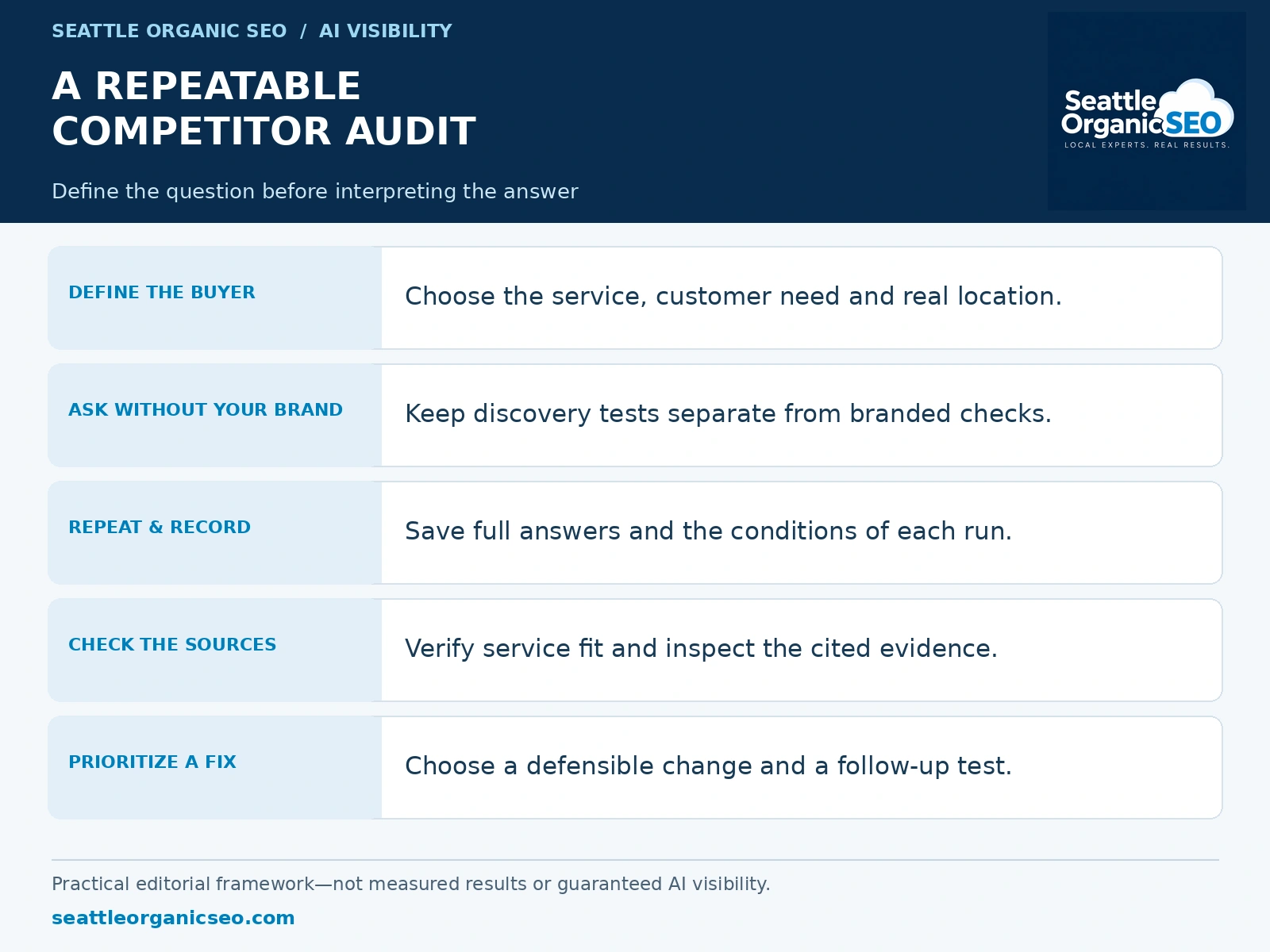
Write down who you want to attract, what they need and what you can genuinely provide. Then choose the questions. Otherwise it is remarkably easy to keep changing the wording until an answer confirms what you wanted to find.
| Define first | A useful decision |
|---|---|
| Service | The specific engagement or treatment the business wants to grow |
| Customer | A realistic buyer whose needs the business can serve |
| Geography | The actual service area, jurisdiction or appointment location |
| Comparison set | Competitors that offer genuinely comparable services |
| Outcome | An appropriate inquiry, consultation or booking |
Use inquiry themes from your reception team, sales calls and contact forms to sharpen the scenarios. Summarize them without identifiable client or patient information. An assistant can help brainstorm additional questions, but generated ideas should be labeled as proposed prompts rather than customer demand data.
Use four kinds of questions
- Discovery: “Which providers in [real service area] offer [specific service] for [relevant need]?”
- Comparison: “How should I compare providers for this situation, including costs, limitations and qualifications?”
- Verification: “Which claims about these providers can you verify from current sources?”
- Action: “What should I confirm before booking or requesting a consultation?”
For unbranded discovery, do not name your own company in the prompt. If you ask “Why is our company the best choice?” you have supplied both the brand and the preferred conclusion. That can be useful for a different research task, but it cannot demonstrate that an unknown buyer would be shown your business.
Repeat the test, and keep the inconvenient answers
A manageable pilot is 12 relevant prompts, three platforms and three fresh-session runs per prompt. That produces 108 planned responses in each observation window. It is a proposed research design, not a statistically validated sample size for every business.
Record the product and mode, date, location assumptions, language, search use, named providers, cited URLs and full answer. Record failures too. A response that never searched the web still belongs in the record. Analyze multi-turn journeys separately because a follow-up inherits the previous conversation.
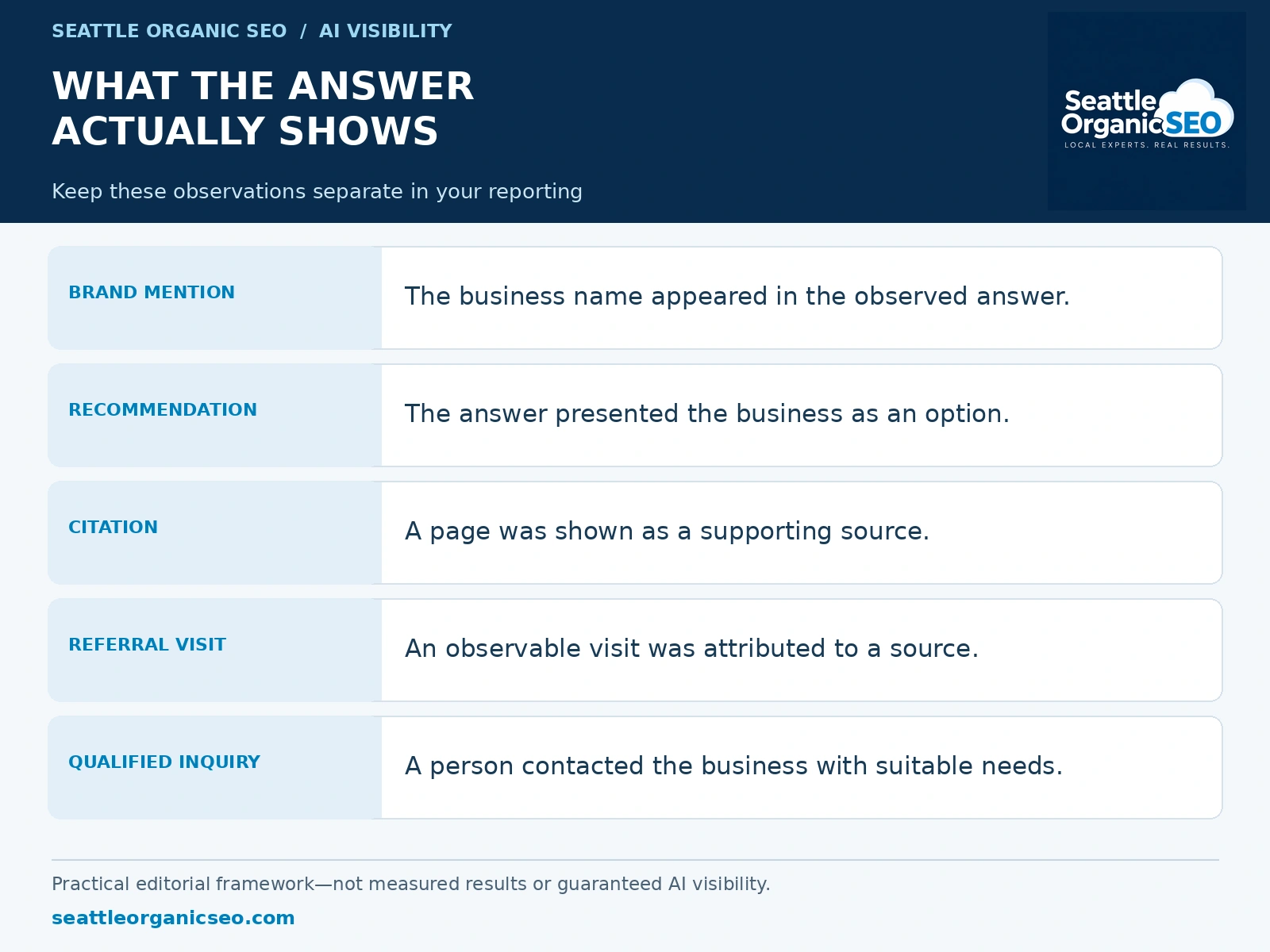
Report results by platform and prompt. “Our business was explicitly recommended in four of 36 completed runs on this platform” is interpretable. “Our AI authority increased 42%” requires a definition, a denominator and considerably more explanation.
Where do competitors appear while your business is missing?
Ask us about an AI competitor visibility audit focused on the services and customer situations that matter to your business.
Inspect what the competitor’s sources actually say
The interesting part starts after you collect the names. Open the sources. Does the cited page substantiate the service? Is the location correct? Is the page current? Does it genuinely explain why the provider fits the request, or did the assistant make a leap?
A competitor’s repeated appearance is a lead for investigation. It does not prove that its review count, page format or directory listing caused the recommendation. Several differences can travel together: brand familiarity, search visibility, service relevance, independent coverage and more complete information.
Build a gap list you can defend. “We do not explain consultation fees anywhere” is actionable. “AI likes their brand more” is a feeling dressed as a diagnosis.
| Observed gap | Reasonable next action | What remains uncertain |
|---|---|---|
| Missing service details | Improve the relevant service page and supporting links | Whether the change affects recommendations |
| Outdated third-party facts | Request correction from the actual source | When an assistant will use the corrected source |
| Unclear credentials or suitability | Publish accurate, verifiable information | How much weight any system assigns it |
| Competitor cited from a relevant publication | Assess legitimate editorial opportunities | Whether another mention changes future answers |
There is a reason to act—and a reason to stay skeptical
A repeated omission around a valuable service is a reasonable reason to improve your information. It is not a defensible revenue-loss estimate by itself. You need evidence about customer behavior and subsequent business outcomes before attaching a dollar amount.
Pew’s analysis of March 2025 browsing by 900 U.S. adults found lower traditional-result click-through on Google visits with AI summaries than on visits without them. It is observational evidence about that sample, not a forecast of lost leads for your company.
That makes website traffic an incomplete place to stop the investigation. It does not make every AI mention valuable. Someone might see a business name and never act. Another person might call later without an observable referral link.
What should improve after the audit?
Set two kinds of goals. The first concerns the information: fewer factual errors, clearer service matches and better evidence for claims. The second concerns the business: appropriate inquiries, attended appointments, accepted engagements or another meaningful outcome.
Retest the same prompt panel after the relevant changes have had time to be discovered. Log other changes, including promotions, website edits, competitors and model updates. A before-and-after difference is informative, but it does not isolate the effect of your changes.
If the answer is “we do not have enough evidence yet,” keep measuring or narrow the question. An honest inconclusive result is more useful than a confident explanation invented after the fact.
A worked example: the same omission can have different explanations
Consider a hypothetical restaurant trying to attract weekday business dinners. Its owner tests a request for a private room for twelve people, vegetarian options, clear minimum spending and a convenient arrival process. Two competitors keep appearing. The restaurant does not. This is an invented teaching example; no restaurant or measured result is being described.
The first useful check is whether the restaurant actually meets the request. Perhaps its largest private room seats ten. In that case, exclusion may be appropriate. Perhaps it can accommodate twelve, but the public events page gives no capacity and its inquiry form does not explain which details to send. That creates a different problem, one the business can investigate and address.
Now inspect the competitors’ cited pages. One publishes capacities, sample menus, event terms and an event inquiry route. The other is described in a local publication that discusses group dining. Those observations identify sources worth understanding. They do not tell you which individual detail caused the assistant to select either venue.
The restaurant might improve its own event page first because the information is useful, verifiable and under its control. It should not copy a competitor’s capacity, invent a minimum spend or claim a dietary accommodation the kitchen cannot reliably provide. The point of the audit is to make the business’s actual suitability easier to establish.
That distinction matters to the sales conversation. “Your competitor appears and you do not” can start an investigation. “Your private-dining offer is difficult to verify, and here are the missing facts” gives the owner a concrete decision about what to fix.
How to interpret a result that changes from one run to the next
Keep the variation visible. If your business appears in one run, disappears in the next and returns in a third, retain all three. Do not select the most flattering screenshot for your report and quietly treat it as the stable result. You are examining a variable system, and the variability is part of what you observed.
Separate changes in the answer from changes in the test. A new location assumption, a different model, a follow-up conversation or an instruction to favor inexpensive providers can change the question being asked. Compare like with like where possible, and label the places where the conditions differ.
Look for patterns narrow enough to act on. You might repeatedly appear in broad category answers but rarely in questions about a particular service. You might be named accurately while the assistant links to a source with outdated booking information. Those are more useful findings than an average that combines every situation into one number.
When the results remain inconsistent, improve the underlying customer information and continue observing the fixed panel. You can also reduce the scope to a single service or a single platform to make the next test easier to interpret. Expanding the number of prompts is not always the best response to an unclear research question.
Keep a record of exclusions too. If a competitor operates outside the relevant jurisdiction, does not offer the requested service or is confused with another company, flag that answer rather than treating it as a clean competitive win. An assistant’s confidence does not establish that its shortlist was suitable.
Choose the first improvement before approving a large campaign
Ask the agency to identify one change it can explain in ordinary business language. Which customer question will the change answer? Which page or external record needs work? Who can confirm the facts? What evidence would make the team continue, revise or stop after the next observation window?
A sensible first project may be small: clarify the scope of a service, reconcile an outdated profile, explain a quote process or repair a broken inquiry route. A broader content or reputation program may be appropriate later. The audit should show why that larger investment deserves priority over the other work competing for your budget.
Give the review an owner inside the business. Marketing can organize the evidence, but an operations lead may need to confirm availability, a clinician may need to review service claims and a partner may need to approve engagement terms. Accurate information often requires a short conversation with the person who actually delivers the work.
Finally, agree on a decision date that fits the business and the likely observation lag. At that meeting, review the changes completed, the quality of the evidence and the appropriate inquiries received. Even a decision to keep the experiment limited is useful when it prevents a much larger spend built on an unexplained screenshot.
The report you should expect to receive
- The exact questions tested and why they were chosen.
- The complete responses, conditions and dates.
- Separate counts for mentions, explicit recommendations and citations.
- Competitors and supporting sources appearing repeatedly.
- A prioritized list of missing, conflicting or weakly supported information.
- A defined follow-up test and a way to review qualified inquiries.
Seattle Organic SEO sells this work, so the standard should apply to us too. You should be able to inspect the evidence behind an audit and understand the next three actions it recommends. You should also be able to see where our interpretation stops and uncertainty begins.
Your competitor’s appearance in an answer can be a useful wake-up call. The strongest next move is to find out whether it represents a repeatable gap—and which parts of that gap you can actually fix.
Sources and scope
The examples and proposed tests in this article are illustrative. They are not client case studies, measured findings about a named business, or evidence that a particular change will produce AI recommendations.
Written by the Seattle Organic SEO Team
The Seattle Organic SEO team combines more than 30 years of hands-on client experience across SEO, paid media, email marketing and affiliate marketing. Our team has worked for leading technology companies, including Amazon, Expedia and Google-acquired DoubleClick. We bring that experience to source-based research, transparent analysis and practical guidance for Seattle businesses. Learn more about our team and approach.
Find out where your business is missing
Talk with Seattle Organic SEO about a documented competitor audit and a prioritized plan for improving the information buyers need.