

AI visibility · Research checked October 29, 2026
Your business can appear in an AI answer and still be missing the opportunity you care about. A restaurant might be mentioned for casual lunches while its private dining room goes unnoticed. An accounting firm might be described as a tax preparer while its ongoing business advisory work is absent.
A report that counts every mention equally can make both situations look better than they are. The business name appeared. The commercially important service did not.
Choose the services you want to grow before deciding what “good AI visibility” means. Otherwise you risk optimizing a number that has little connection to the work your team needs.
Start with the business decision
Which services can you deliver well? Which attract suitable customers? Which have room to grow without overwhelming the team? Which produce a worthwhile contribution after delivery costs?
These questions belong in the brief before anyone assembles a prompt list. A service with a high advertised price can also have high costs, long sales cycles or limited capacity. A less expensive recurring engagement may be more valuable to the business. Your actual economics should decide the priority.
For professional practices, commercial priorities also need to fit the people you can appropriately serve. Improving visibility for a dental service is not a reason to steer every patient toward it. The useful content explains assessment, suitability, alternatives and limits.
| Business | A more specific opportunity to examine | What a buyer needs to verify |
|---|---|---|
| Dental practice | Appropriate implant consultations | Assessment, alternatives, qualifications and estimate inclusions |
| Law firm | A defined business-dispute engagement | Jurisdiction, matter fit, fees and consultation process |
| Accounting firm | Ongoing accounting for a particular business type | Scope, reporting, responsibilities and year-round availability |
| Restaurant | Private dining for business groups | Capacity, menus, minimum spend and confirmed availability |
| Consultancy | A paid operations diagnostic | Inputs, deliverables, implementation burden and scope |
These are illustrative priorities. They are not recommendations that every business in these fields should sell those services.
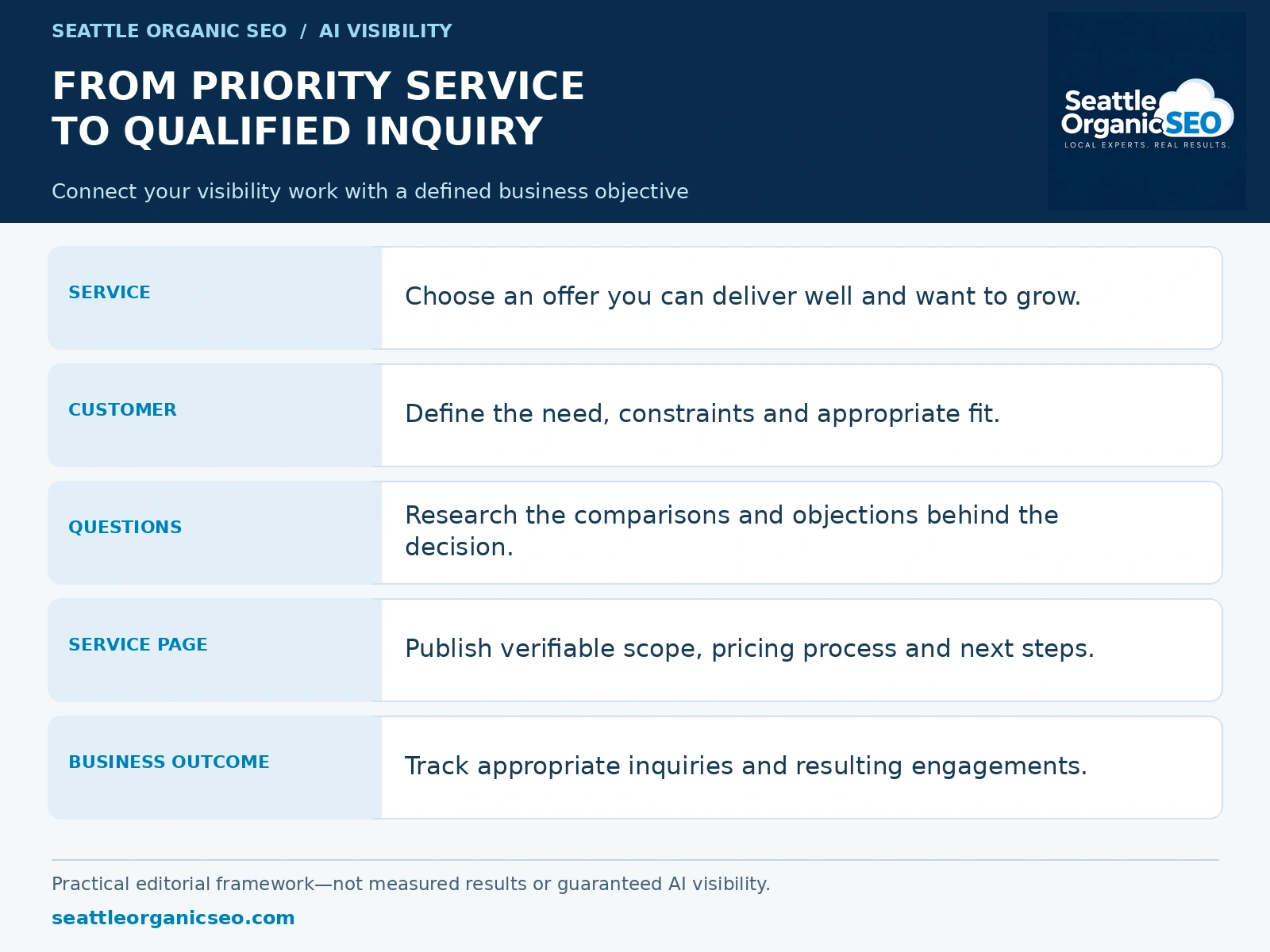
Turn one service into a realistic buying situation
“Accountant Seattle” is a category. “An accountant for a growing ecommerce business that needs monthly books, planning meetings and clear responsibility for tax notices” describes an engagement someone might actually want to buy.
The second version tells you what to investigate: business-model experience, service boundaries, communication, credentials and cost. It also exposes a practical problem if your site only says “comprehensive solutions.”
Use a short service brief: the customer, their immediate problem, the relevant constraints, what you provide and what you exclude. Then ask your team what usually delays the decision. Those objections are valuable research inputs because someone has actually needed an answer.
Build a small prompt panel around the service
- Need: “What kind of provider should a [customer type] look for when dealing with [situation]?”
- Local fit: “Which providers serve [real area or jurisdiction] and offer [defined service]?”
- Comparison: “How should I compare scope, qualifications, fees and alternatives?”
- Objection: “What should I understand about [a real cost, suitability or implementation concern] before committing?”
- Verification: “Which providers’ official pages substantiate those details?”
- Action: “What should I prepare before requesting a consultation or quote?”
Treat the wording as proposed research prompts. A question you generated is not proof of search volume. Refine the panel with anonymized inquiry themes and separate branded checks from unbranded discovery.
Google describes related-query research and the continuing role of core search systems in its AI features. Our practical inference is to examine the specific information needed for a service decision. That does not establish how any one prompt will be handled.
Check whether the answer fits the service
Do not stop when the business name appears. Read the surrounding explanation. Does the assistant identify the actual service? Does it describe the right customer? Does it cite a relevant page? Does it send someone to a useful next step?
A generic homepage citation may be accurate and still leave the important questions unanswered. Conversely, a detailed service explanation could be useful even when the assistant does not include your brand in its opening list. Record these as different observations.
| Observation | Useful interpretation |
|---|---|
| Brand mentioned without the service | General brand awareness in that answer |
| Service correctly connected to the brand | A more specific relevance signal in that answer |
| Own service page cited | A visible reference to your material |
| Explicit recommendation for the scenario | The system presented you as an option for that request |
| Appropriate inquiry or booking | A separate business outcome requiring its own measurement |
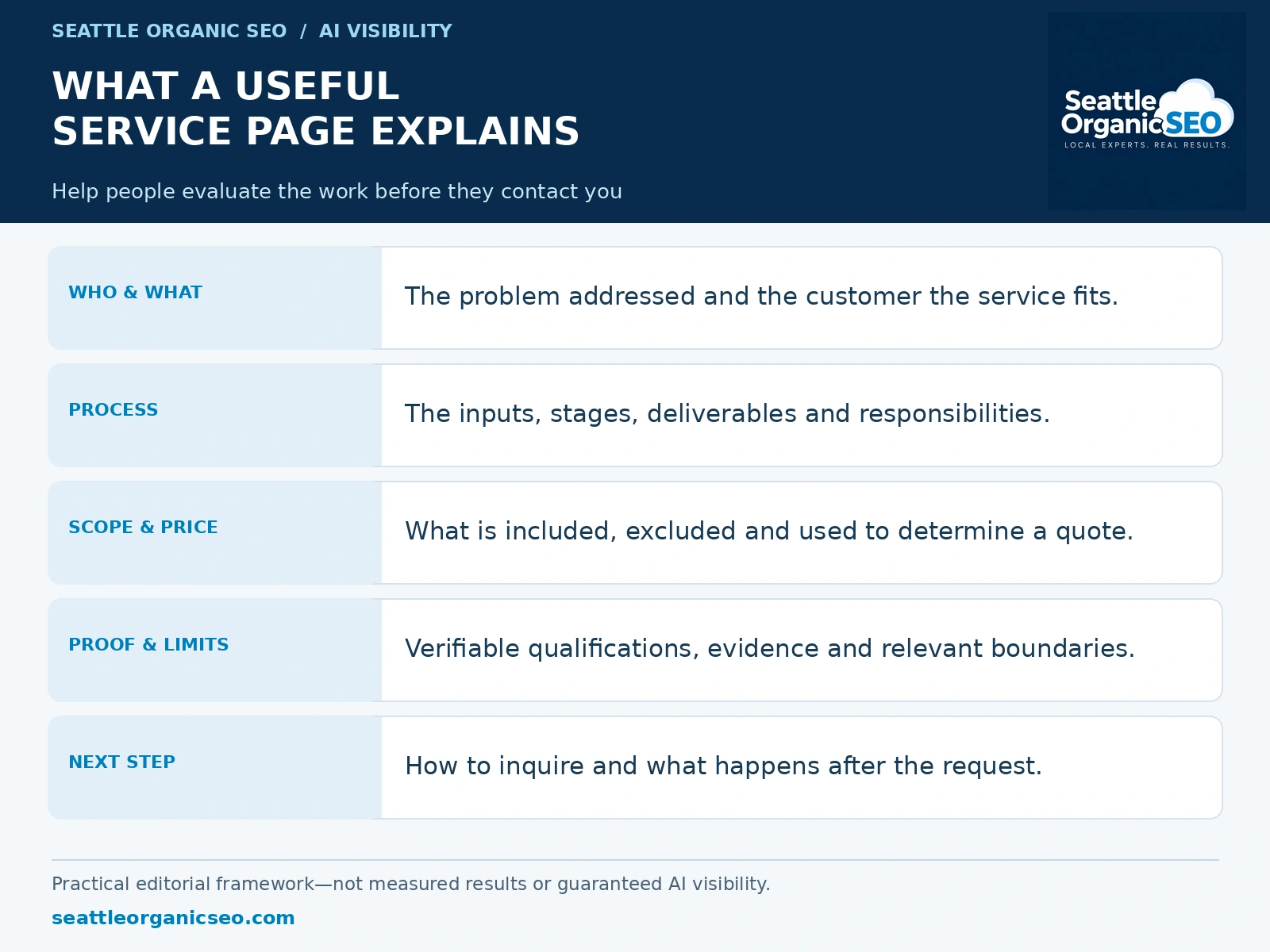
Give the service a page that can support a decision
A useful service page explains the problem it addresses, who the work is suitable for, what happens, who performs it, how pricing works and what the person should do next. It makes qualifications verifiable and states relevant limitations.
For an accounting engagement, that may mean a scope table showing whether bookkeeping, planning, payroll and notice response are included. For private dining, it may mean capacity, menu options, minimum spending and cancellation terms. For consulting, a fictional diagnostic deliverable can show what a buyer will receive.
The exact presentation can vary. The underlying facts need to remain accurate. Do not remove a price limitation or suitability exception because it makes a marketing card look cleaner.
Choose one sensible home for each service. Improve a relevant existing page when it already serves the purpose. Connect it through useful internal links and check that important text renders correctly and can be discovered. A pile of nearly identical city pages does not explain the engagement any better.
Can customers verify the service you want to grow?
We can review the service page, supporting information and inquiry path for a defined business priority, then recommend the next changes to test.
Make the next step match the service
A “Contact us” button can work, but its surrounding text should explain what happens after the click. A prospect considering a private event needs to know which details to send. Someone seeking an accounting proposal needs to understand the scope review. An appropriate consultation has a different purpose from an immediate purchase.
Ask for enough information to route the inquiry. Avoid requesting private medical, financial or legal records through an ordinary marketing form. Explain the approved next step for sensitive documents when the relationship requires them.
Then verify the mechanics: does the form reach the right team, does confirmation explain the response process, and can that team deliver the advertised service? Visibility can expose an operational gap as quickly as it creates an opportunity.
Put a business value against the test—carefully
Use your own data where possible. A simple planning model is: additional qualified inquiries multiplied by the share that become clients, multiplied by expected contribution per engagement, less additional acquisition and servicing costs. Adjust for appointment attendance or other intermediate steps when they matter.
For a deliberately simplified hypothetical, six additional qualified inquiries, a 25% conversion rate and $2,000 contribution per completed engagement imply $3,000 expected contribution before additional marketing or handling costs. Those inputs are invented to explain the arithmetic. They are not a forecast, a client result or a value you can infer from AI mentions.
The difficult part is establishing which inquiries were additional and what caused them. An optional discovery-source question, referral data where available and a disciplined inquiry log can help. They will not capture every assisted journey or eliminate attribution uncertainty.
Keep service-level reporting separate from the visibility total
Bing’s AI Performance report can identify cited pages and associated grounding queries across supported experiences. Microsoft distinguishes citation activity from ranking and prominence. Use the data to investigate which service pages participate; it cannot tell you the profit generated by a citation.
For the pilot, track a fixed question panel and a defined service-page change. Record the baseline, changes, dates and subsequent observations. Pair this with qualified inquiries and the actual engagements the business accepts. Keep platforms separate and account for seasonality, promotions and other changes.
A month may tell you that information improved and the test became easier to interpret. It may be too short to establish a visibility or sales effect. An engagement with a long buying cycle needs follow-up long enough to observe the outcome.
A practical service brief before you commission more content
Write a one-page brief for the service you want to grow. Name the customer, the situation that brings them to you, the outcome you can reasonably help with and the limits of your engagement. Include the inputs you need, the work you deliver and the next decision the customer will need to make.
For a hypothetical operations consultancy, the priority might be a diagnostic for a growing service business whose scheduling and handoffs are becoming unreliable. The deliverable could be a process map, a prioritized issue list and an implementation recommendation. Those details are invented to demonstrate how a brief becomes specific.
A useful page would explain how information is gathered, which staff need to participate, how long the assessment is expected to take and what the client receives. It would distinguish the diagnostic from implementing a new system. It would also explain which circumstances might make an internal hire, training or a software change a better fit.
Now the prompt research has a job. You can examine whether answers connect the consultancy with an appropriate diagnostic engagement, whether the cited material substantiates the deliverable and whether the buyer is being given useful questions to ask before committing.
The same brief also helps your team evaluate inquiries. Someone seeking outsourced daily operations may need a different provider from someone seeking a scoped assessment. Treating both as equally qualified because they completed a form can make the campaign look busier while making delivery harder.
Prioritize a service using capacity as well as commercial value
Before choosing the pilot, compare a few real opportunities with the people responsible for delivery. Look at customer need, contribution after delivery costs, available capacity, sales cycle and how well the business can substantiate the offer. Use actual figures internally when they are available. You do not need to publish confidential margins.
A service can be attractive on paper and still be a poor immediate marketing priority. Perhaps the only qualified practitioner is fully booked, or a promised turnaround depends on a supplier with uncertain availability. Improving demand before resolving that constraint may create avoidable frustration.
Likewise, a small recurring engagement may deserve attention because it fits the team, serves customers well and creates a stable relationship. The most expensive offer is not automatically the most valuable one to promote. Make the priority explicit so the content plan does not default to whichever service has the longest page.
Give each pilot a clear boundary. Define the target service, the relevant page, the inquiry type and the business outcome you will review. Keep unrelated offerings out of the test where possible. If several services share a page, explain how you will tell their inquiries apart before interpreting the result.
Make a decision when the signals disagree
Suppose the page becomes clearer and your own-domain citations increase in the repeated test panel, but appropriate inquiries remain unchanged. That is a reason to inspect the next step, the sample and the time lag. It is not enough evidence to announce a revenue win. The service may have a long buying cycle, the observed prompts may not represent meaningful demand, or the booking path may still be difficult.
If qualified inquiries increase while the AI observations remain flat, examine other acquisition channels, promotions and operational changes. The improved service page may be helping people who arrive from ordinary search or referrals. That can be valuable work, but the explanation should match the available evidence.
If inquiries increase but suitability declines, review the promise and the information people see before contacting you. A clearer exclusion or a better explanation of price and scope may reduce volume while improving the quality of the work the business receives.
Agree in advance on the next choices: continue observing, revise the offer explanation, repair the conversion path, expand a promising pilot or stop spending on an approach with weak evidence. A service-level program becomes useful when its findings change a business decision, even if the most sensible decision is to keep the next step small.
A useful place to start
Choose one service with clear customer value, credible delivery capacity and a business reason to grow. Audit how it is described on your site and in a small panel of AI answers. Improve the missing information, test again and review the quality of the inquiries.
You can expand once the first service has a sensible measurement process. The aim is to build a repeatable way to learn which visibility work helps your business attract work it actually wants and can responsibly deliver.
Sources and scope
The examples and proposed tests in this article are illustrative. They are not client case studies, measured findings about a named business, or evidence that a particular change will produce AI recommendations.
Written by the Seattle Organic SEO Team
The Seattle Organic SEO team combines more than 30 years of hands-on client experience across SEO, paid media, email marketing and affiliate marketing. Our team has worked for leading technology companies, including Amazon, Expedia and Google-acquired DoubleClick. We bring that experience to source-based research, transparent analysis and practical guidance for Seattle businesses. Learn more about our team and approach.
Focus AI visibility on the work you want to grow
Tell us which service matters to your business. Seattle Organic SEO can help scope a focused visibility, content and conversion review.