
By Brandon Na, Seattle Organic SEO | Updated September 2026 | 16-minute read
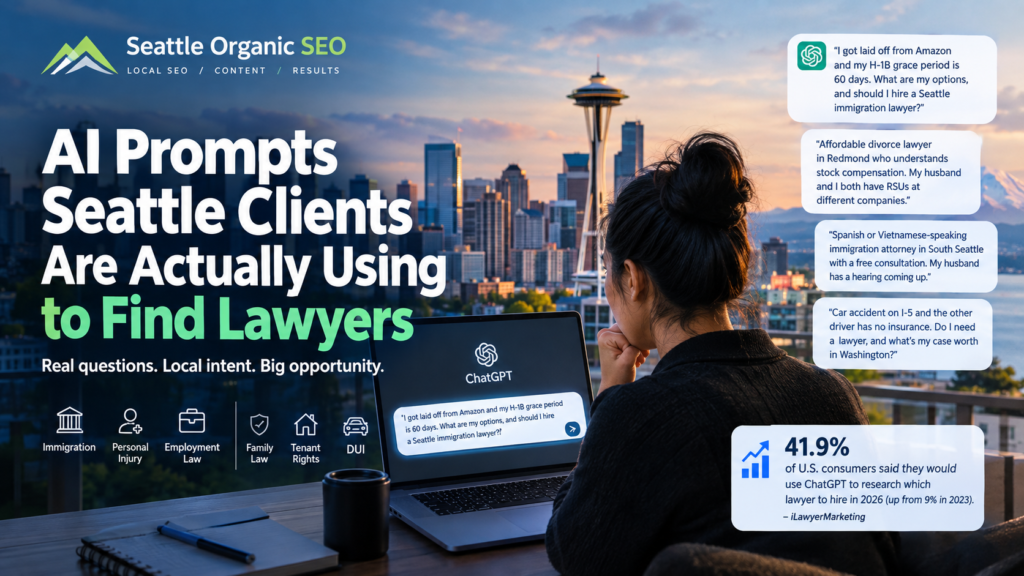
A Seattle immigration firm can rank on page one of Google for “immigration lawyer Seattle” and still never be mentioned when a laid-off engineer in Redmond types this into ChatGPT:
That isn’t a keyword. It’s an intake call. And the firm the AI names in its answer is often the only firm that person ever contacts.
This shift is moving faster in legal than almost anywhere else. In iLawyerMarketing’s 2026 survey of 1,110 U.S. consumers, 41.9% said they would use ChatGPT to research which lawyer to hire, up from 9% in 2023. In the same survey series, Google’s share of lawyer research dropped from 86.7% to 71.9% in a single year, and the share of ChatGPT users who double-check on Google fell from 94% to about 70%.
So what are Seattle clients actually typing? This post maps the AI prompts people use to find lawyers here, starting with the three practice areas with the most search demand (immigration, personal injury, and employment law) and then the fast-rising ones: workplace injury, family law, tenant rights, and DUI. Every example is written the way real people write to AI: long, specific, local, and a little panicked.
What Google data tells us about Seattle AI prompts
You can’t pull a keyword report out of ChatGPT. But Google search data for Seattle legal terms still points to where AI demand is, if you know how to read it.
When we look at Seattle-area legal search volume, the order is consistent: immigration leads, followed by personal injury, employment, car accidents, divorce, and criminal defense. Two signals inside that data matter most for AI.
Signal 1: “Best” searches are a floor, not a ceiling
Searches with a “best” modifier, like “best immigration attorney in Seattle” or “best divorce attorney Seattle,” make up only about 5 to 10% of head-term volume in Google. That sounds small until you realize this is exactly the question people now take to ChatGPT or Claude instead. Asking a search engine “who’s the best” gives you ten blue links and a pile of ads. Asking an AI gives you a named shortlist with reasons.
So treat Google’s “best” volume as the floor of recommendation demand. The real number of people asking “who should I hire in Seattle for this?” is larger, and a growing share of it is happening where you can’t see it in Search Console.
Signal 2: “Free consultation” means constraint-heavy prompts
“Free consultation” variants show up clearly for immigration and divorce. That’s a tell. People who search with a cost qualifier in Google are the same people who type long, constraint-loaded prompts into AI: language, neighborhood, budget, gender preference, schedule. If your site doesn’t state those facts plainly, AI has nothing to match you on.
| What they typed into Google | What they type into ChatGPT now |
|---|---|
| best divorce attorney seattle | “Affordable divorce lawyer in Redmond who understands stock compensation. My husband and I both have RSUs at different companies.” |
| immigration lawyer free consultation | “Spanish or Vietnamese-speaking immigration attorney in South Seattle with a free consultation. My husband has a hearing coming up.” |
| car accident lawyer seattle | “Car accident on I-5 and the other driver has no insurance. Do I need a lawyer, and what’s my case worth in Washington?” |
The length difference is real. Semrush’s clickstream study of ChatGPT found the average prompt runs about 23 words when web search isn’t switched on, compared with roughly 3 to 4 words for a typical Google query. And once the AI answers, the click is mostly gone: in Pew Research Center’s analysis of 68,879 Google searches, people who saw an AI summary clicked a regular result on only 8% of visits (versus 15% without one) and clicked a source cited inside the summary just 1% of the time.
The most popular ChatGPT prompts for legal help
Before we get local, it helps to know what people ask AI about the law in general. The most detailed look so far comes from a study by the UK legal charity JUSTICE and the Administrative Fairness Lab, which reviewed real chatbot transcripts tied to live legal disputes. People used AI to understand their rights and options, to draft letters and complaints, to double-check what their own lawyer told them, and for emotional reassurance.
In the U.S., Clio’s 2025 Legal Trends Report found more than half of consumers have used or would consider using AI to answer a legal question, and 28% of those who did were told by the AI to contact a lawyer. That handoff moment is the whole game: the AI is effectively running the first half of your intake.
Across practice areas, the same handful of prompts show up again and again. Here they are, with the Seattle version clients actually type:
| The universal prompt | How a Seattle client phrases it |
|---|---|
| Do I need a lawyer? | “I got rear-ended on I-5 near the Ship Canal Bridge and the insurer offered $4,000. Do I need a lawyer or should I just take it?” |
| How long do I have? | “What’s the statute of limitations for a car accident in Washington?” |
| What’s my case worth? | “What is my case worth in Washington if I broke my wrist and missed six weeks of work?” |
| What if I was partly at fault? | “I was biking in the door zone on Dexter when a car door opened. Can I still recover in Washington?” |
| Is this legal? | “My Seattle landlord raised my rent 12%. Is that legal under the new Washington law?” |
| Explain this document | “Here’s my severance agreement. What am I giving up if I sign it?” |
| Write this for me | “Draft a letter to my landlord asking for my deposit back under Washington law.” |
| Can I do this myself? | “Can I file for divorce in King County without a lawyer if we agree on everything?” |
| Who should I hire? | “Recommend an immigration attorney in Bellevue who handles EB-2 NIW.” |
Notice that only the last row is a “find me a lawyer” prompt. The other eight are where trust gets built. The firm whose content answers “how long do I have” and “what’s my case worth” clearly is far more likely to be the name the AI offers when the client finally asks “who should I hire?”
The seven intents behind legal AI prompts
Nearly every legal prompt people type into ChatGPT, Claude, Gemini, Perplexity, or Google’s AI Mode falls into one of seven intents. Each one needs a different kind of content before the AI will cite you.
| Intent | What the client is really asking | What the AI needs from your firm |
|---|---|---|
| Situation | “Here’s what happened. Do I need a lawyer?” | Plain-English scenario pages that say when a lawyer actually helps |
| Discovery | “Who’s best at this, here?” | Third-party proof: directory profiles, reviews, press, bar credentials |
| Constraint | “Find someone who fits my exact needs.” | Stated facts: languages, cities served, fees, free consults, hours |
| Cost | “Can I afford this?” | Honest fee explanations and what’s included |
| Washington process | “What does the law here say, and what happens next?” | Dated, attorney-reviewed pages tied to the RCW, Seattle ordinances, and local courts |
| Vetting | “Is this firm good? How do they compare?” | Consistent reviews across platforms and clear attorney bios |
| Urgent | “This is happening right now. What do I do?” | Step-by-step pages naming real deadlines, agencies, and courthouses |
The Seattle twist: tech-worker prompts
Seattle has a prompt category most cities don’t: the tech worker whose job, visa, equity, and legal problem are all tangled together. These prompts cut across three or four practice areas at once, and they’re some of the highest-value questions in the market.
That last one is a good example of why local content beats national content. Washington is a community property state, so the question isn’t just “how are RSUs divided” but “how are they divided here, including the unvested ones.” A national family-law site gives a vague answer. A Bellevue or Redmond family law firm that explains it with Washington specifics becomes the obvious source.
Immigration law prompts
Immigration leads Seattle legal search volume, and it has two very different audiences. On the Eastside, it’s tech workers and employers asking about H-1B layoffs, EB-2 NIW, and green card delays. In South Seattle, White Center, Tukwila, and Kent, it’s families dealing with removal, asylum, and detention.
The H-1B fee question shows why freshness wins. A federal court in Massachusetts vacated the guidance behind the $100,000 payment on June 8, 2026, the First Circuit declined to pause that ruling on July 24, and on September 18 the administration extended the proclamation through September 2027 anyway. Several immigration firms have published that the fee still can’t be collected while the court order stands. A Seattle firm with a clear, dated, attorney-reviewed explainer becomes the source every Eastside HR manager’s AI assistant quotes this month.
Personal injury and car accident prompts
Personal injury and car accidents together make up the second-biggest pool of Seattle legal demand, and it’s the most competitive AI category in legal. National brands dominate generic prompts, so local firms win on specifics: the road, the injury, the insurance fight, the Washington rule.
The “no insurance” prompt is worth a dedicated page on its own. It pulls in uninsured motorist coverage, PIP, and whether a lawyer is worth it when there’s no at-fault insurer to pay, which is precisely the kind of layered question national directory pages answer badly.
Employment law prompts
Seattle’s layoff cycle keeps employment law prompts high, and Washington keeps changing the rules, which means a steady supply of new questions.
The non-compete prompt is the biggest employment content opportunity in the region. For 2026, Washington only allows employee non-competes when annualized earnings exceed $126,858.83 ($317,147.09 for independent contractors). And ESHB 1155, signed March 23, 2026, will void nearly all non-competes regardless of pay starting June 30, 2027, including ones already signed. Every engineer, salesperson, and stylist with a non-compete will ask AI about this over the next nine months.
Beyond the big three: fast-rising Seattle prompts
Workplace injuries: people say “L&I,” not “workers’ comp”
This is one of the most important local phrasing differences in Washington. Clients rarely type “workers’ compensation lawyer.” They name the agency.
If your workers’ comp pages never say “L&I” in plain language, you’re invisible to how Washingtonians actually ask the question.
Family law: stock compensation and moving away
Tenant law: the rent cap is creating brand-new prompts
New Washington laws are one of the best sources of fresh AI prompts, because people ask AI about rules too new for them to understand. Right now, the biggest one is rent stabilization.
House Bill 1217 limits annual residential rent increases to 7% plus inflation or 10%, whichever is lower. The cap is 9.683% for 2026, and the Department of Commerce has set it at 10% for 2027. Rent can’t go up at all in the first 12 months of a tenancy, and some housing is exempt, including new construction for its first 12 years and owner-occupied duplexes through fourplexes. That combination of a number, a deadline, and exemptions generates exactly the kind of questions people bring to ChatGPT:
Criminal defense: DUI and the license clock
DUI prompts are almost always urgent and almost always about the driver’s license first. The deadline to request a license hearing is short, so the firm with a clear “what to do this week” page earns the call.
Tie your firm to the local entities AI already knows
AI engines understand the world through entities: named courts, agencies, statutes, and places. When your content connects your firm to the entities in a client’s prompt, you become a much better match. For Seattle law firms, the entities worth naming consistently include:
| Entity type | Names to use on your pages |
|---|---|
| Courts | King County Superior Court, Seattle Municipal Court |
| Agencies | Washington L&I, Seattle Office of Labor Standards, Department of Commerce (rent cap) |
| Law | The RCW by chapter, HB 1217, ESHB 1155, Seattle ordinances |
| Cities | Seattle, Bellevue, Redmond, Kirkland, Tacoma, Everett, Kent |
| Roads and places | I-5, I-405, SR 520, SR 99, South Lake Union, South Seattle |
The prompt families to test first
If you run a Seattle firm, don’t try to test every prompt. Start with the families where demand and case value are both high:
| Practice area | Prompt families to run monthly |
|---|---|
| Immigration and tech workers | H-1B layoff grace period, EB-2 NIW, green card delays, “immigration lawyer in Bellevue who handles tech workers” |
| Employment | Non-compete enforceability in Washington, severance review after tech layoffs, wrongful termination |
| Personal injury | “Car accident on I-5, other driver has no insurance,” “What is my case worth in Washington?” |
| Workplace injury | “L&I denied my claim, what now?” and appeal questions |
| Family | Splitting RSUs and stock options (community property), custody when moving out of state |
| Tenant | Rent cap, deposit disputes, eviction defense, “free tenant lawyer Seattle” |
| Criminal | DUI in King County, license consequences, Seattle Municipal Court |
Run each prompt in ChatGPT, Claude, Gemini, and Perplexity. Write down which firms get named and which sources get cited. That list is your real competitive landscape, and it’s often different from who you compete with on Google.
The other side: popular ChatGPT prompts for lawyers
Clients aren’t the only ones typing legal prompts. Lawyers use ChatGPT heavily, too: surveys of in-house legal teams report the large majority use AI tools daily or weekly for drafting, summarizing, and review. The prompts that matter for marketing are the ones that turn client questions into content, like:
That’s a smart workflow, with one hard rule: an attorney reviews every word. AI tools still invent case law and misstate statutes, and courts are sanctioning lawyers for it. In July 2026, a California appellate court fined an attorney whose brief quoted language that didn’t exist in the cases it cited, even though his office had a written verification policy. A client-facing page with a wrong deadline is a liability, not a marketing asset. It also won’t stay cited for long.
What to do this month
- State your constraints in plain text. Languages spoken, cities served, fee structure, free consultations, evening or weekend hours. If “free consultation” shows up in your practice area’s Google data, it’s in the AI prompts too.
- Use the words clients use. “L&I,” not just “workers’ compensation.” “RSUs,” not just “marital assets.” “Rent cap,” not just “RCW 59.18.”
- Build one page per new-law question. The rent cap, the non-compete ban, the H-1B fee. Each with an attorney’s name, a “last reviewed” date, and a direct answer in the first two sentences.
- Answer the universal prompts locally. “How long do I have,” “what’s my case worth,” and “what if I was partly at fault,” all answered for Washington specifically.
- Clean up your directory profiles. AI engines lean heavily on legal directories like Avvo, Justia, Martindale, and Super Lawyers. Make sure your name, practice areas, languages, and locations match everywhere, including your Google Business Profile and WSBA listing.
- Add schema. Person schema on attorney bios, and LegalService or Attorney schema on practice pages, connected to the courts and cities you serve.
- Mind the bar rules. Washington’s Rules of Professional Conduct still apply. You don’t need to claim you’re “the best.” You need to be the clearest, most current answer to the question the client actually asked.
The bottom line
Google’s “best lawyer” searches are shrinking into a small slice of the market because the people asking that question have found a better place to ask it. They describe their situation to an AI, list their constraints, and let it build the shortlist.
The Seattle firms that win this shift won’t be the ones with the biggest ad budgets. They’ll be the ones who wrote down, plainly and specifically, who they help, where, in what language, for what fee, and under which Washington law. That’s work any firm can start this month.
See which firms AI recommends instead of yours
Our free AI visibility audit runs real Seattle client prompts for your practice area through ChatGPT, Claude, Gemini, Perplexity, and Google AI Overviews. You’ll see who gets named, which sources the AI trusts, and the specific gaps keeping your firm out of the answer. No jargon, no obligation.
Get my free AI visibility audit
Or reach Brandon or Shane directly: (206) 210-3398 | hello@seattleorganicseo.com

Written by
Brandon is the founder of Seattle Organic SEO, the agency he built into the top-ranking result for “SEO Seattle.” He helps small businesses and professional service firms, including law firms, get found in Google and in AI answers from ChatGPT, Claude, Gemini, and Perplexity. He brings 30+ years in C-suite roles across tech companies and startups, hosts the Startup Wins podcast, and writes books on startups and education. His focus is where local SEO meets generative engine optimization (GEO), explained in plain English for business owners.
brandonna.com | Contact Brandon | hello@seattleorganicseo.com
Sources
- iLawyerMarketing, “What Online Sources Do People Use to Research and Find Attorneys in 2026?”
- Legal Torch, “The State of AI Search for Law Firms: 2026 Data” (summarizing iLawyerMarketing and Pew Research Center)
- Semrush, ChatGPT search behavior study
- The Justice Gap, “Public turn to ChatGPT for legal support” (JUSTICE and Administrative Fairness Lab study)
- HAQQ, Legal AI Statistics 2026 (citing Clio 2025 Legal Trends Report)
- Clio, “ChatGPT Prompts for Lawyers: What’s Safe to Use, and What Isn’t”
- Washington Department of Commerce, 2026 rent cap announcement
- Washington State Standard, “WA’s new rent cap set just below 10% for 2026”
- Seattle Daily Journal of Commerce, 2027 rent cap announcement
- USCIS, H-1B FAQ and SHRM, “$100K H-1B Fee Extended Through 2027”
- Washington L&I, Noncompetition Enforceability Thresholds for 2026 (WSR 25-20-099)
- Duane Morris, “Washington State’s Near-Total Noncompete Ban”