
The Alarming Reality of AI Search in 2026
You rank #1 on Google. Your competitor doesn't rank at all. Yet every time a customer asks ChatGPT or Perplexity who to hire — your competitor gets recommended and you don't.
This isn't random luck. It's a structural problem — and it has a structural fix.
Here's a number that should make every business owner stop scrolling: only 12% of AI-cited URLs match Google's top 10 results for the same search query. That means the game has changed — and most businesses are still playing by the old rules.
Platforms like ChatGPT, Perplexity, Google AI Overviews, and Claude aren't ranking your website the way Google does. They're doing something fundamentally different: they're retrieving specific passages from your content, evaluating whether those passages are trustworthy and clear, and then either citing you — or moving on to someone else.
The businesses that understand this shift are compounding visibility every month. The businesses that don't are slowly becoming invisible — even if their traditional SEO rankings haven't moved an inch.
This guide gives you everything: how AI systems actually decide what to cite, what content structure gets you included, which signals kill your chances, and a practical playbook you can start using this week.
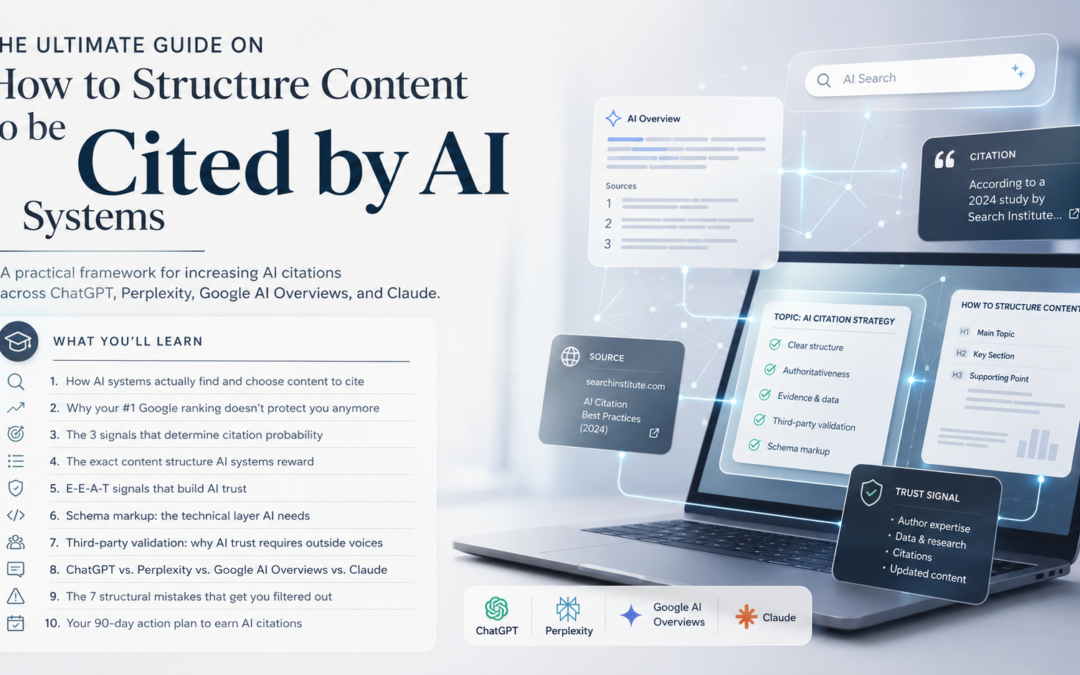
What You'll Learn in This Guide
- How AI systems actually find and choose content to cite
- Why your #1 Google ranking doesn't protect you anymore
- The 3 signals that determine citation probability
- The exact content structure AI systems reward
- E-E-A-T signals that build AI trust
- Schema markup: the technical layer AI needs
- Third-party validation: why AI trust requires outside voices
- ChatGPT vs. Perplexity vs. Google AI Overviews vs. Claude
- The 7 structural mistakes that get you filtered out
- Your 90-day action plan to earn AI citations
Section 1: How AI Systems Actually Find Content to Cite
Before you can optimize for AI citations, you need to understand how these systems actually work — because they're fundamentally different from Google.
Most AI assistants — ChatGPT, Perplexity, Claude, Google AI Overviews — use a process called Retrieval-Augmented Generation (RAG). Here's the plain-English version of what that means:
How RAG Works (Plain English)
Your content gets split into chunks. AI crawlers break your pages into segments of roughly 200–500 words each. Each chunk is stored as a mathematical "fingerprint" of meaning — called a vector embedding.
A customer's question is converted to the same format. When someone asks "Who's the best HVAC company in Seattle?", the AI converts that question into a matching fingerprint and looks for chunks that are mathematically similar.
The AI synthesizes an answer from the best chunks. It pulls from the clearest, most trustworthy, most relevant passages it finds — and cites those sources. If your content can't be cleanly extracted in a chunk, it never makes it to this stage.
The Critical Insight
AI systems cite chunks, not pages. Your brilliant 3,000-word article is useless if no individual 200-word section can stand alone and directly answer a question. This is the single biggest reason businesses with great content still get zero AI citations.
The AI doesn't sit down with a cup of coffee and read your whole article the way a customer might. It's looking for a passage it can confidently extract, verify, and attribute — in seconds. If your content isn't structured to make that easy, it moves on.
Section 2: Why Your Google Rankings Don't Protect You Anymore
This is the part most business owners find genuinely alarming — and it should be. The assumption that "if I rank well on Google, I'll show up in AI answers" is wrong.
12%
of AI-cited URLs match Google's top 10 for the same query
(Ahrefs, 2025)
67%
of ChatGPT's top citations come from pages with zero Google visibility
(Ahrefs, 2025)
62%
of users now start their search journey with AI tools, not Google
(ROI Revolution, 2025)
14.2%
conversion rate for AI-referred visitors vs. 2.8% for Google organic
(Semrush, 2025)
Let that last stat sink in: a visitor arriving from an AI citation is five times more likely to become a customer than a visitor arriving from a Google click. AI-referred visitors arrive already educated, already trusting, and already pre-sold on the category.
Here's the good news: you don't have to choose. The structural changes that make your content AI-citation-ready also make it better for traditional SEO. They're complementary strategies, not competing ones.
Section 3: The 3 Signals That Determine Whether AI Cites You
Once an AI retrieves a batch of potential sources, it evaluates them against three core signals. Understanding these is the foundation of everything else in this guide.
Section 4: The Exact Content Structure AI Systems Reward
This is the most practical section of this guide. The structural improvements here are things you can start applying to your content today — and research shows they can improve AI citation rates by 40% or more.
Rule #1: Lead with the Answer (Not the Story)
Research from Frase shows that 44.2% of all AI citations come from the first 30% of a page's text. Your opening paragraph is prime citation real estate — and most businesses waste it on a long, scene-setting introduction that doesn't say anything useful.
Rule #2: Write in Self-Contained Sections
Each major section of your content should open with a direct statement, explain it, and support it — all within that section. The test: if someone extracted any 200-word segment and read it without context, would it still make complete sense and provide real value?
A good section formula looks like this:
Direct answer — State the clearest, most specific answer to this section's question in the first sentence.
Explanation — Unpack what that means and why it matters.
Distinction — Clarify the common mistake or misconception in this area.
Specific support — Add a named statistic, real example, or concrete detail that verifies the claim.
Rule #3: Use Question-Based Headings
Most AI queries are phrased as questions or task requests. Headings that mirror these patterns make your relevance obvious to the retrieval system.
❌ Weak headings AI ignores:
- "Our Services"
- "Key Considerations"
- "Overview"
- "Final Thoughts"
✅ Strong headings AI extracts:
- "How much does Seattle roof repair cost in 2026?"
- "What's included in a dental cleaning appointment?"
- "How long does a personal injury case take in Washington State?"
- "Which Seattle neighborhoods does our HVAC service cover?"
Rule #4: Build a Real FAQ Section
FAQ sections are among the most-cited content formats across every major AI platform. But only if they're written correctly. Each Q&A pair should function as a complete, standalone answer unit.
Rule #5: Use Specific Numbers, Not Vague Claims
The Princeton GEO study found that adding statistics increases AI citation visibility by 22%, and including expert citations can boost it by up to 115% for mid-ranked pages. AI systems are designed to prefer verifiable, specific claims over generic opinion.
❌ Vague (filtered out)
"Conversion rates improved significantly after implementing personalization. Results were quite impressive across all our client campaigns."
✅ Specific (gets cited)
"Conversion rates improved 47% after implementing AI-driven personalization across our dental practice clients' Google Ads campaigns in Q3 2025, with cost-per-lead dropping from $148 to $79."
Rule #6: Maintain Consistent Terminology
If your homepage says "roofing contractor," your About page says "roof specialist," your service pages say "roofing company," and your blog says "roofer" — you're creating entity ambiguity that AI systems penalize. Use your core business descriptor consistently across every page. Same goes for service names, neighborhood names, and key terms.
Section 5: E-E-A-T Signals That Build AI Trust
Google's E-E-A-T framework (Experience, Expertise, Authoritativeness, Trustworthiness) didn't disappear with the rise of AI search — it became more important. AI platforms use similar trust signals to decide whether your content is worth citing.
Experience
Reference real cases, real projects, real outcomes. "We replaced 47 roofs in Seattle's Eastside this winter" beats "we have extensive roofing experience." First-hand specifics signal credibility.
Expertise
Name your author, include credentials, and link to supporting research. AI systems scan for trust indicators in the first 200 words of content. An unnamed "staff writer" gets filtered out.
Authoritativeness
Cite named sources, link to data, and earn mentions from other recognized sites in your industry. Brands cited on 5+ external domains see AI citation rates improve by 67%, per industry research.
Trustworthiness
Display "Last Updated" dates. Keep information current. 76.4% of ChatGPT's most-cited pages were updated within 30 days. Stale content is penalized. A "Last Updated: May 2026" timestamp signals ongoing maintenance.
⚡ The Highest-Leverage E-E-A-T Fix for Most Small Businesses
Add a named author byline with a photo, title, and one-paragraph bio to every page and blog post. Establish a Person schema (covered in the next section). This single change can dramatically improve how AI systems evaluate your content's trustworthiness — and it costs nothing but time.
Section 6: Schema Markup — The Technical Layer AI Needs
Think of schema markup as labels you put on your content so AI systems don't have to guess what it means. A 2024 experiment found that pages with well-implemented schema appeared in AI Overviews while identical pages without schema weren't even indexed. Pages with proper schema markup are 30–40% more likely to be cited in AI-generated answers.
You don't need to understand the code — you need to understand what each type does and ask your developer (or use a WordPress plugin like Yoast or Rank Math) to implement it:
| Schema Type | Best For | Why It Matters for AI |
|---|---|---|
| Article | Blog posts, guides, news | Tells AI the author, publish date, and topic — the most basic trust signal |
| FAQPage | Any page with Q&A sections | Highest-impact schema for AI. Explicitly marks each Q&A as a citable retrieval unit |
| LocalBusiness | Service area businesses | Verifies your business name, address, hours, and service areas — critical for local AI queries |
| HowTo | Step-by-step guide content | Explicitly structures process content that AI systems frequently cite for "how to" queries |
| Person | Author pages, team bios | Builds author credibility and connects your experts to their published content across the web |
| Review / AggregateRating | Service and product pages | Signals social proof and customer validation — heavily weighted in comparison queries |
Important: Schema markup is support infrastructure, not a shortcut. It helps AI understand content that's already well-written and clearly structured. Schema on top of a vague, disorganized page won't save it. Get the content structure right first, then layer in schema.
Section 7: Why AI Trust Requires Outside Voices
Your website saying you're great doesn't mean much to an AI system. Other websites saying you're great — that's what moves the needle. AI platforms are fundamentally more likely to cite a source that other trusted sources have mentioned first.
Brands with citations across 5 or more external domains see AI citation rates improve by 67%. Here's where to focus your energy:
Google Reviews, Yelp, and Industry Review Sites
Review platforms are cited regularly across all major AI platforms. Encourage customers to leave detailed reviews that mention your specific services and location. "Great Seattle dentist who explained every step of my crown procedure" is far more citable than "5 stars, great!"
Local Press & Industry Publications
A mention in the Seattle Times, a local business journal, or an industry association newsletter creates the kind of third-party validation AI systems weight heavily. Even small local press mentions matter.
Reddit and Community Platforms
Reddit accounts for 46.5% of Perplexity's citations and 21% of Google AI Overview citations. When customers or community members mention your business in a relevant Seattle subreddit (r/Seattle, r/seattlehomes, r/askseattle), it's one of the most powerful validation signals available.
LinkedIn Articles and Professional Profiles
LinkedIn was among the top-cited sources by major AI systems in 2025. Long-form LinkedIn articles published by your team members, with your business consistently mentioned and linked, create citation sources that AI systems — especially Claude — actively trust.
Business Directories and Listings
Google Business Profile, Yelp, the Better Business Bureau, your local Chamber of Commerce, and any industry-specific directories (Avvo for lawyers, Healthgrades for doctors, Houzz for contractors) all contribute to entity validation. Make sure every listing is complete, consistent, and up to date.
Section 8: ChatGPT vs. Perplexity vs. Google AI Overviews vs. Claude
Each AI platform has different citation preferences. The core framework in this guide applies everywhere — but understanding the quirks of each platform helps you prioritize.
Section 9: The 7 Structural Mistakes That Get You Filtered Out
Most businesses are failing to earn AI citations for completely predictable, fixable reasons. Here are the seven most common structural mistakes — and what to do instead.
Mistake #1: Burying the Answer
Long, scene-setting intros that take 300+ words to get to the point. AI retrieval systems hate this — they grab a chunk, find mostly fluff, and move on.
Fix: Put your clearest answer in the first 40–60 words of every section. Always.
Mistake #2: Vague, Generic Claims
"We provide excellent service" and "we're industry leaders" are invisible to AI. These claims can't be verified against any external reference, so they're treated as noise.
Fix: Replace every vague claim with a specific fact, stat, or example that can stand on its own.
Mistake #3: Keyword Stuffing
What worked in 2015 actively hurts you now. Repeating "Seattle dentist Seattle dental office Seattle teeth cleaning" dilutes semantic clarity in the vector embedding — making your content less relevant, not more.
Fix: Write naturally about your full topic. Cover the entity cloud around your services.
Mistake #4: Inconsistent Brand Naming
If your website says one thing and your profiles say another, AI flags the inconsistency and deprioritizes all your content. Entity clarity is binary — either you're consistent or you're creating doubt.
Fix: Audit every online profile for consistent naming, service descriptions, and contact info.
Mistake #5: Stale, Undated Content
Content without a visible publication or update date gets heavily penalized by recency-sensitive platforms like Perplexity. No date = no freshness signal = lower citation probability.
Fix: Add "Last Updated:" dates to key pages and actually refresh them regularly.
Mistake #6: No External Validation
A beautifully written website with zero external mentions is an uncorroborated source. AI systems treat it like an anonymous tip — possibly interesting, but not worth repeating.
Fix: Prioritize earning mentions in local press, review platforms, directories, and community forums.
Mistake #7: Blocking AI Crawlers
Major AI crawlers — GPTBot (ChatGPT), ClaudeBot, PerplexityBot, Google-Extended — will index your site unless you've blocked them in your robots.txt file. Some website setups do this accidentally.
Fix: Ask your developer to verify you're allowing these crawlers. Blocking them means zero AI visibility — ever.
Section 10: Your 90-Day Action Plan to Earn AI Citations
Here's the reality: you don't need to do everything at once. Initial AI citations typically appear within 4–8 weeks of implementing structural content changes. Here's a sequenced plan.
Frequently Asked Questions
Does getting cited by AI hurt my traditional Google SEO?
No — the structural improvements required for AI citations are the same foundations of strong traditional SEO. Clear headings, factual density, schema markup, E-E-A-T signals, and external citations all strengthen both channels simultaneously. GEO and SEO are complementary strategies.
How long does it take to start getting AI citations after making these changes?
Most businesses see initial citation improvements within 4–8 weeks of implementing structural content changes and schema markup. Perplexity tends to respond fastest due to its recency bias. ChatGPT and Google AI Overviews take longer because they weight established authority signals. External citation building has the highest impact but the longest lead time — plan for 90 days to see full results.
Is this only for big businesses with large budgets?
No. The core tactics — content restructuring, schema markup, FAQ optimization, and review building — cost primarily time, not money. With over 47% of brands having no GEO strategy at all, the competitive window for small local businesses to establish AI citation authority is still wide open. Local specificity is actually an advantage: smaller, locally-anchored businesses can dominate city-specific AI queries that national brands can't own.
AI is describing my business inaccurately. What do I do?
This is an entity clarity gap. When AI platforms lack clear, authoritative information about your brand, they fill the void with whatever signals they can find — which may be outdated or wrong. Fix it by: (1) improving your About page and homepage with clear, specific descriptions of what you do and who you serve, (2) ensuring consistent information across all online profiles, (3) creating content that explicitly defines your business category, and (4) earning more third-party coverage that accurately describes your services.
Do I need different content for each AI platform?
The core framework in this guide applies universally across ChatGPT, Perplexity, Google AI Overviews, and Claude. Platform-specific tactics amplify results for individual platforms once you've mastered the fundamentals. Start with universal optimization — then layer in platform-specific approaches based on where your customers are most active.
What should I measure to know if my AI visibility is improving?
Three things: (1) Citation frequency — manually test 15–20 questions your customers typically ask across ChatGPT, Perplexity, and Google AI Overviews. Note whether you appear and which pages get cited. (2) AI-referred traffic — set up GA4 tracking for sessions from chatgpt.com, perplexity.ai, and claude.ai. (3) Brand search volume — brands mentioned in AI responses often see branded search spikes as users turn to Google to learn more about them.
The Bottom Line
The businesses getting cited by AI today aren't necessarily the biggest or the best-known. They're the ones whose content is the easiest to extract, verify, and trust. That's a structural advantage anyone can build — and the window to build it before your competitors do is still open.
With 47% of businesses having no AI visibility strategy at all, acting now means building citation authority before the competitive landscape hardens. The brands that establish this foundation in 2025–2026 will be significantly harder to displace as AI search continues its explosive growth.
Free for a Limited Number of Seattle Businesses
Find Out If AI Can See Your Business Right Now
We're offering a complimentary AI Visibility Audit to a limited number of Seattle-area businesses. We'll test your brand across ChatGPT, Perplexity, Google AI Overviews, and Claude — then give you a plain-English report showing exactly where you're invisible and what to do about it.
Claim Your Free AI Visibility Audit →Spots are limited. No pitch, no obligation — just a clear picture of your AI visibility gap.
