
Published May 2026 | By Brandon Na, Seattle Organic SEO
How AI Is Transforming Marketing Strategy in 2026
Here is a number that should stop every small-business owner cold: according to Gartner research cited in a May 2026 MarTech report, only 15% of CEOs describe their own marketing leader as strongly AI-savvy — even as 82% of those same business leaders say their brand must evolve to keep pace with AI. That gap is not a technology problem. It is a strategy problem. And it is wide open for the businesses that close it first.
This post breaks down what the most credible voices in marketing research — PwC, IBM, Harvard, Gartner, Adobe, and peer-reviewed academic journals — are actually saying about AI's role in 2026. Not hype. Not vendor pitches. The real strategic picture, translated into plain language for contractors, lawyers, dentists, consultants, and anyone else running a local service business who needs to understand what is changing and what to do about it.
The Question Every CMO — and Every Business Owner — Is Now Answering Wrong
PwC and the Association of National Advertisers (ANA) co-published a major study with a title that doubles as a warning: To Matter More or Cost Less? Their research found that most marketing organizations are using AI primarily as an efficiency tool — a way to cut costs and produce content faster. That is the wrong frame.
The CMOs who are outperforming peers are not just automating tasks. They are using AI to shape markets, influence how customers perceive value, and guide enterprise-level strategy. PwC's research calls this group "market shapers" — and they apply AI to monitor shifting customer needs, synthesize fragmented signals, and run rapid experiments that inform strategic decisions, not just execution.
The Gartner Stat Worth Printing Out: The average marketing leader has only an 11% chance of exceeding CEO and CFO expectations. The reason, according to Gartner research reported in MarTech, is that most organizations still see marketing as an execution engine — not a strategic partner. AI is the lever that changes that equation, but only if you use it strategically.
For a Seattle contractor or a Bellevue law firm, the translation is simple: are you using AI just to write faster blog posts, or are you using it to understand what your ideal clients are actually asking AI tools like ChatGPT and Perplexity — and making sure your business is the answer they get?
The $4.4 Trillion Reason AI Adoption Is No Longer Optional
IBM's comprehensive guide to AI in marketing cites a McKinsey estimate that generative AI could add as much as $4.4 trillion to the global economy annually. A separate McKinsey figure IBM references shows that AI adoption across the global business landscape reached 72% as of 2024. These are not startup numbers. These are mainstream adoption numbers.
IBM's guide also draws from the IBM Institute for Business Value's annual CEO study, which found that over 70% of the highest-performing executives surveyed believe competitive advantage now depends on having the most advanced generative AI. These executives are not talking about AI as a future consideration. They are acting on it now.
IBM identifies several core benefits of AI in marketing that apply at any business size: faster decision-making through near-real-time campaign analysis, improved ROI by identifying optimal channels and ad placements, more accurate measurement of KPIs through AI-enhanced dashboards, and richer CRM capabilities that reduce human error and identify at-risk customers before they leave.
What IBM Identifies as AI's Core Marketing Use Cases in 2026
- Audience segmentation: AI divides customers by behavior and intent — not just age and zip code — leading to stronger targeting and ROI.
- Content generation: Blog posts, email sequences, ad copy, video subtitles, and website copy produced at scale.
- Customer service assistants: Generative AI-powered tools now handle natural-language conversations across the entire customer journey.
- Predictive analytics: AI identifies which products will perform, optimizes pricing, and improves lead scoring by analyzing historical patterns.
- Programmatic advertising: AI uses customer history and context to place more relevant ads with higher conversion rates automatically.
- SEO and content optimization: AI helps marketers create content that meets constantly shifting search and AI-discovery standards.
- Sentiment analysis: AI evaluates opinions and emotions expressed in reviews, social posts, and feedback so you can adjust messaging proactively.
- Workflow automation: Repetitive tasks — data entry, social scheduling, simple customer interactions — are offloaded so teams focus on strategy.
Harvard Says: "Your Job Won't Be Taken by AI — But by Someone Who Knows How to Use It"
Christina Inge, author of Marketing Analytics: A Comprehensive Guide and Marketing Metrics and an instructor at Harvard's Division of Continuing Education Professional & Executive Development, offers one of the most quoted lines in modern marketing conversations. "Your job will not be taken by AI," she says. "It will be taken by a person who knows how to use AI. So it is very important for marketers to know how to use AI."
The Harvard DCE article details exactly what AI is changing in marketing practice. Algorithms are now analyzing customer interactions in real time, predicting consumer behavior, and personalizing content. Marketers who once reacted to consumer behavior can now predict it and create personalized campaigns before the customer even knows what they want.
Inge also identifies barriers that remain real for many small and mid-size businesses: lack of education and training, absence of clear AI strategy, talent gaps, and insufficient investment of time and financial resources. The good news is that these are solvable problems — and the businesses that solve them first gain a durable lead.
What Harvard Identifies as Key AI Marketing Trends: Advanced data analytics (mining structured and unstructured data like social posts and videos), hyper-personalization powered by predictive engines, and AI-driven chatbots and virtual assistants that can handle queries, recommend products, and complete transactions in real time.
From Campaigns to Systems: Why Adobe's Framework Changes Everything
Adobe's 2026 State of Marketing report, based on a survey of 150 marketing leaders and practitioners across the US, UK, Canada, France, and Germany, delivers a finding that reframes the entire AI conversation. 90% of respondents say their workflows can support rapid or high-frequency campaign cycles — but 69% say doing so causes significant strain or is not actually possible at all.
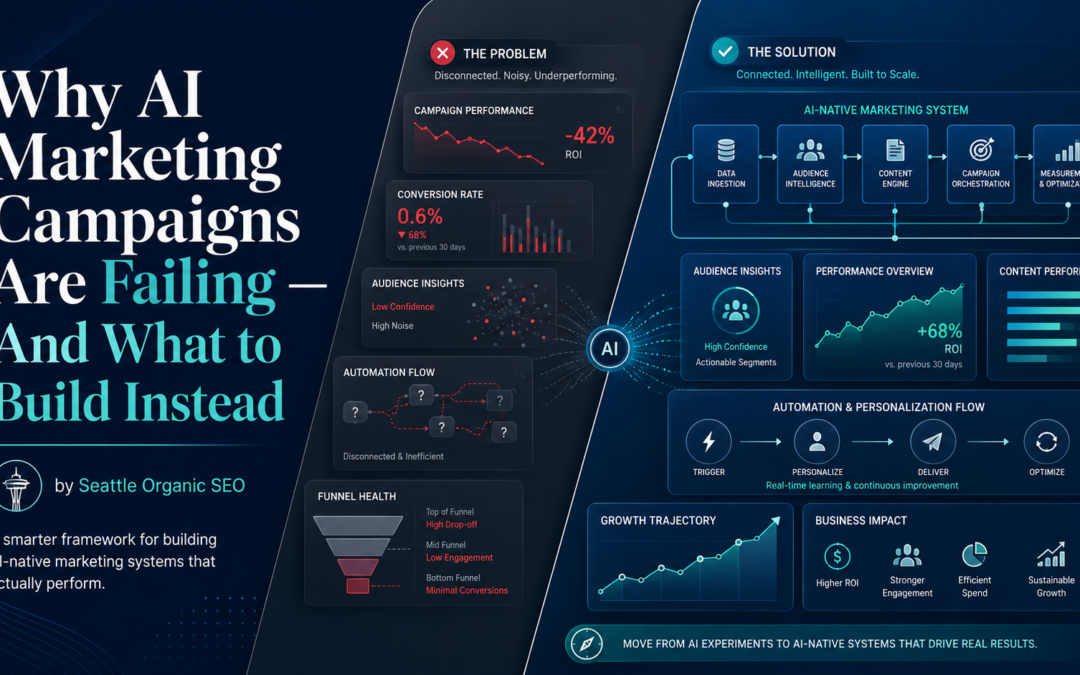
Adobe's conclusion: the problem is not the speed of individual campaigns. The problem is that most marketing organizations are still built around campaigns as isolated events rather than AI-powered systems that continuously learn, optimize, and improve. When marketing works as a system — where performance data from one campaign directly feeds the next creative cycle — AI stops being a tool and starts being a competitive advantage.
Adobe's research also revealed that 86% of marketing leaders say generative AI will significantly increase content speed and volume. But speed and volume without governance creates what Adobe calls "AI slop" — content that is fast, plentiful, and off-brand. The solution is building the governance infrastructure alongside the production capability. Adobe's own internal creative teams used AI-powered content generation for their global Adobe MAX conference, creating design variations for testing — and one treatment drove a 57% uplift in engagement. That is not a volume play. That is a system working as designed.
| Campaign-Based Marketing | System-Based AI Marketing |
|---|---|
| Each campaign starts from scratch | Every campaign feeds learning into the next |
| Performance data reviewed after the fact | Performance data updates creative in real time |
| Speed creates strain on teams | Speed is sustainable because AI handles repetition |
| Content governance is manual and inconsistent | Governance is built into the production workflow |
| AI used for individual tasks | AI integrated across strategy, creation, activation, and measurement |
What Gartner and MarTech Say: The CMO Credibility Crisis
Sharon Cantor Ceurvorst, VP Analyst writing in MarTech in May 2026, summarizes the central tension in marketing leadership today: AI is already changing discovery, buying decisions, and how organizations evaluate market opportunities — and yet most CMOs are still being evaluated primarily on campaign execution.
Gartner's research found a profile of marketing leaders who consistently outperform their peers. These "market shapers" are not just using AI more — they are using it differently. They apply AI to understand how customer questions are evolving, how AI-powered discovery is changing buying journeys, and where trust is eroding. They test hypotheses quickly, simulate scenarios, and explore unmet needs before committing significant resources.
For a Seattle-area service business, this has a very practical meaning. When a potential client searches Google, ChatGPT, or Perplexity for "best Seattle dentist accepting new patients" or "Seattle contractor for bathroom remodel," your AI visibility is not just a marketing question — it is a revenue question. Market-shaping businesses are the ones appearing in those AI-generated answers. The rest are invisible.
The Three Behaviors That Separate Market Shapers from the Rest (Gartner via MarTech):
- They use AI to monitor how customer questions and needs are shifting — not just to produce content faster.
- They translate macro signals into decisions about where to compete and how to differentiate, not just how to execute.
- They use AI to influence brand perception and guide investment priorities across the organization.
What Academic Research Confirms: Five Themes Dominating AI Marketing in 2025–26
A 2025 systematic review published in Discover Artificial Intelligence (Springer Nature) analyzed 381 peer-reviewed journal articles from 2021 to 2025 using topic modeling and sentiment analysis. The research identified five dominant themes shaping the AI-in-marketing academic conversation — and they map almost perfectly to the practitioner challenges businesses face right now.
Theme 1: AI-Driven Personalization and Customer Engagement
The dominant research theme. AI enables businesses to anticipate customer preferences based on behavioral data and deliver experiences that feel individually relevant — not mass-produced. The academic consensus is that this is where AI creates the most direct competitive advantage for businesses that invest in it.
Theme 2: Big Data Analytics and Predictive Modeling
Predictive modeling — forecasting which leads will convert, which customers will churn, and which offers will perform — has moved from enterprise-only capability to accessible tool. Research shows a shift from purely technological optimization toward understanding customer behavior at a granular level.
Theme 3: Generative AI Applications in Digital Content Creation
Research publications on this theme spiked sharply after 2022 and peaked in 2024, reflecting the rapid mainstreaming of tools like ChatGPT and Claude. Academic findings echo practitioner experience: generative AI dramatically increases content velocity, but quality governance remains the critical gap.
Theme 4: Ethics, Data Privacy, and Trust
The research is clear: trust is both the biggest risk and the biggest opportunity in AI marketing. Adobe's research found that 45% of consumers say visibility and control over their data is a top priority. Businesses that build transparent AI governance win trust. Those that don't face reputation and regulatory risk.
Theme 5: AI Deployment in B2B and SME Marketing Contexts
A growing body of research is focusing specifically on how small and mid-size enterprises can successfully adopt AI marketing tools. The core finding: successful AI adoption depends on aligning technological innovation with ethical responsibility and organizational readiness — not just deploying the latest tool.
Your Website in the AI Era: Acquia's Practical Framework
Acquia, a major digital experience platform, published a 2025–2026 guide to rethinking digital strategy in the AI era that offers a framework directly applicable to local service businesses. Their core argument: most websites were built for human search behavior. AI has fundamentally changed discovery — and most websites are not ready.
The Acquia guide points to three specific capabilities businesses need to build for AI-era visibility: delivering deeper insights through connected data, enabling agile content delivery that can respond to AI-driven discovery patterns, and creating personalized customer interactions that hold up across AI-mediated touchpoints. This is precisely what our AI Visibility Audits assess — whether your website and content are structured to be found, cited, and recommended by AI tools.
AI-Era Website Readiness: A Practical Self-Assessment
Check each that currently applies to your business:
☐ Your Google Business Profile answers the specific questions AI tools pull from local businesses
☐ Your website has clear, structured answers to the top 10 questions your clients ask before hiring you
☐ Your content is written in direct, factual language that AI systems can cite and quote accurately
☐ You have consistent NAP (name, address, phone) data across all directories and citation sources
☐ Your website loads in under 2.5 seconds on mobile (AI discovery tools deprioritize slow sites)
☐ You have Schema markup that helps AI tools understand your services, location, and reviews
☐ Your reviews contain keyword-rich language that reinforces your authority for specific services
☐ You are actively appearing in AI Overviews for your core service + city keyword combinations
If you checked fewer than five of these, your business has meaningful AI visibility gaps that are actively costing you leads.
The Human-AI Partnership: What the Research Actually Says About Replacing Marketers
Every major source reviewed for this article reaches the same conclusion: AI is not replacing marketing professionals or business owners. It is raising the skill floor. The IBM guide, the Harvard DCE article, the PwC/ANA report, and the MarTech/Gartner analysis all point to the same dividing line — those who understand how to use AI strategically versus those who do not.
Adobe's research reinforces this with a finding about the optimal implementation model: successful AI adoption requires both a senior sponsor who creates organizational conditions for AI to scale, and a practitioner champion who drives day-to-day adoption. Without both, AI investments stall. With both, they compound.
For most small and mid-size businesses in Seattle and across the Pacific Northwest, the "senior sponsor" and the "practitioner champion" are often the same person: the owner. That means the businesses that will win are the ones where owners have enough AI literacy to make smart decisions — not necessarily to do the work themselves, but to direct it, evaluate it, and hold their marketing partners accountable for results.
The Practical Division of Labor in 2026
| What Humans Do Best | What AI Does Best |
|---|---|
| Set strategy and define goals | Process and analyze data at scale |
| Maintain brand voice and values | Generate content variations rapidly |
| Build relationships and trust | Personalize interactions at scale |
| Apply ethical judgment | Predict behavior and model outcomes |
| Handle nuance and exceptions | Execute repetitive tasks consistently |
| Direct creative vision | Test and optimize across channels simultaneously |
What This Means for Your Seattle Business Right Now
The research is consistent. The trend lines are clear. Here is what it means practically for a service business competing in the Seattle metro area in 2026.
✔ AI is not coming — it's here. With 72% global business adoption and generative AI traffic to US retail websites up 1,200% (Adobe Analytics), AI has moved from the future to the present. Your competitors are already using it, even if they don't talk about it.
✔ Efficiency is the wrong goal. PwC's research is explicit: businesses using AI just to cut costs are leaving their biggest strategic opportunity on the table. The goal is to matter more — to become the business AI tools recommend when your ideal clients ask for help.
✔ Your content needs to be structured for AI discovery. Generative AI tools synthesize answers from credible, clearly structured content. If your website reads like a brochure instead of an expert resource, AI tools will cite your competitors instead of you.
✔ Trust and transparency are now ranking factors. Both academic research and Adobe's consumer data confirm that customers are watching how businesses handle data and AI. Transparency is a differentiator, not just a legal requirement.
✔ The window for early-mover advantage is closing. Gartner's data shows a credibility gap between businesses that lead with AI strategy and those that follow. In competitive local markets like Seattle, Bellevue, and Tacoma, that gap translates directly to lead flow.
Is Your Business Visible to AI? Find Out for Free.
We run a complimentary AI Visibility Audit for local Seattle-area service businesses — checking how your business appears in Google AI Overviews, ChatGPT, Perplexity, and Gemini for your core service + city keyword combinations. No automated reports. A real human looks at your actual visibility and tells you exactly where you stand.
We only take on a limited number of new audits each month. Spots are currently available.
Request Your Free AI Visibility Audit →References and Citations
- PwC and Association of National Advertisers (ANA). (2025). Marketing in the AI Era: To Matter More or Cost Less? PricewaterhouseCoopers US. Available at: pwc.com
- Inge, C. / Harvard Division of Continuing Education. (2025, April; updated March 2026). AI Will Shape the Future of Marketing. Harvard Professional & Executive Development. Available at: professional.dce.harvard.edu
- Cantor Ceurvorst, S. (2026, May 4). How Marketing Leaders Are Succeeding in the AI Era. MarTech. Available at: martech.org. (Cites Gartner research on CMO strategic credibility and market-shaper profiles.)
- Flinders, M., Hayes, M., & Downie, A. (2025). A Guide to AI in Marketing. IBM Think. Available at: ibm.com/think. (Cites McKinsey estimates on generative AI's $4.4T economic impact and IBM Institute for Business Value CEO Study.)
- Adobe Inc. (2026, April). State of Marketing in an AI-Driven World: The Search for Impact in an Era of Speed. Adobe Business. Survey conducted by Advanis on behalf of Adobe, December 2025–January 2026, n=150 marketing leaders and practitioners. Available at: business.adobe.com
- Adobe Inc. (2025, March). Why Campaigns Must Become Systems. Adobe Business Blog. Available at: business.adobe.com
- Holmes, N. (2025). Rethinking Your Website: Building a Smarter Digital Strategy in the AI Era. Acquia Blog. Available at: acquia.com
- [Author TBD]. (2025). Artificial Intelligence (AI) Adoption in Marketing Strategies: Navigating the Present and Shaping the Future Business Landscape. Journal of Open Innovation: Technology, Market, and Complexity, Volume 11, Issue 3, Article 100600. ScienceDirect / Elsevier. Available at: sciencedirect.com
- [Multiple Authors]. (2025, December). Emerging Trends, Challenges and Research Opportunities in Artificial Intelligence Applications in Marketing: A Systematic Review of 381 Peer-Reviewed Articles (2021–2025). Discover Artificial Intelligence. Springer Nature. Available at: link.springer.com
Additional Resources
These sources provide deeper reading on AI in marketing, generative engine optimization, and AI-powered business strategy:
- Marketing AI Institute — Education, research, and annual State of Marketing AI Report; the most comprehensive practitioner-focused AI marketing resource available.
- IBM Think: AI in Marketing — IBM's comprehensive guide to AI marketing definitions, use cases, benefits, and best practices, updated regularly.
- Harvard DCE: AI Will Shape the Future of Marketing — In-depth article by Harvard instructor Christina Inge on practical AI marketing tools and career implications.
- MarTech.org — Practitioner-focused coverage of marketing technology, AI adoption, and CMO strategy from Gartner analysts and industry leaders.
- Gartner: AI in Marketing Research — Enterprise-grade research on CMO AI strategy, market-shaper profiles, and predictive analytics frameworks.
- Adobe Business Blog — Original research and practitioner case studies on content supply chains, AI governance, and personalization at scale.
- PwC/ANA: Marketing in the AI Era Report — Joint PwC and Association of National Advertisers study on how leading CMOs are using AI to drive enterprise value, not just efficiency.
- McKinsey: The Economic Potential of Generative AI — Source for the $4.4 trillion generative AI economic impact estimate cited in IBM's marketing guide.
- Seattle Organic SEO: AI & Answer Engine Optimization Services — Our GEO and AEO service page outlining how we help Seattle-area businesses appear in AI-generated answers.
About This Article: This post was researched and written by Brandon Na of Seattle Organic SEO using primary sources from PwC, IBM, Harvard DCE, MarTech/Gartner, Adobe, Acquia, and peer-reviewed academic journals. AI tools were used to assist in research synthesis and formatting; all facts and statistics are verified against the original source documents linked in the references section above.
Published: May 2026 | Topic: AI Marketing Strategy, Generative Engine Optimization, Local SEO
