
Updated September 2026
A law firm can rank on the first page of Google and still disappear when someone asks ChatGPT:
“Who is a good employment lawyer in Seattle for a tech worker reviewing a severance agreement?”
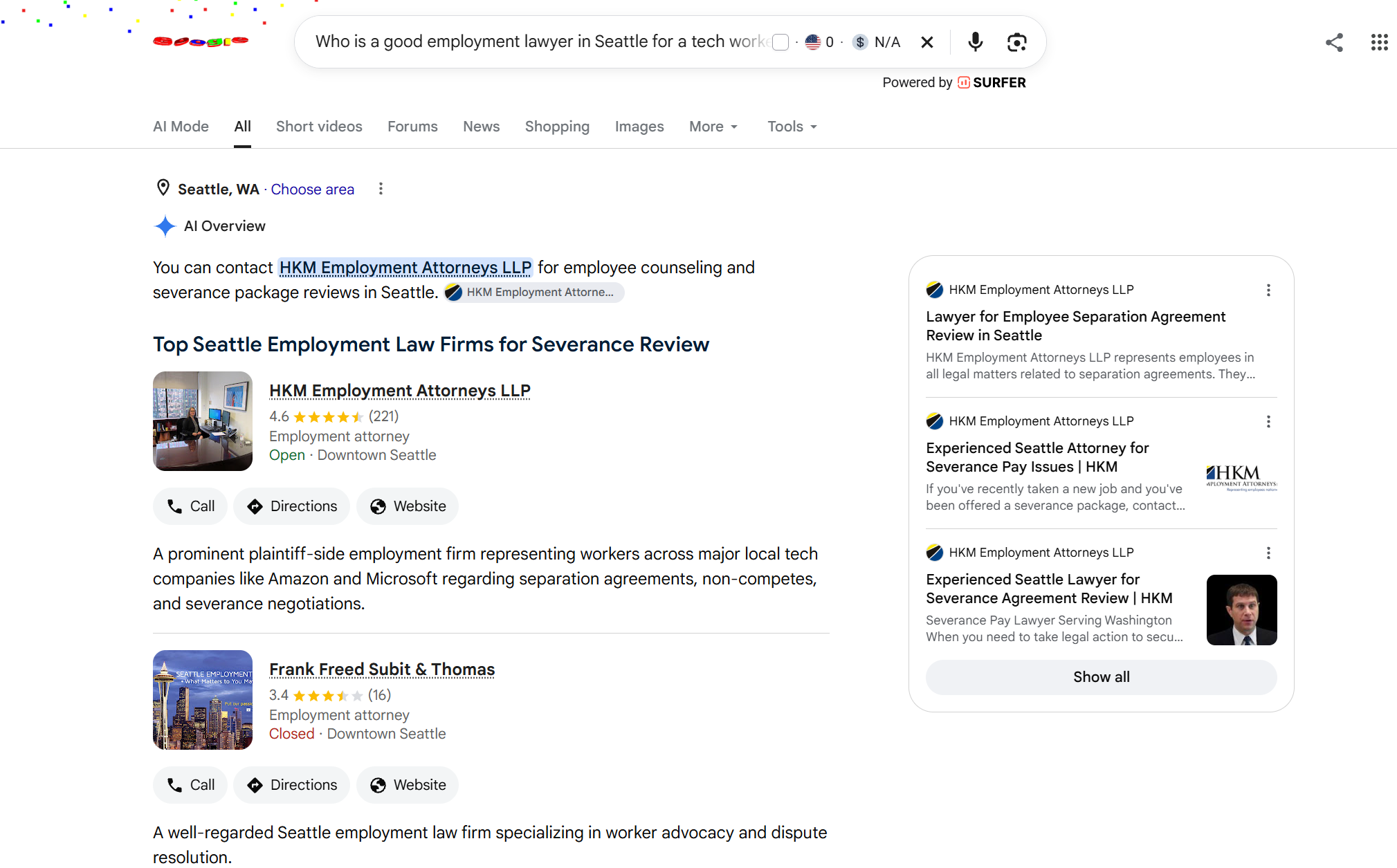
Another firm—sometimes one that ranks below it in traditional Google results—may be named instead.
That is the new visibility problem for attorneys.
Prospective clients are no longer searching only with two- or three-word phrases such as
Seattle immigration lawyer or car accident attorney near me.
Increasingly, they describe the entire problem: what happened, where they live, what type of
lawyer they need, how urgent the situation is, what language they prefer, whether they need
a free consultation and sometimes which firms they are already considering.
Then they ask ChatGPT, Claude, Gemini, Perplexity or Google’s AI search experiences to help narrow the field.
Quick Answer: What Is AI Visibility for Law Firms?
AI visibility for law firms is the likelihood that a law firm, individual attorney or the firm’s content is surfaced, mentioned or cited when someone asks an AI engine a relevant legal question.
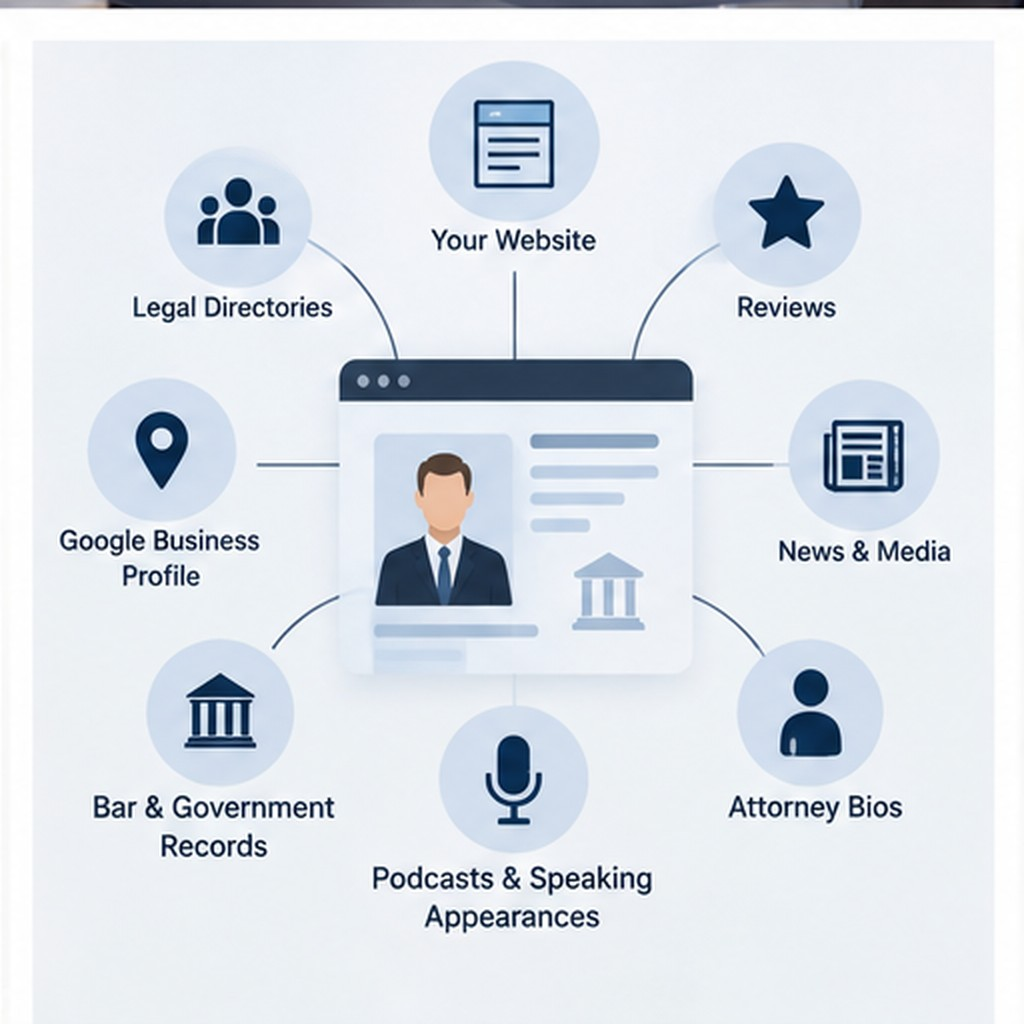
AI systems may draw evidence from a firm’s own website, attorney biographies, legal directories, reviews, Google Business Profile information, bar and government records, news coverage, podcasts, speaking appearances and other independent sources.
The objective is not simply to “rank #1 in ChatGPT.” AI answers are variable. The more useful goal is to make your firm a consistently credible candidate across the questions prospective clients actually ask.
The question law firms need to ask is therefore changing from:
“Where do we rank?”
to:
“When an AI system is asked about a matter we handle, does it know enough about our attorneys to consider us for the answer?”
That is AI visibility for law firms.
It is becoming another layer of legal marketing built on top of traditional SEO, local SEO, reputation, content, entity clarity and digital PR.
If you want to see the kinds of questions prospective clients are already asking, start with our companion research:
The AI Prompts Clients Use to Find Lawyers in Seattle: 40+ Real Examples
.
In This Guide
- How AI Decides Which Lawyers to Mention
- Google Rankings vs. AI Recommendations
- How ChatGPT, Claude and Google AI Find Information
- The Six Evidence Layers Behind AI Visibility
- Turning Your Website Into AI Evidence
- Why Attorney Bios Matter
- Schema Markup for Law Firms
- The Washington-Specific Advantage
- How to Measure AI Visibility
- A 90-Day Law Firm AI Visibility Plan
- The Seattle Legal AI Visibility Index
- Frequently Asked Questions
How Does AI Decide Which Lawyers to Recommend or Mention?
 There is no single public “ChatGPT ranking algorithm” for lawyers.
When an AI system uses current web information to answer a question, it may gather evidence from several places and synthesize those sources into an answer.
Depending on the engine, location and prompt, that evidence can include:
- the law firm’s own website;
- individual attorney biography pages;
- legal directories such as Justia, Avvo, Super Lawyers, Best Lawyers, Lawyers.com and FindLaw;
- Google Business Profile and other local-business information;
- client reviews;
- bar, court and government information;
- news articles, interviews and earned media;
- podcasts, CLEs, conference appearances and other independent mentions; and
- pages explaining the particular legal issue a user asked about.
Think of AI visibility as a corroboration problem.
Can an AI system find enough credible information to connect
who you are + what you handle + where you practice + why you are relevant to this particular situation?
If those facts are supported across your website and trusted third-party sources, an AI engine has a stronger evidence base from which to consider your firm.
 If all of that information exists only in vague marketing language on a homepage, the system has much less to work with.
Ranking on Google and Being Recommended by AI Are Not the Same Thing
Traditional SEO still matters enormously.
Google says its existing SEO fundamentals continue to apply to generative AI experiences such as AI Overviews and AI Mode. Google also specifically says website owners do not need special AI markup or a separate secret optimization system to become eligible for those experiences.
Google Search Central: AI Search Optimization Guidance
But traditional Google rankings and AI recommendations are not identical outcomes.
BrightLocal analyzed more than 200,000 localized AI searches in 2026 across ChatGPT, Google AI Mode and Google AI Overviews. A tracked business appeared in Google Maps in roughly 66% of searches but appeared on the tested AI surfaces only about 32% to 38% of the time.
Read BrightLocal’s Local AI Visibility Study
The study also found substantial variation when similar local prompts were tested repeatedly. That matters for attorneys because AI visibility should not be viewed as one permanent blue-link ranking.
Law-firm-specific research points in the same direction.
A 2026 study from 12AM Agency recorded 748 ChatGPT prompt runs across 332 U.S. legal markets. Of 13,053 practice-matched firms in its comparison set, 96.6% were not named in any recorded answer during the study.
More importantly, changing the phrasing often changed the firms ChatGPT named. Among 231 family-law markets tested using two prompt phrasings, 31.2% of the answer pairs shared no firms at all.
Read the ChatGPT Law Firm Recommendation Study
AI visibility is not a single ranking. A more realistic goal is to become part of the pool of credible firms an AI system is willing to consider repeatedly across relevant prompts.
How AI Search for Lawyers Actually Works
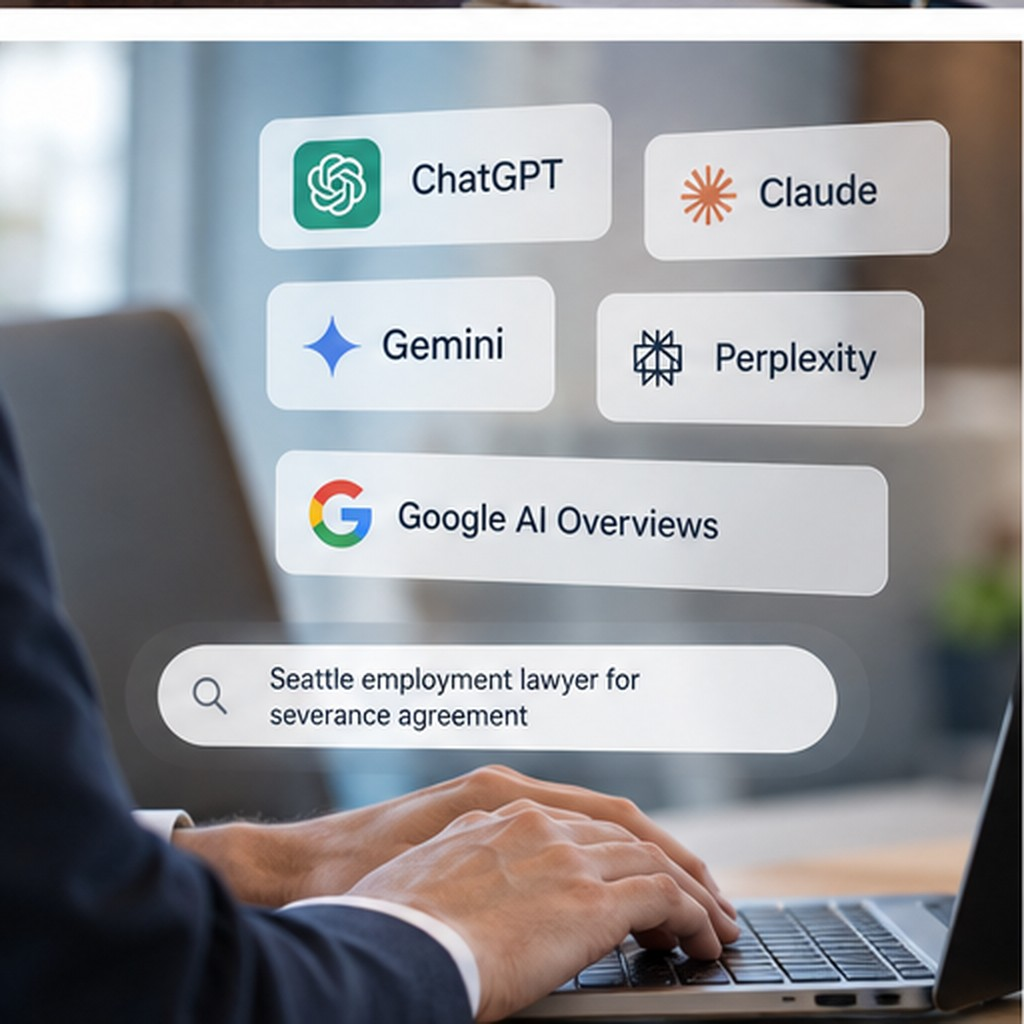 The precise ranking and recommendation systems used by OpenAI, Anthropic and Google are proprietary.
But the companies provide enough public information to understand an important part of the process: search-enabled AI systems can retrieve information from the web and use that information to ground answers.
ChatGPT
ChatGPT Search can retrieve current information from the public web and provide links to sources. OpenAI says sites must permit its OAI-SearchBot crawler if they want to be eligible for inclusion in ChatGPT search results. Eligibility does not guarantee placement.
OpenAI: Searching the Web With ChatGPT
For law firms, this makes technical accessibility a starting point. Important credentials, practice descriptions and legal resources should be available in crawlable, understandable HTML.
Claude
Anthropic says Claude’s web-search capability can search live web sources and provide citations to those sources.
Anthropic: Enabling and Using Web Search
Google AI Overviews and AI Mode
Google’s AI experiences are connected to Google’s broader Search systems.
Google says existing fundamentals such as crawlability, internal links, useful content, textual information, page experience and accurate Business Profile data continue to matter.
That is why the practical strategy is not SEO versus GEO.
It is SEO + local SEO + reputation + authoritative content + entity clarity + third-party corroboration.
For the broader framework behind this work, see our
Generative Engine Optimization (GEO) guide
The Six Evidence Layers Behind Law Firm AI Visibility
Think about your firm’s online presence as six overlapping evidence layers.
1. Your Law Firm Website
Do not underestimate your own domain.
In BrightLocal’s 2026 analysis of approximately 1.9 million local AI citations, business websites accounted for a large share of citations and the overwhelming majority of unique domains used as sources.
For a law firm, the site needs to answer basic questions without forcing a person—or a machine—to guess.
Instead of:
“Our attorneys provide sophisticated representation tailored to each client’s unique circumstances.”
say something more explicit:
“Our Seattle employment attorneys represent employees in severance negotiations, wrongful termination claims, workplace discrimination matters and Washington non-compete disputes.”
The second version identifies:
- profession;
- city;
- side represented;
- practice areas; and
- jurisdiction.
Machines understand it better. Prospective clients do too.
2. Legal Directories
Legal directories deserve more attention in the AI era than many firms give them.
A 2026 InterCore study examined 18,900 citations generated through Perplexity Sonar for high-intent lawyer-hiring prompts covering six practice areas and 30 U.S. metropolitan areas.
A legal directory was the first cited source in 77.8% of the measured answers. Justia was particularly prominent, while other major legal directories also appeared frequently.
The limitation matters: this was one platform, one methodology and one set of prompts. It should not be generalized into a universal ChatGPT, Claude or Google ranking factor.
Review the InterCore Law Firm AI Visibility Research
For attorneys, check:
- exact firm name;
- attorney names;
- office locations;
- practice areas;
- bar admissions;
- languages;
- biographical information;
- website URL;
- phone number;
- awards and recognitions; and
- whether attorneys listed are still associated with the firm.
A contradiction between your website, Justia, Avvo, the Washington State Bar directory and Google Business Profile introduces uncertainty.
Consistency creates corroboration.
3. Reviews and Reputation
Reviews are especially interesting because they provide independent language describing what clients associate with a firm.
A review might naturally contain language such as:
“They helped me after my L&I claim was denied.”
or:
“She understood my immigration problem after I was laid off from a Seattle tech company.”
That gives search and AI systems more contextual information than a numerical rating alone.
The 2026 ChatGPT law-firm study also found that review volume had the strongest measured association with whether a firm was named in its dataset.
The researchers explicitly describe this as an association, not proof of causation. Firm size, brand strength, market characteristics and other variables may explain part of the relationship.
So do not interpret a particular review count as a magic ChatGPT ranking threshold.
Build an ethical review program because reviews create genuine independent evidence about your services and client experience.
4. Google Business Profile and Local Information
Google has another enormous information layer available for location-dependent questions: its local-business ecosystem.
For law firms, make sure information such as the following is current:
- primary and secondary business categories;
- office location;
- hours;
- website;
- phone number;
- services;
- business description;
- photos; and
- review information.
An incomplete Business Profile is no longer merely a Maps problem. It can also make the firm’s overall digital entity less clear.
5. Independent Authority and Earned Media
Your website is you talking about yourself.
Independent authority is other credible organizations talking about you.
For lawyers, that can include:
- Seattle Times quotes;
- Puget Sound Business Journal interviews;
- local television appearances;
- bar association articles;
- podcast interviews;
- CLE presentations;
- conference appearances;
- university commentary;
- trade-publication articles;
- expert commentary; and
- local and ethnic media.
A firm website can say an attorney understands Washington employment law.
The evidence becomes richer when that attorney has also been quoted about Washington employment law, taught a CLE about it and published a useful guide about the subject.
That is what a corroborated digital footprint looks like.
6. Fresh, Specific Legal Content
The easiest content to create is:
“Seattle Personal Injury Lawyer.”
The more useful content answers what actually happened to the person:
- “The insurance company says I was partly at fault. Can I still recover in Washington?”
- “My L&I claim was denied. What happens next?”
- “I was laid off while on an H-1B. How much time do I have?”
- “What happens to unvested RSUs in a Washington divorce?”
- “Can my Seattle landlord raise my rent this much?”
- “I was arrested for DUI in King County last night. What should I do first?”
Those questions are much closer to conversational AI prompts because they describe situations rather than keywords.
We mapped dozens of examples in
our Seattle legal AI prompt study
.
Your Website Is No Longer Just Ranking for Keywords. It Is Supplying Evidence.
This is one of the most important mindset shifts in generative engine optimization for lawyers.
Suppose someone asks:
“Recommend a Seattle immigration attorney who handles H-1B layoffs for tech workers, preferably someone familiar with Eastside technology employees.”
An AI system may need evidence for several different dimensions:
| Dimension | What the AI Needs to Understand |
|---|---|
| Location | Seattle, Bellevue, Redmond or surrounding area |
| Practice | Immigration law |
| Matter | H-1B |
| Situation | Layoff or termination |
| Audience | Technology employees |
| Relevant Experience | Employment-related immigration matters |
If your site says only:
“Experienced Seattle immigration lawyers”
it establishes only a small portion of that context.
A firm with useful pages covering H-1B grace periods, tech layoffs, employer sponsorship, Bellevue and Redmond clients, EB-2 NIW and changing federal immigration rules provides a much richer topical footprint.
This is why AI-search optimization benefits from specificity.
Not keyword stuffing. Specificity.
Seven Types of Legal AI Prompts Your Content Should Cover
| Intent | What the Client Is Asking | What the Firm Should Publish |
|---|---|---|
| Situation | “This happened to me. What now?” | Scenario-specific articles |
| Discovery | “Who should I hire?” | Profiles, reviews, directories and external authority |
| Constraint | “Who fits my exact needs?” | Languages, location, fees, hours and case types |
| Process | “How does this work in Washington?” | State-specific guides |
| Cost | “What will this cost?” | Fee and consultation information |
| Vetting | “Can I trust this attorney?” | Bios, credentials, reviews and independent validation |
| Urgent | “What should I do today?” | Deadline and first-step content |
A traditional SEO plan might create a page targeting employment lawyer Seattle.
An AI-visibility strategy builds that page and the body of expertise surrounding it:
- Seattle severance agreement review;
- Washington non-compete law;
- wrongful termination after medical leave;
- legal issues after tech layoffs;
- retaliation;
- RSUs and severance;
- employment-law filing deadlines; and
- attorney biographies establishing relevant experience.
One keyword becomes an entire body of evidence.
Attorney Bios May Be Some of the Most Important Pages on Your Site
Many law-firm biographies are surprisingly thin.
They say where the attorney went to law school, list a few memberships and finish with a paragraph about hobbies.
For AI visibility, an attorney biography should clearly establish the attorney as an identifiable professional entity.
Where accurate and appropriate, include:
- full professional name;
- title;
- professional photograph;
- practice areas;
- Washington bar admission;
- other state or federal admissions;
- courts;
- years practicing;
- representative types of matters;
- certifications;
- languages;
- publications;
- media quotes;
- CLEs;
- speaking appearances;
- professional associations;
- legitimate awards and the organizations granting them;
- geographic focus; and
- links to substantive articles written or reviewed by the attorney.
Then support the visible information with accurate structured data where appropriate.
Schema does not make an attorney authoritative. It can help machines interpret authority signals already visible on the page.
What About Schema Markup for Law Firms?
Schema is worth implementing, but attorneys should be skeptical of anyone promising that a block of JSON-LD will suddenly make ChatGPT recommend a firm.
Google specifically says there is no special structured-data markup required for its generative AI features.
Structured data remains valuable when it accurately describes visible page content.
Depending on the page, useful schema types can include:
LegalService;Attorney;Person;Organization;BreadcrumbList;ArticleorBlogPosting; andFAQPagewhen the visible page actually contains the corresponding FAQs.
The larger objective is entity clarity:
This person works with this firm, practices these areas of law, serves these places and authored or reviewed this content.
Why Washington Law Gives Seattle Firms an AI Visibility Advantage
National legal publishers can produce enormous amounts of generic legal content.
They have a harder time staying ahead of highly specific Washington questions.
That creates an opening for local firms.
Consider questions around:
- Washington rent-law changes;
- annual non-compete thresholds;
- Washington’s changing non-compete rules;
- L&I claim appeals;
- Seattle employment ordinances;
- Washington divorce and community-property issues;
- King County court procedures;
- Washington-specific personal-injury deadlines; and
- immigration developments affecting Seattle’s technology workforce.
Every significant legal change creates new client questions.
When a rule has just changed, search engines and AI systems need current, reliable sources.
A local attorney who publishes an accurate explanation early, cites primary sources, adds an attorney byline and maintains a real Last Reviewed date can create a useful information asset before national sites catch up.
National publishers can copy your keywords. They cannot be more local than you are.
Freshness Matters More in Law Than Almost Any Other Industry
An old restaurant article may still help someone choose dinner.
An old legal article can give someone the wrong answer.
That distinction matters to clients and to systems attempting to retrieve reliable current information.
Important legal resources should clearly display information such as:
Published: [date]
Last reviewed: [date]
Reviewed by: [attorney]
Prioritize review cycles around:
- statutes;
- regulatory guidance;
- annual thresholds;
- court procedures;
- immigration policies;
- benefit amounts;
- deadlines; and
- city ordinances.
Do not simply change the date to make an old article look new.
Actually review it.
Reviews, Directories and Earned Media Create Third-Party Proof
One of the biggest mistakes in law-firm SEO is concentrating almost every effort on the firm’s own domain.
Your website matters enormously.
But AI recommendation also involves what the broader web appears to know about you.
Attorney A
Has an excellent website and good traditional rankings, but:
- Avvo is incomplete;
- Justia lists an old office;
- the attorney biography is thin;
- the Google profile has little recent review activity;
- few independent interviews can be found;
- publications are difficult to find; and
- speaking appearances are not documented online.
Attorney B
Has a strong website and:
- complete legal-directory profiles;
- recent legitimate reviews;
- Washington-specific articles;
- a detailed attorney biography;
- media quotes;
- CLE presentations;
- podcast interviews; and
- consistent professional information across the web.
Which attorney gives an AI system more independently verifiable evidence to work with?
That is the question firms should be asking.
AI Visibility Is About Individual Attorneys as Much as Firms
The entity an AI recommends does not always have to be the law firm.
It can be the individual attorney.
That makes personal authority increasingly important for:
- partners building a book of business;
- lateral partners;
- high-profile litigators;
- niche practitioners;
- multilingual attorneys;
- frequent speakers; and
- lawyers with recognized media expertise.
If one attorney is repeatedly associated online with Washington non-compete agreements and another is repeatedly associated with EB-2 NIW petitions for Seattle technology workers, those associations create a clearer professional entity.
And unlike a firm’s domain authority, an attorney’s professional footprint can follow that individual throughout a career.
LinkedIn Alone Is Not Enough
Attorneys should publish expertise on LinkedIn.
But valuable expertise should not live only there.
A better workflow is:
- An attorney answers a timely question.
- The firm publishes the complete, sourced version on its own website.
- The attorney publishes a condensed version on LinkedIn.
- The firm pitches the attorney to relevant reporters, podcasts and organizations.
- Those third-party appearances are added back to the attorney biography.
One original idea now creates several complementary authority signals.
What Law Firms Can Control—and What They Cannot
You Can Control:
- whether search crawlers can access important pages;
- how clearly practice areas are described;
- attorney biography quality;
- content depth and usefulness;
- local specificity;
- publication and review dates;
- accurate structured data;
- internal linking;
- directory consistency;
- Google Business Profile accuracy;
- how systematically you request legitimate client reviews;
- whether your firm publishes original information; and
- whether attorneys pursue credible third-party visibility.
You Can Influence but Not Control:
- earned media;
- links;
- reviews;
- directory prominence;
- AI citations; and
- which attorneys an AI system chooses to mention.
You Cannot Control:
- the exact answer generated;
- future model changes;
- prompt wording;
- personalization;
- the user’s inferred location; or
- recommendation volatility.
That last point is why AI visibility should be measured repeatedly instead of demonstrated with one favorable screenshot.
How to Measure Your Law Firm’s AI Visibility
Do not type your firm’s name into ChatGPT and call that an audit.
Use non-branded questions a real prospective client might ask.
“Recommend an employment attorney in Seattle who reviews severance agreements for tech employees.”
“Who is a good immigration lawyer in Bellevue for an H-1B employee who was laid off?”
“I was rear-ended on I-5 and the insurance company is blaming me. What kind of Seattle lawyer should I call?”
Run meaningful variations of the same intent.
Then test across relevant platforms such as:
- ChatGPT;
- Claude;
- Gemini;
- Google AI Mode or AI Overviews when applicable; and
- Perplexity.
| Metric | What to Measure |
|---|---|
| Mention Rate | How often the firm appears across a defined prompt set |
| Attorney Mention Rate | How often an individual lawyer appears |
| Citation Rate | How often the firm’s own domain is cited |
| Third-Party Source Rate | Which directories and publishers repeatedly support answers |
| Competitor Overlap | Which firms repeatedly appear in the same answer sets |
| Prompt Coverage | Which types of client questions surface the firm |
| Persistence | Whether the firm reappears across repeated tests |
| Geography | Seattle vs. Bellevue vs. Redmond vs. statewide prompts |
A single favorable screenshot is marketing. Repeated measurements are data.
A 90-Day Law Firm AI Visibility Plan
If we were starting with a Seattle law firm today, this is the sequence we would use.
Days 1–30: Establish the Baseline
Build approximately 25–50 prompts covering:
- highest-value practice areas;
- common client situations;
- lawyer-discovery prompts;
- local and neighborhood prompts;
- cost questions;
- urgent questions; and
- questions your intake team hears repeatedly.
Test multiple variations and document:
- which firms appear;
- which individual lawyers appear;
- which sources are cited;
- which directories dominate; and
- what recurring competitors have that your firm does not.
Do not optimize before understanding the answer landscape.
Days 31–60: Fix the Public Record
Audit:
- attorney biographies;
- practice pages;
- Google Business Profile;
- Justia;
- Avvo;
- FindLaw;
- Lawyers.com;
- Martindale;
- Super Lawyers;
- Best Lawyers where applicable;
- Washington State Bar information; and
- other important local and legal profiles.
At the same time:
- improve internal linking;
- strengthen author attribution;
- implement appropriate schema;
- make important facts visible in text; and
- confirm important pages are crawlable.
Days 61–90: Build the Content Gap
Take the 20 questions your intake team hears most frequently.
Turn those questions into useful Washington-specific resources.
Prioritize questions that combine:
high client value + high local specificity + weak existing answers.
Instead of another page called:
“Why Hire Our Seattle Law Firm?”
publish something genuinely useful:
- “L&I Denied My Claim in Washington: What Happens Next?”
- “Can My Employer Enforce My Non-Compete in Washington?”
- “What Happens to RSUs in a Washington Divorce?”
- “How Long Do I Have to File a Car Accident Claim in Washington?”
Those pages are useful before they are promotional.
That is part of what makes them potentially valuable AI sources.
AI Visibility Does Not Replace SEO
Law firms should resist replacing every mention of SEO with GEO.
Google continues to state that foundational SEO practices remain relevant to its generative search experiences.
Strong organic visibility still supports:
- discovery;
- crawlability;
- authority;
- links;
- branded searches;
- local searches;
- high-intent traditional searches; and
- follow-up verification after an AI recommendation.
Consumers also tend to use more than one channel. BrightLocal’s consumer research indicates that people who use AI during local-business discovery frequently continue checking Google or other sources before making a decision.
See BrightLocal’s Consumer Search Research
A modern client journey can therefore look like:
Ask ChatGPT → See Several Firms → Google the Firms → Read Reviews → Visit Websites → Contact One
Your firm needs to survive every step.
SEO gets you discovered.
GEO helps machines understand and surface your expertise.
Reputation helps people trust you.
Conversion turns visibility into consultations.
The Seattle Legal AI Visibility Index
There is a significant problem with AI-search marketing today:
Almost everybody has anecdotes.
Far fewer organizations have local, repeatable, longitudinal data.
Seattle Organic SEO is developing the Seattle Legal AI Visibility Index to help close that gap.
The concept is straightforward.
Each reporting period, we will run a fixed group of approximately 100 Seattle-area legal prompts across major AI platforms covering practice areas such as:
- immigration;
- personal injury;
- employment law;
- workers’ compensation and L&I;
- family law;
- tenant law; and
- criminal defense.
We plan to track:
- which firms get named;
- which individual attorneys get named;
- which directories are cited;
- which law-firm websites are cited;
- how often firms reappear;
- how results differ by platform;
- how results respond to prompt wording; and
- how those patterns change over time.
That should give Seattle attorneys something much more useful than another generic article predicting the future of AI:
actual local observations.
A Note About Washington Legal Advertising Rules
More visibility does not mean law firms should make more aggressive claims.
Washington RPC 7.1 prohibits false or misleading communications about lawyers and their services.
That matters when optimizing around a prompt such as:
“Who is the best personal injury attorney in Seattle?”
Your website does not need to proclaim:
“We are Seattle’s best personal injury lawyers.”
A stronger approach is to publish factual evidence about:
- practice focus;
- experience;
- bar admissions;
- publications;
- reviews;
- case information presented appropriately;
- languages;
- local experience;
- third-party recognition; and
- useful legal information.
You do not need to call yourself the best.
Build enough evidence for prospective clients—and the systems helping them research—to understand why you may be relevant.
Frequently Asked Questions About AI Visibility for Law Firms
Can my law firm rank well on Google but not appear in ChatGPT?
Yes. Traditional organic ranking and AI recommendation overlap, but they are not identical. Current research shows businesses and law firms can have substantial traditional search visibility while appearing inconsistently—or not at all—in AI-generated recommendations.
Does ChatGPT simply use Google rankings to choose law firms?
There is no public evidence that ChatGPT simply converts Google rankings into law-firm recommendations. Search-enabled AI systems can retrieve information from multiple web sources, and observed recommendation sets frequently differ from traditional search results.
Which legal directories matter for AI visibility?
Justia, Avvo, Super Lawyers, Best Lawyers, Lawyers.com, FindLaw, Martindale and other authoritative legal profiles can contribute to a firm’s broader public record. Their relative importance varies by AI platform, prompt, location and practice area.
Do Google reviews affect ChatGPT recommendations?
A 2026 study found a strong association between review volume and whether firms were named in its ChatGPT dataset, but it did not establish that reviews caused those recommendations. Reviews remain useful as independent evidence about reputation, services and client experience.
Does schema help law firms appear in AI results?
Schema helps machines understand entities and page content, but it does not guarantee AI visibility. Google specifically says no special schema is required for its generative AI search experiences. Structured data should accurately represent information visible on the page.
What should a law firm publish for AI search?
Start with the questions prospective clients already ask during intake. Publish direct, jurisdiction-specific answers about situations, deadlines, costs, processes and recent legal changes. Attribute substantive legal content to qualified attorneys and review it regularly for accuracy.
How often should a law firm test AI visibility?
Monthly tracking is a reasonable starting point for a competitive practice. Use a stable core prompt set so changes can be compared over time, while also testing reasonable rephrasings because AI answers can vary substantially with prompt wording.
Is GEO replacing SEO for law firms?
No. GEO and AI visibility build on many of the same foundations as SEO: crawlability, useful content, authority, links, reputation, structured information and local relevance. AI optimization extends that work into the sources and conversational situations generative systems use to construct answers.
Where Seattle Law Firms Should Start
If your firm wants to become more visible in ChatGPT, Claude, Gemini, Perplexity and Google’s AI experiences, do not begin by publishing 100 generic AI-written blog posts.
Start by answering five questions:
- What prompts are prospective clients actually asking about our practice area?
- Which law firms currently appear for those prompts?
- Which sources are being cited or used to support those answers?
- What does the public web clearly know about our attorneys that it does not know about competitors—and vice versa?
- What genuinely useful, authoritative information are clients asking for that nobody in our market has answered particularly well?
Answer those questions and the strategy becomes much clearer.
For examples of the questions Seattle legal clients may be asking, read:
And for our broader methodology, visit:
Generative Engine Optimization: The Complete GEO Guide
Find Out Whether AI Recommends Your Law Firm
Seattle Organic SEO offers a free AI visibility audit for law firms.
We test realistic client-style prompts related to your practice area across platforms including ChatGPT, Claude, Gemini, Perplexity and Google’s AI search experiences.
You can see:
- whether your firm gets named;
- which competing firms appear;
- which directories and websites are influencing the answers;
- which individual attorneys are being surfaced;
- where entity information appears inconsistent;
- which content opportunities exist; and
- which gaps are most worth addressing first.
No generic automated score. We analyze the actual questions prospective clients might ask.
Get My Free Law Firm AI Visibility Audit
Call: (206) 210-3398
Email: hello@seattleorganicseo.com
Sources & Further Reading
- Google Search Central — Optimizing Your Website for Generative AI Features on Google Search
- Google Search Central — AI Features and Your Website
- OpenAI — Searching the Web With ChatGPT
- Anthropic — Enabling and Using Web Search
- BrightLocal — Local AI Visibility Study
- BrightLocal — Consumer Search Behavior Research
- 12AM Agency — ChatGPT Law Firm Recommendation Study
- InterCore Research — The State of AI Search Visibility for Law Firms
- Washington Courts — RPC 7.1: Communications Concerning a Lawyer’s Services
- Seattle Organic SEO — The AI Prompts Clients Use to Find Lawyers in Seattle
