
There is no single best platform for every business. The right choice depends on whether customers already want your service, need to see it demonstrated, trust a professional recommendation or buy repeatedly.
Build a small, connected system: a website that explains the offer, one channel that brings the right people in, and a way to maintain permission-based relationships. Add platforms when you can explain the role each one plays.
A platform guide based on customer behavior The recommendations below are our editorial framework, not measured platform ROI rankings. Features and advertising options change; check current availability in your account before building a campaign around them.
| Platform or channel | Strongest starting use case | First useful asset | Measure |
|---|---|---|---|
| Google Search and Maps | Customers looking for a local provider now | Accurate profile and strong service page | Qualified calls, bookings and sales |
| Google Ads and Microsoft Advertising | Testing existing search demand | Focused offer and matching landing page | Fully loaded acquisition cost |
| YouTube | Demonstrations and considered purchases | A clear answer or product walkthrough | Qualified visits and assisted sales |
| Instagram and Facebook | Visual discovery and repeat local contact | Real customer-use demonstration | Bookings, purchases and qualified inquiries |
| B2B expertise and professional audiences | Specific problem-solving example | Qualified pipeline and closed revenue | |
| TikTok | Discovery through compelling short video | Native demonstration with a clear hook | New customers and qualified site actions |
| Visual planning and inspiration | Useful project or product guide | Qualified outbound visits and sales | |
| Reddit and Nextdoor | Learning community needs and earning trust | Helpful participation within community rules | Relevant conversations and attributable inquiries |
| Retention and longer purchase decisions | Useful welcome or follow-up sequence | Repeat contribution profit | |
| Relevant directories and marketplaces | Buyers comparing providers or products | Complete, accurate listing | Net profit after fees and acquisition cost |
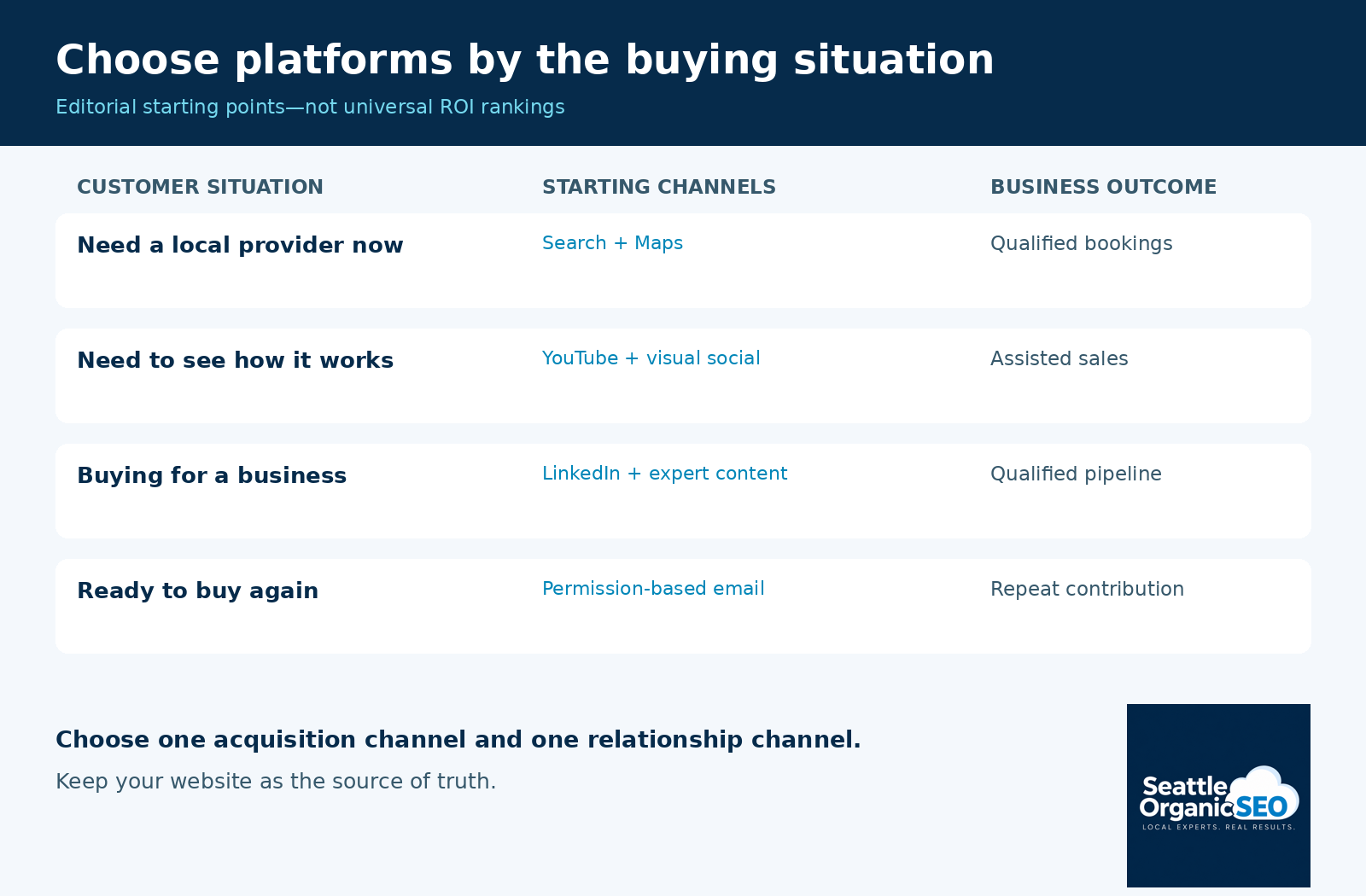
Start with the buying moment A homeowner with a broken appliance may need a provider today. Search and Maps deserve an early test. Someone considering a kitchen redesign may need demonstrations and examples before choosing a contractor; video and visual platforms can support that decision.
A business selling to operations leaders needs access to a narrow professional audience. LinkedIn’s advertising targeting options include company and job-experience attributes. That capability is a reason to test—not proof that its leads will be profitable.
For a Seattle café, a correct Maps listing, current menu and useful neighborhood communication may be a better first system than a national thought-leadership campaign. For a specialist consultancy, an expert article, professional distribution and a focused email follow-up may be more relevant. These are hypothetical starting points.
Reach is context, not a budget recommendation Similarweb’s August 2026 global website estimates put YouTube at roughly 30.4 billion monthly visits, Facebook at 11.5 billion, Instagram at 7.6 billion, TikTok at 3.8 billion and LinkedIn at 2.0 billion.
Those are estimated website sessions worldwide, including repeat visits—not unique people, Seattle audiences or total app activity. They do not measure ad inventory, buying intent or campaign return. A small professional audience can be more valuable to your business than a much larger irrelevant audience.
Score the platforms before committing Rate each candidate from 1 to 5 on audience fit, purchase intent, ability to demonstrate value, production capacity and measurability. Give audience fit and purchase intent double weight: total score = 2 × audience fit + 2 × intent + proof fit + capacity + measurement. The maximum is 35.
This is a planning aid, not an algorithm that predicts revenue. Score with evidence from customer interviews, referral sources and past results. If you cannot produce good videos reliably, a high theoretical video opportunity may still be a poor first commitment.
Choose one primary acquisition channel and one relationship channel. Keep your website as the source of truth. Avoid copying the same post everywhere; adapt the format to how people use each platform.
Match the asset to the platform On search, answer the buying question: service, location, price drivers and next step. On YouTube, show the work or explain the decision clearly. On Instagram or TikTok, demonstrate one useful thing quickly and provide a relevant next action.
On LinkedIn, explain a business problem and the tradeoffs in solving it. In email, continue a relationship with information appropriate to the recipient’s needs. In community spaces, contribute before promoting and follow moderator rules. Do not use fake customer accounts, manufactured recommendations or AI-generated praise.
An AI assistant mentioning your company is another form of discovery, but it is not a conventional social profile you can reliably post into. Treat AI visibility as a research and information-quality task, covered in our companion playbook.
A 30-day test that produces a decision Week 1: define the audience, offer, landing page and business outcome. Test forms and calls. Establish a budget cap and a weekly time allowance.
Weeks 2–3: distribute a small set of purposeful assets through your primary channel. Keep the core offer stable so you can interpret the result. Record campaign costs and qualified inquiries, including inquiries that arrive by phone or mention several influences.
Week 4: compare acquisition cost, customer quality and production effort. If the sales cycle is longer than a month, assess qualified opportunities and schedule a later revenue review. Do not call a campaign unsuccessful solely because a long-cycle sale has not closed yet.
Illustrative example: one channel costs $800 and produces eight qualified inquiries, while another costs $400 and produces twelve. The second looks cheaper per inquiry. But if the first produces four customers and the second produces one, acquisition cost is $200 versus $400. Contribution profit and fulfillment capacity decide which is better. Include production labor before drawing the final comparison.
Keep the measurement portable Use consistent source, medium and campaign tags for external links. Ask new customers how they heard about you and record multiple influences when appropriate. Reconcile analytics with actual sales; platform dashboards can attribute overlapping credit to the same purchase.
Retain access to your domain, analytics, advertising accounts and customer relationships. Document campaign ownership and export useful reports. The strongest platform strategy gives you options when an algorithm, fee structure or audience changes.
Your next decision List where your last ten good customers first encountered you, what convinced them and how long they took to buy. Use those answers to select a platform test. Being everywhere is a publishing workload; being useful at the right moment is a marketing strategy.
Sources, scope and corrections
Research checked October 28, 2026. Linked sources support factual statements; channel recommendations and planning examples are Seattle Organic SEO’s interpretation. Examples are illustrative, not client results or performance guarantees. Platform features and external estimates may change. Contact us to flag an error or discuss a measurable plan for your business.
Written by the Seattle Organic SEO Team
The Seattle Organic SEO team combines more than 30 years of hands-on client experience across SEO, paid media, email marketing and affiliate marketing. Our team has worked for leading technology companies, including Amazon, Expedia and Google-acquired DoubleClick. We bring that experience to source-based research, transparent analysis and practical guidance for Seattle businesses. Learn more about our team and approach.