
October 31, 2026 | A companion investigation to What Are the Most-Used AI Models Today & How to Use That in Your GEO or AEO Strategy?
When ChatGPT first helped introduce millions of consumers to conversational AI, it was natural to ask which chatbot had the largest audience. That is still an important question. But a second, more revealing competition is emerging: which underlying models are becoming the default tools for legal research, science, customer service, marketing, finance, travel, creative work, and the many other tasks people delegate to AI?
We examined 17 kinds of work people use AI for—coding, legal research, science, education, marketing, sales, finance, health, customer support, travel planning, gaming, creative work and more. The rankings reveal where developers send requests, but they do not prove one model delivers the best answers. Here’s what the results suggest for choosing an AI assistant and helping businesses appear in AI recommendations.
Where the leading AI models have the strongest share
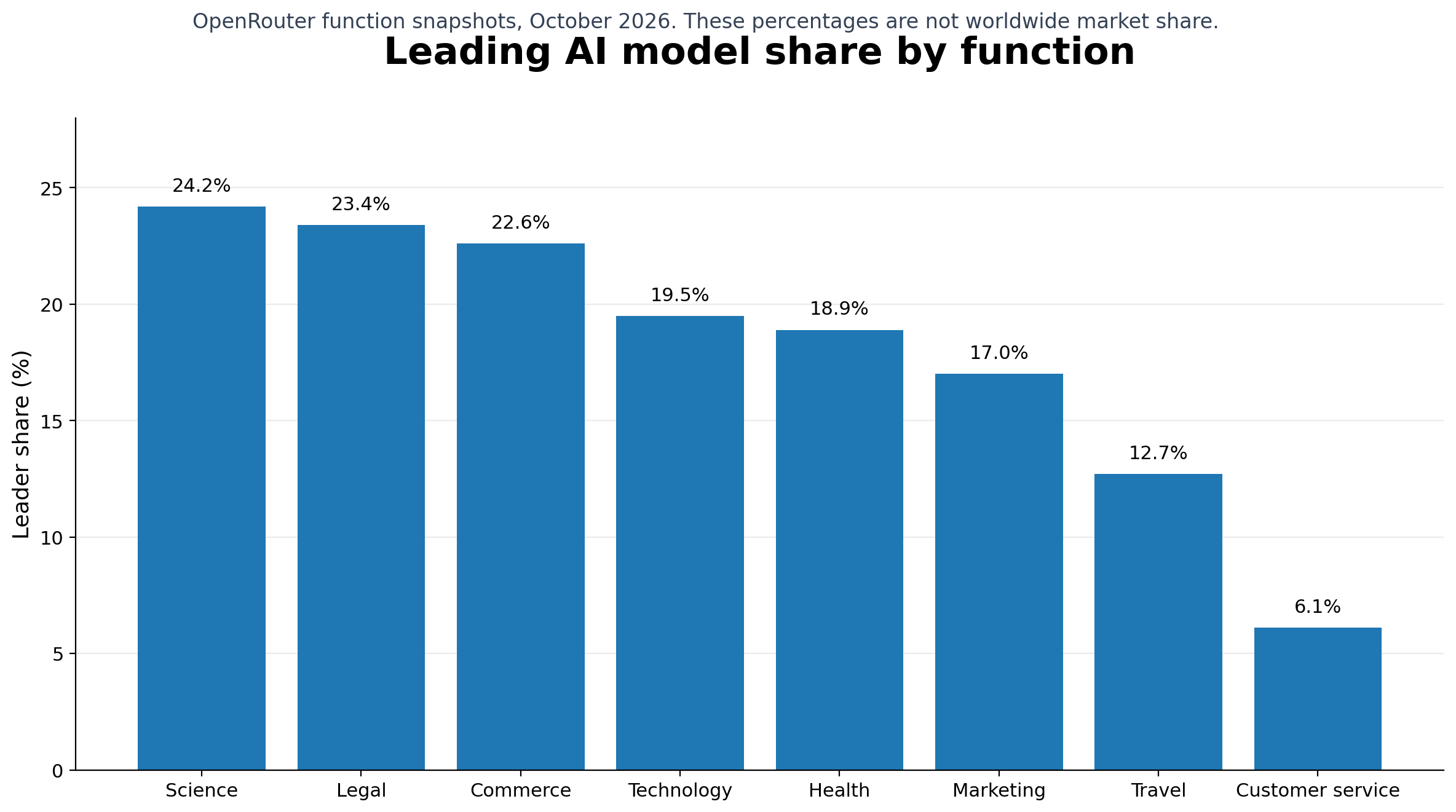
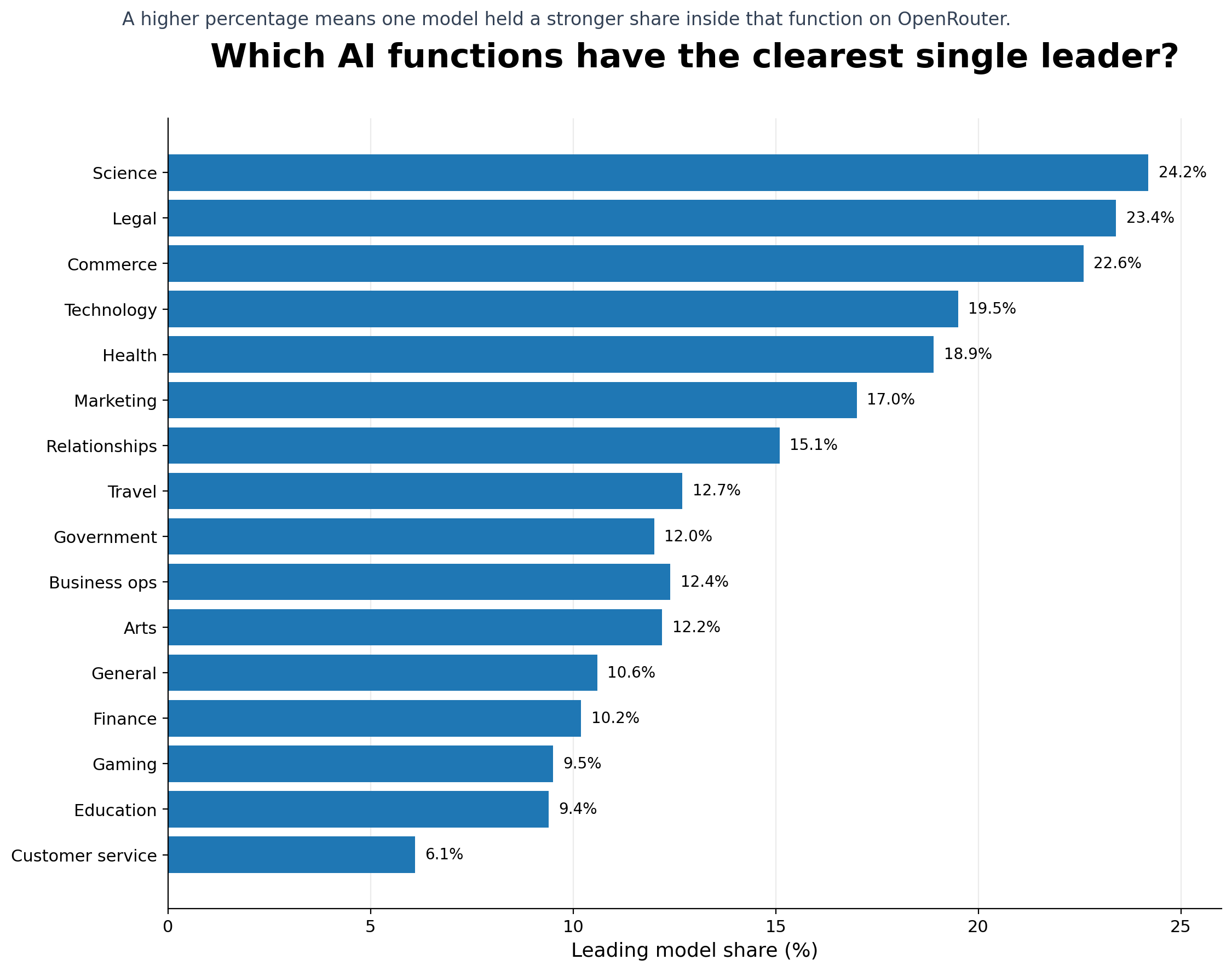
These quick charts show the differences at a glance. A bigger bar means the most-used model has a larger share of OpenRouter requests in that use case—not that it is better at the task.
Which AI models are used for which jobs? 17 popular AI functions
Each percentage below describes OpenRouter’s use-case rankings—not the percentage of all worldwide AI users, or the percentage of time spent on that topic.
| AI function | Leading model | Leader share | Others share |
|---|---|---|---|
| Software & technology | Claude Opus 5.5 | 19.5% | 37.7% |
| General | Claude Opus 5.5 | 10.6% | 54.6% |
| Arts & entertainment | Claude Sonnet 4.5 | 12.2% | 52.9% |
| Business operations | Claude Opus 5.5 | 12.4% | 54.3% |
| Science & engineering | Claude Sonnet 5.5 | 24.2% | 25.2% |
| Gaming | Claude Opus 5.5 | 9.5% | 53.7% |
| Finance | Claude Opus 5.5 | 10.2% | 54.5% |
| Health & wellness | Claude Sonnet 4.6 | 18.9% | 48.2% |
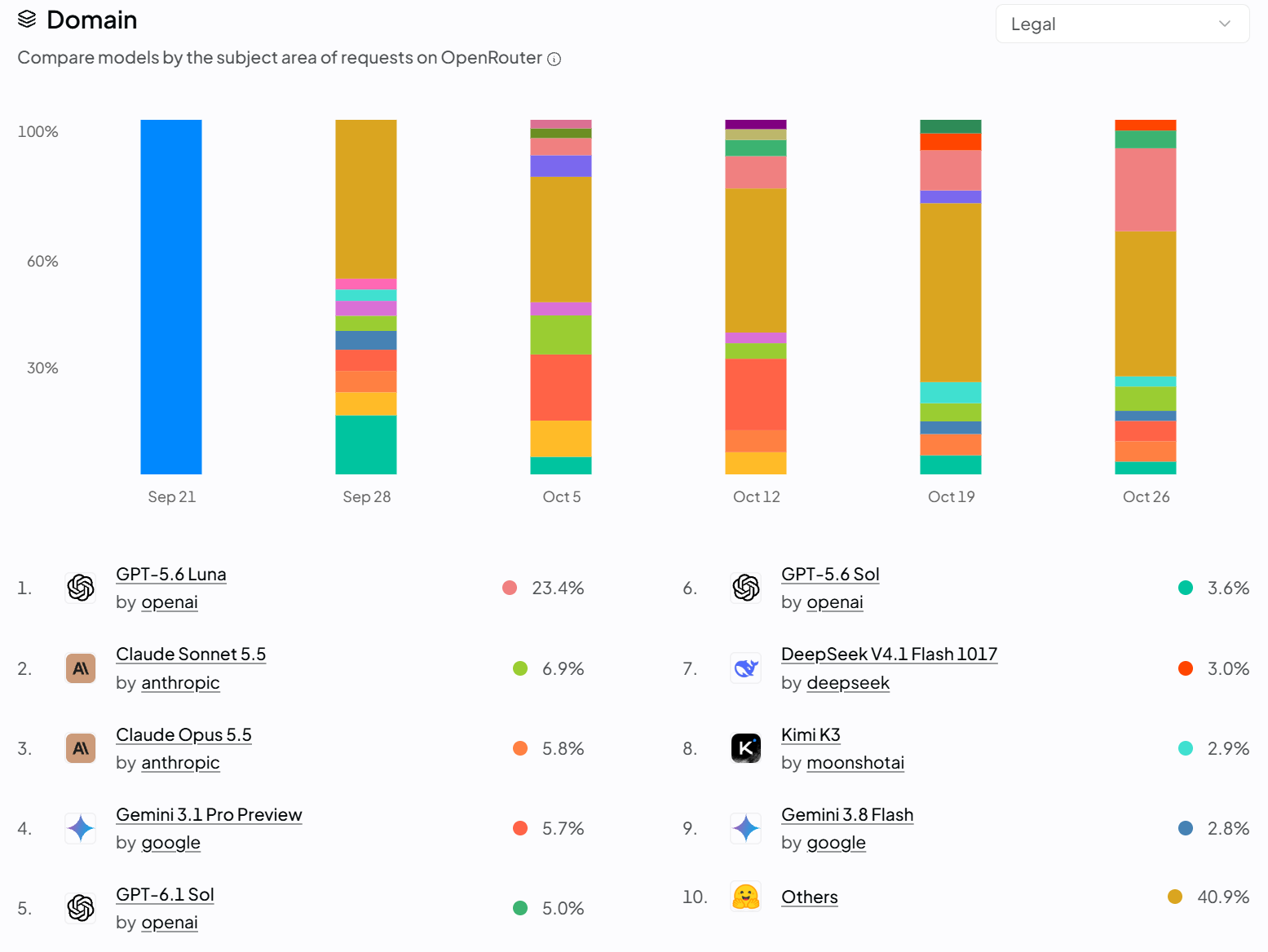
| Legal | GPT-5.6 Luna | 23.4% | 40.9% |
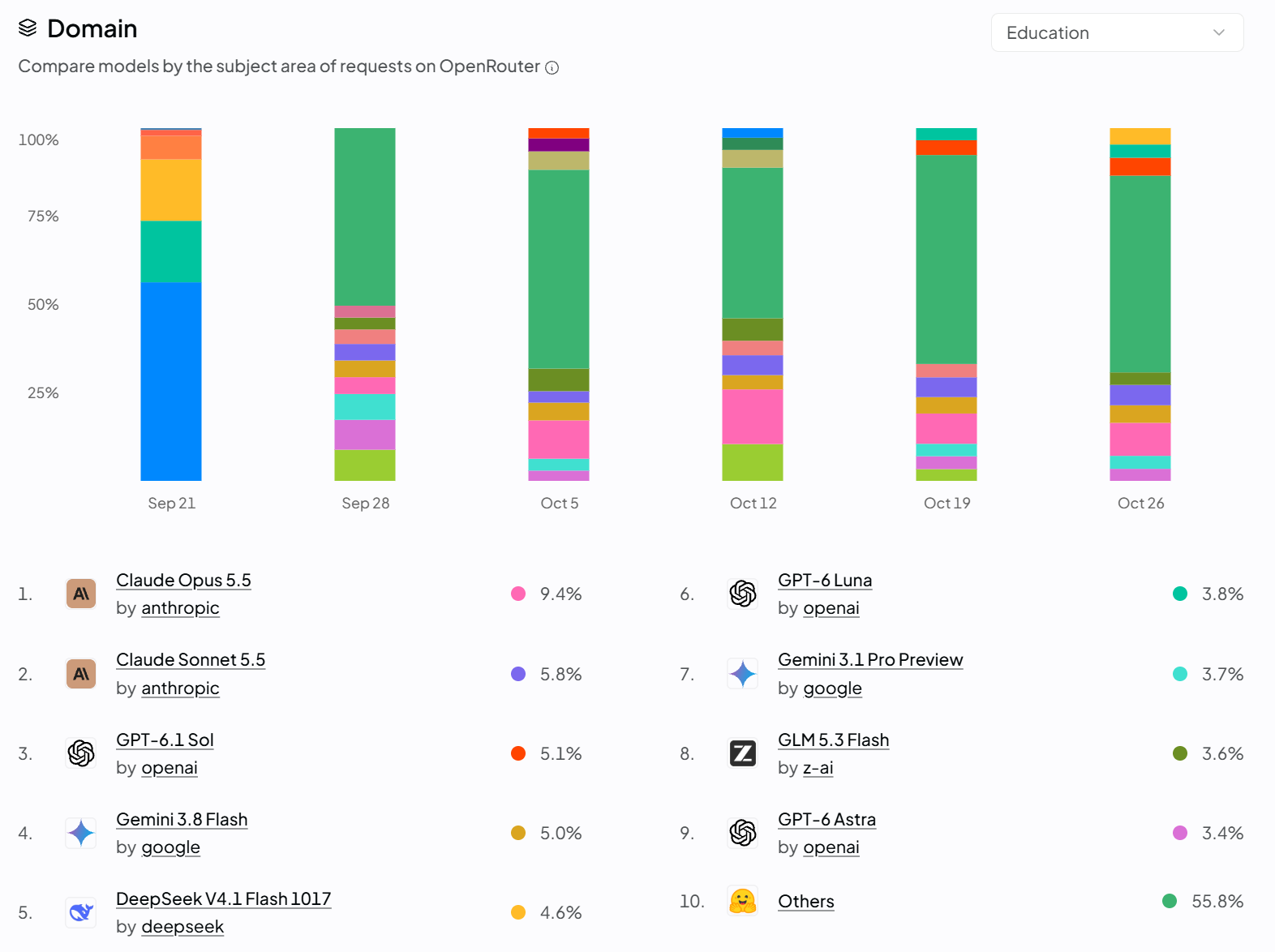
| Education | Claude Opus 5.5 | 9.4% | 55.8% |
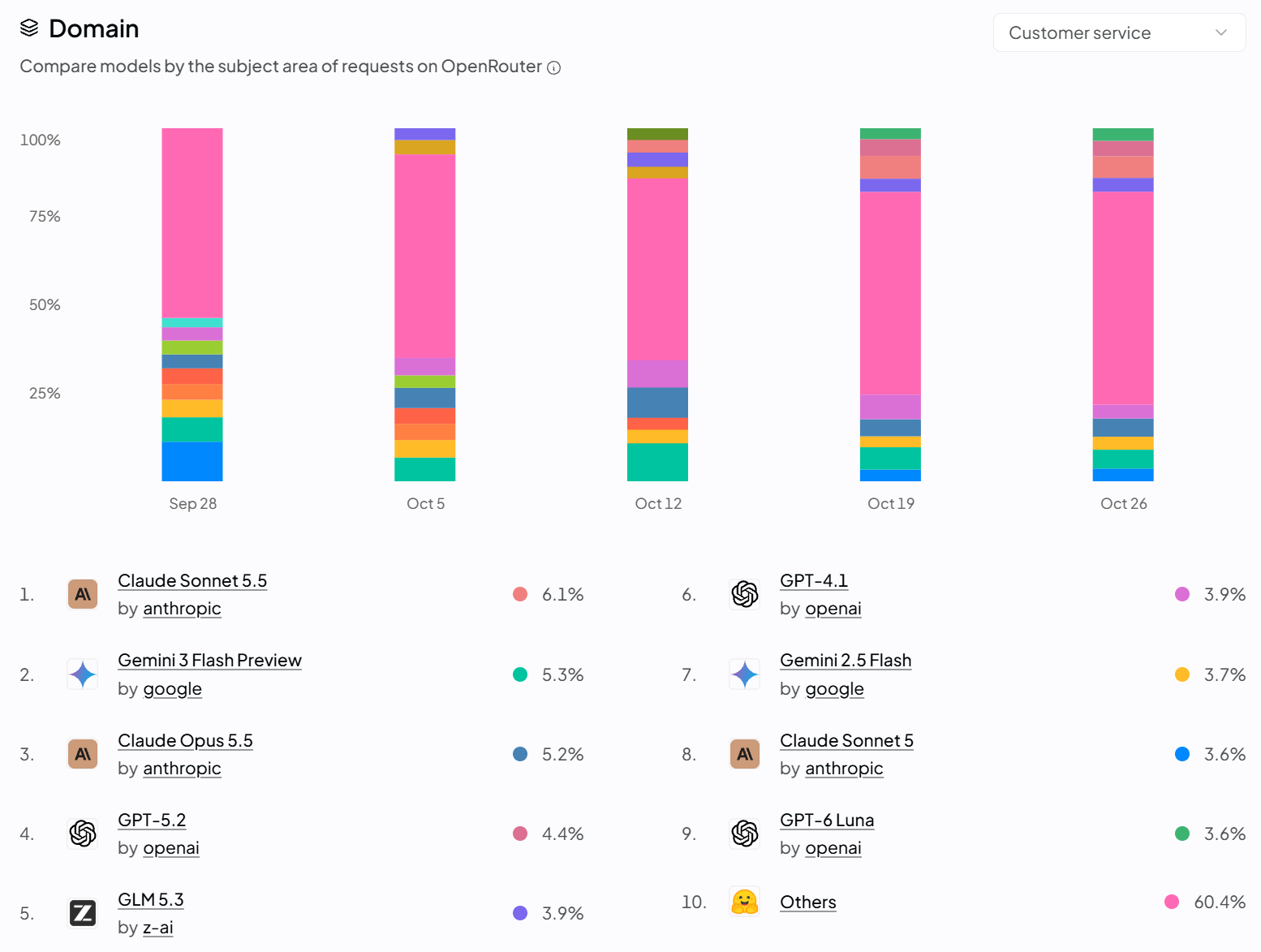
| Customer service | Claude Sonnet 5.5 | 6.1% | 60.4% |
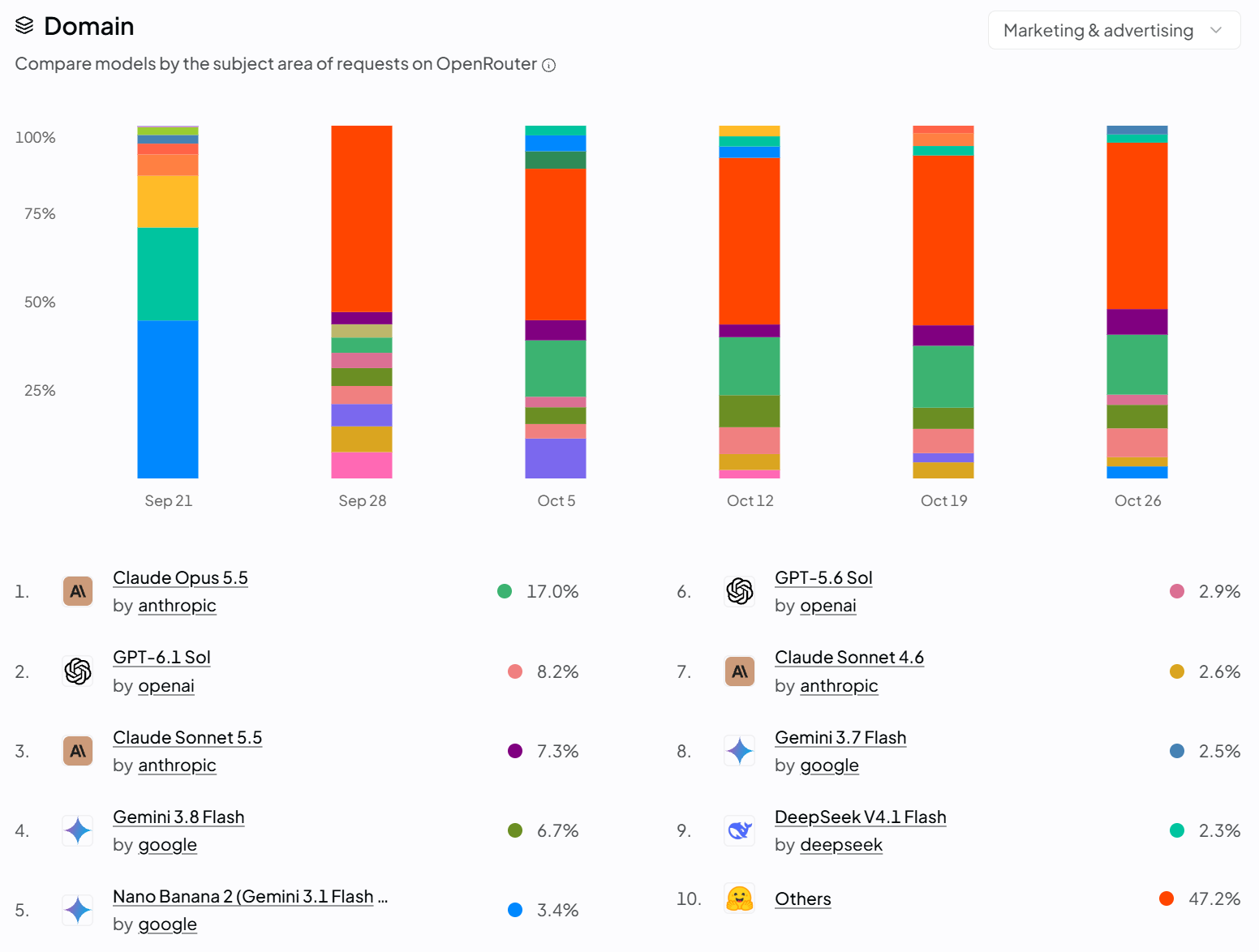
| Marketing & advertising | Claude Opus 5.5 | 17.0% | 47.2% |
| Sales & commerce | Claude Opus 5.5 | 22.6% | 44.4% |
| Government & politics | Claude Opus 5.5 | 12.0% | 51.1% |
| Relationships | Claude Sonnet 4.5 | 15.1% | 40.0% |
| Travel & hospitality | Muse Wonder | 12.7% | 52.8% |
| Lifestyle | Claude Opus 5.5 | 12.9% | 56.2% |
Look beyond the #1 model. In science and engineering, the top model has a 24.2% share and Others is just 25.2%. In customer service, the leader reaches only 6.1%, while Others accounts for 60.4%. That contrast is much more informative than a single universal AI top-10 list.
Why the best AI model for coding may not be the best for law or customer support
General-purpose AI systems can reuse capabilities across coding, reasoning, documents, multimodal content, information extraction and workflow orchestration. More capable models may become attractive for high-stakes or complex work; cheaper and faster models may become the default for simpler automated tasks. Vendor integrations, context length, reliability, latency, data policies, price and developer familiarity all influence what a company deploys.
OpenRouter’s own usage research and multi-model adoption observations suggest developers often use a portfolio rather than one permanent winner. This helps explain how a provider can be influential across professional AI specialties while other models quietly process enormous volumes of inexpensive API traffic. The pattern is consistent with specialization but does not demonstrate why any individual developer chose a model.
Why are so many different AI models used for customer service, finance and education?
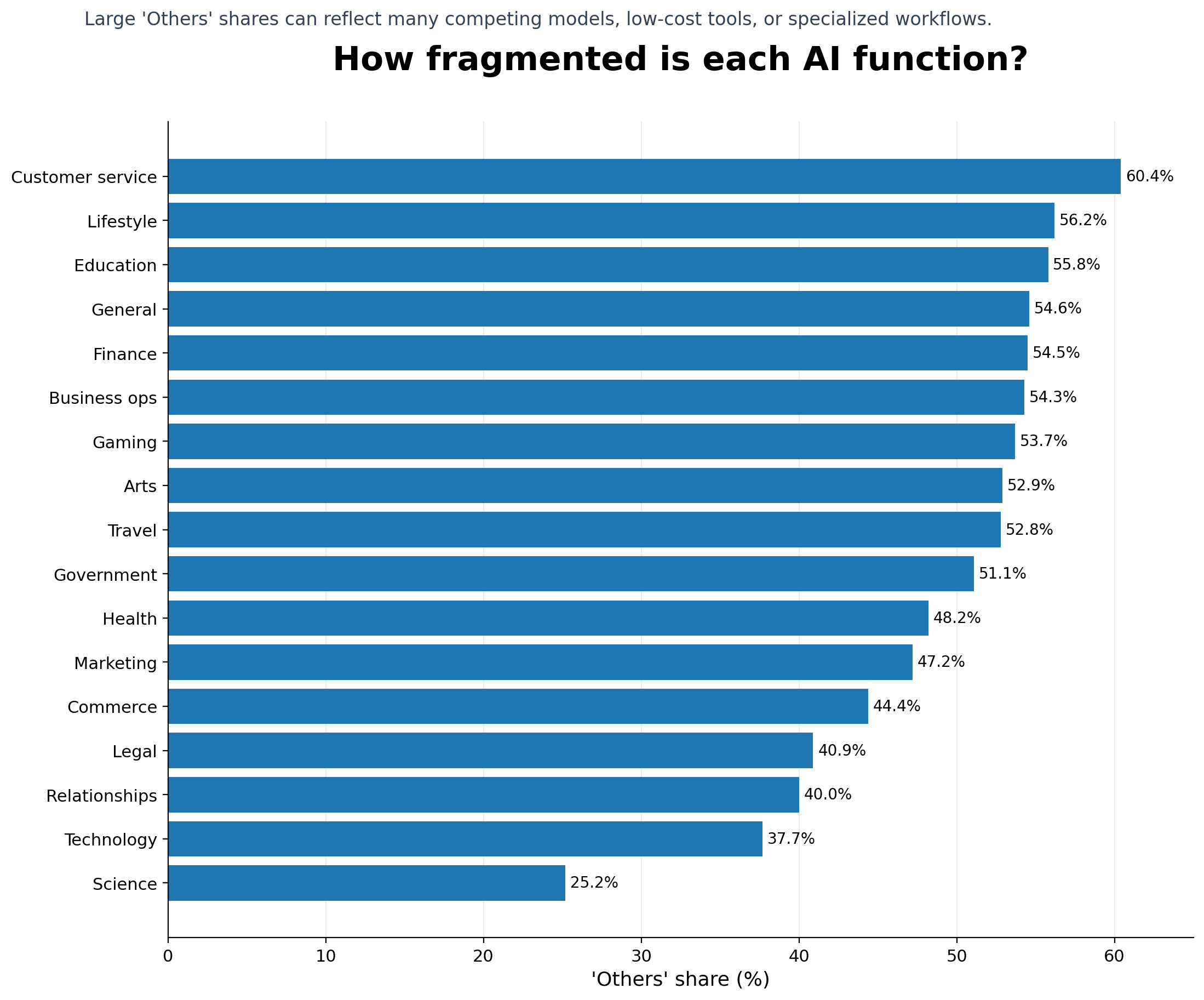
The Others figure groups models outside the individually displayed leaders. It is a reporting bucket, not a product or a measure of inferior quality. A large bucket can mean (1) genuine long-tail specialization, (2) many interchangeable general-purpose models, (3) budget-sensitive high-volume automation, (4) app-specific routing, (5) recently launched models, or (6) changing model identifiers. A model absent from the top nine may still dominate an extremely narrow use case.
Customer service (60.4%), lifestyle (56.2%), education (55.8%), general (54.6%), finance (54.5%) and business operations (54.3%) show especially large Others shares. This does not prove their specialist models are better; we’d need top-50 per-AI function data, task-level quality measures, cost, latency and repeat deployments to establish that. Conversely, science and engineering’s smaller Others bucket (25.2%) may reflect concentrated traffic on a handful of endpoints on OpenRouter, not a universal scientific consensus.
Which AI models do people use for coding, law, marketing, healthcare and other jobs?
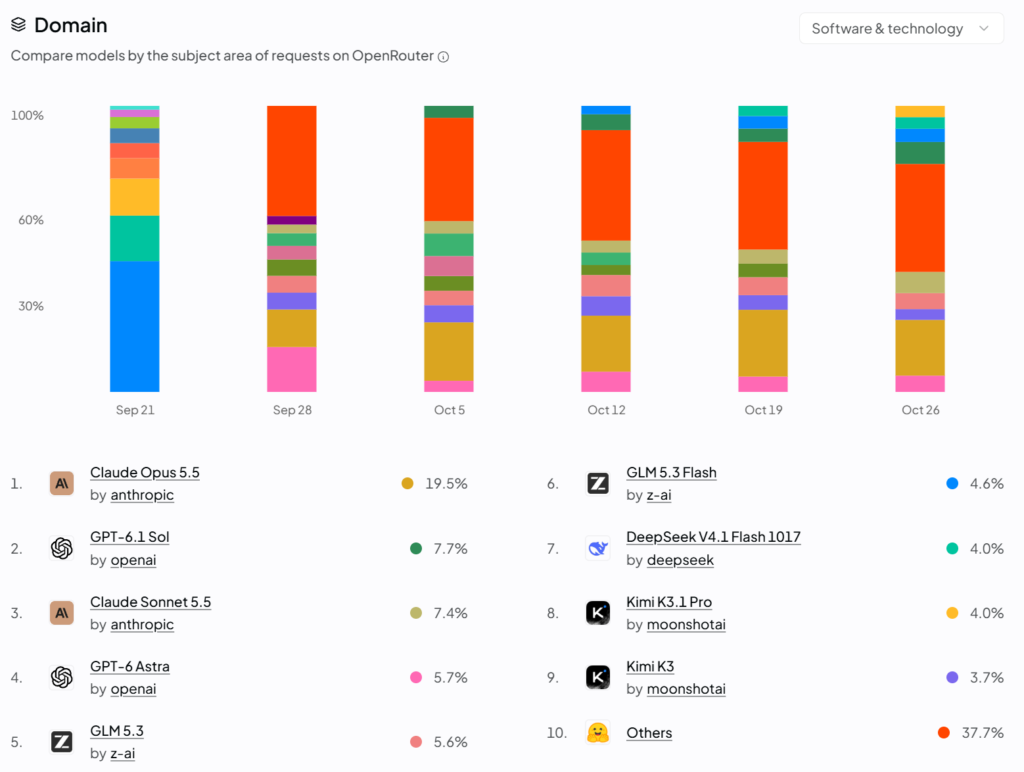
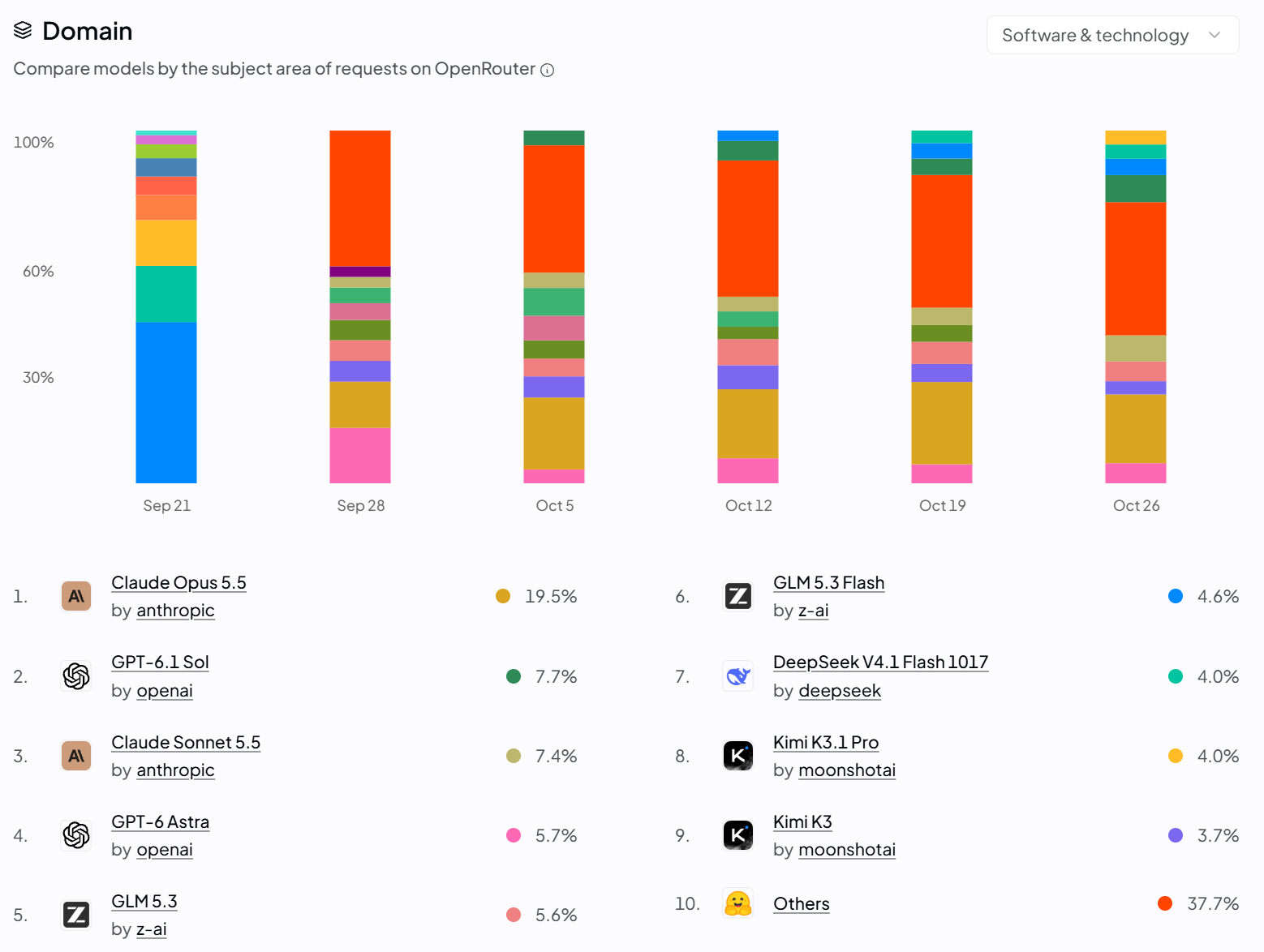
AI for software & technology: Claude Opus 5.5 is most used in this sample (19.5%)
Leading entries: Claude Opus 5.5 19.5%; GPT-6.1 Sol 7.7%; Claude Sonnet 5.5 7.4%. Others: 37.7%.
Coding and engineering demand differs from general chat. Anthropic leads in the supplied sample, but OpenAI, Z.ai, DeepSeek and Moonshot also compete for specialized software workflows.
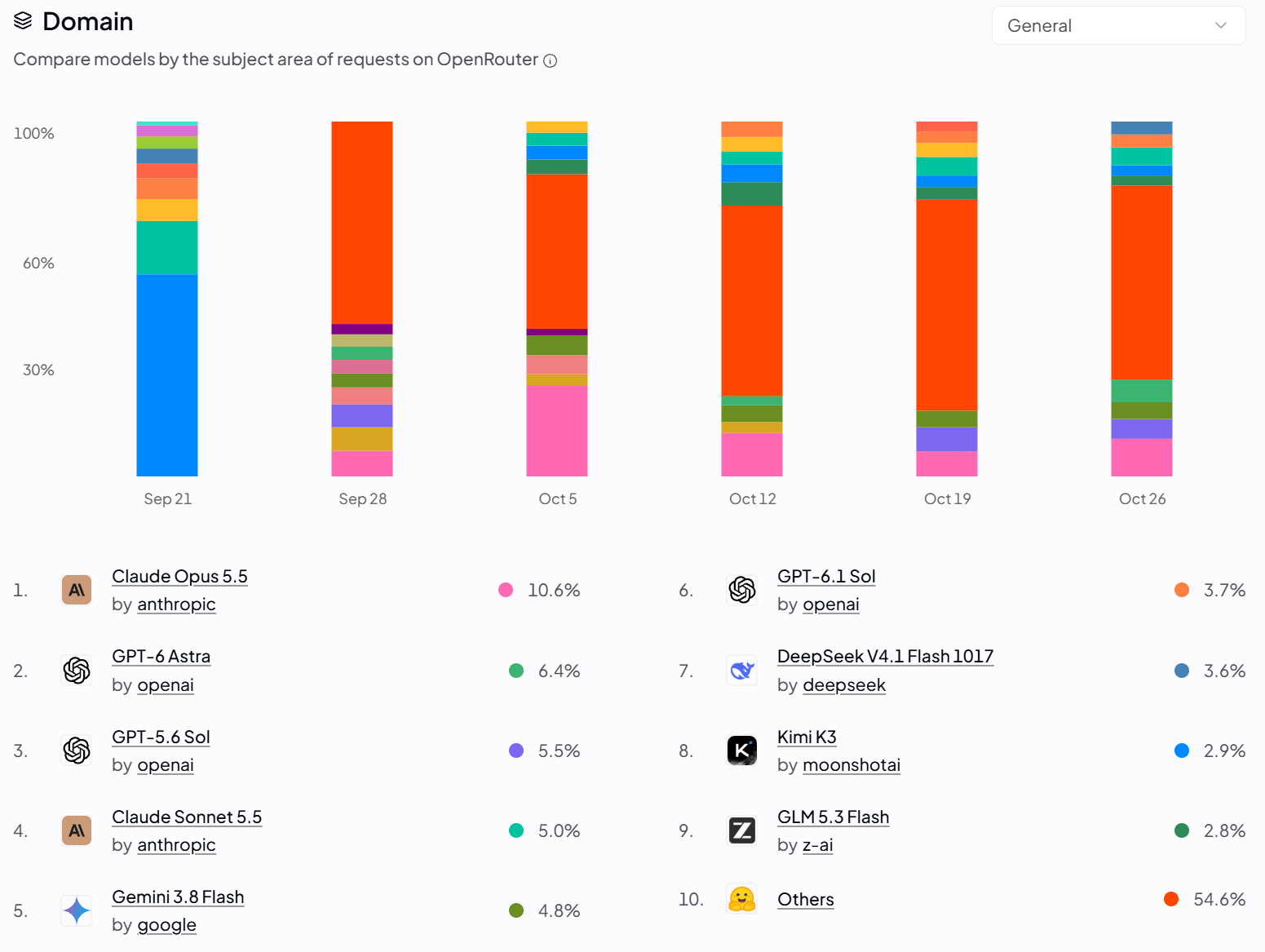
AI for general: Claude Opus 5.5 is most used in this sample (10.6%)
Leading entries: Claude Opus 5.5 10.6%; GPT-6 Astra 6.4%; GPT-5.6 Sol 5.5%. Others: 54.6%.
The largest catchall segment is fragmented; that is consistent with broad purposes, price tiers and diverse apps rather than a single winning model.
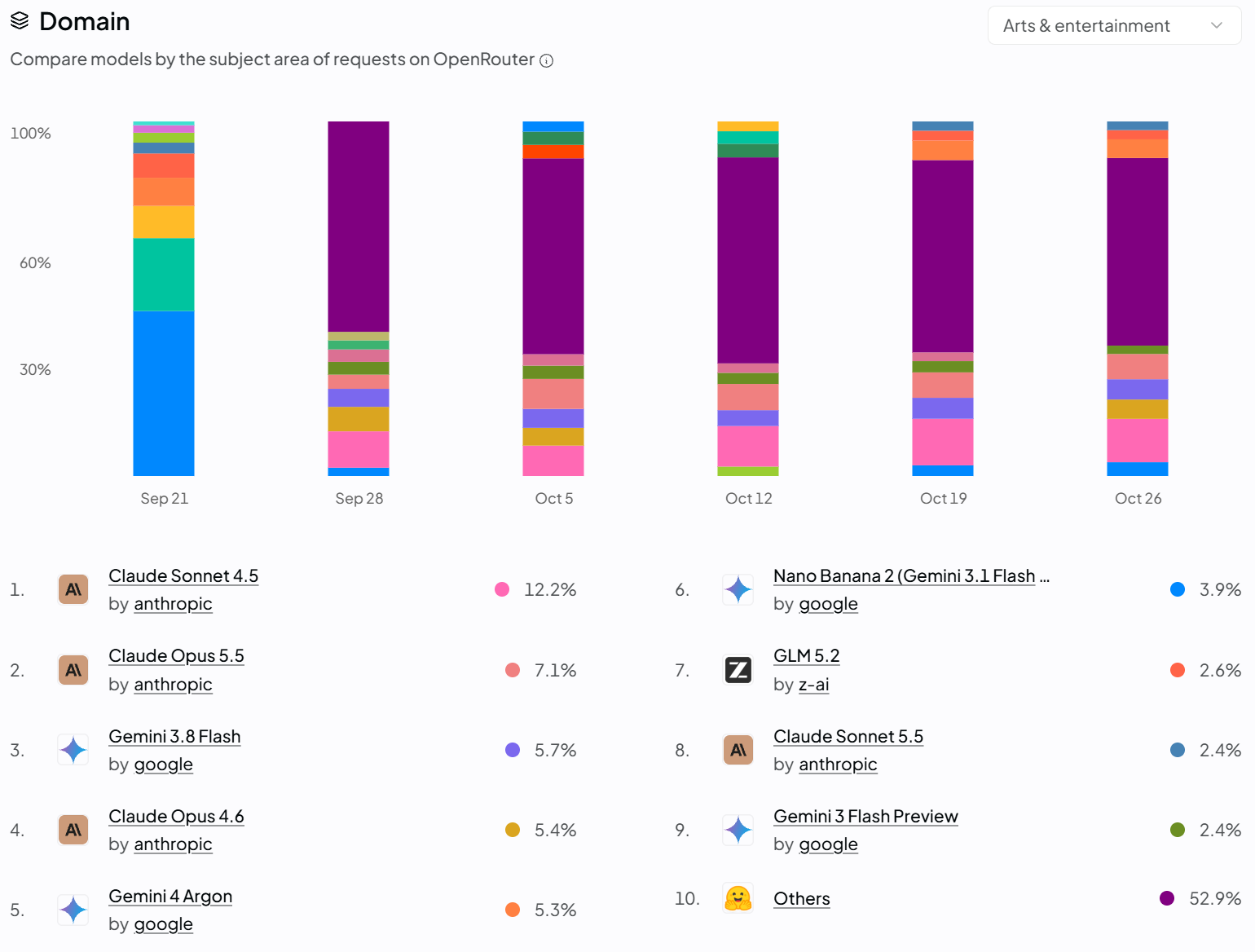
AI for arts & entertainment: Claude Sonnet 4.5 is most used in this sample (12.2%)
Leading entries: Claude Sonnet 4.5 12.2%; Claude Opus 5.5 7.1%; Gemini 3.8 Flash 5.7%. Others: 52.9%.
Creative work includes different text, image, editing and entertainment tasks. A text-oriented routing view cannot measure the entire multimodal creative market.
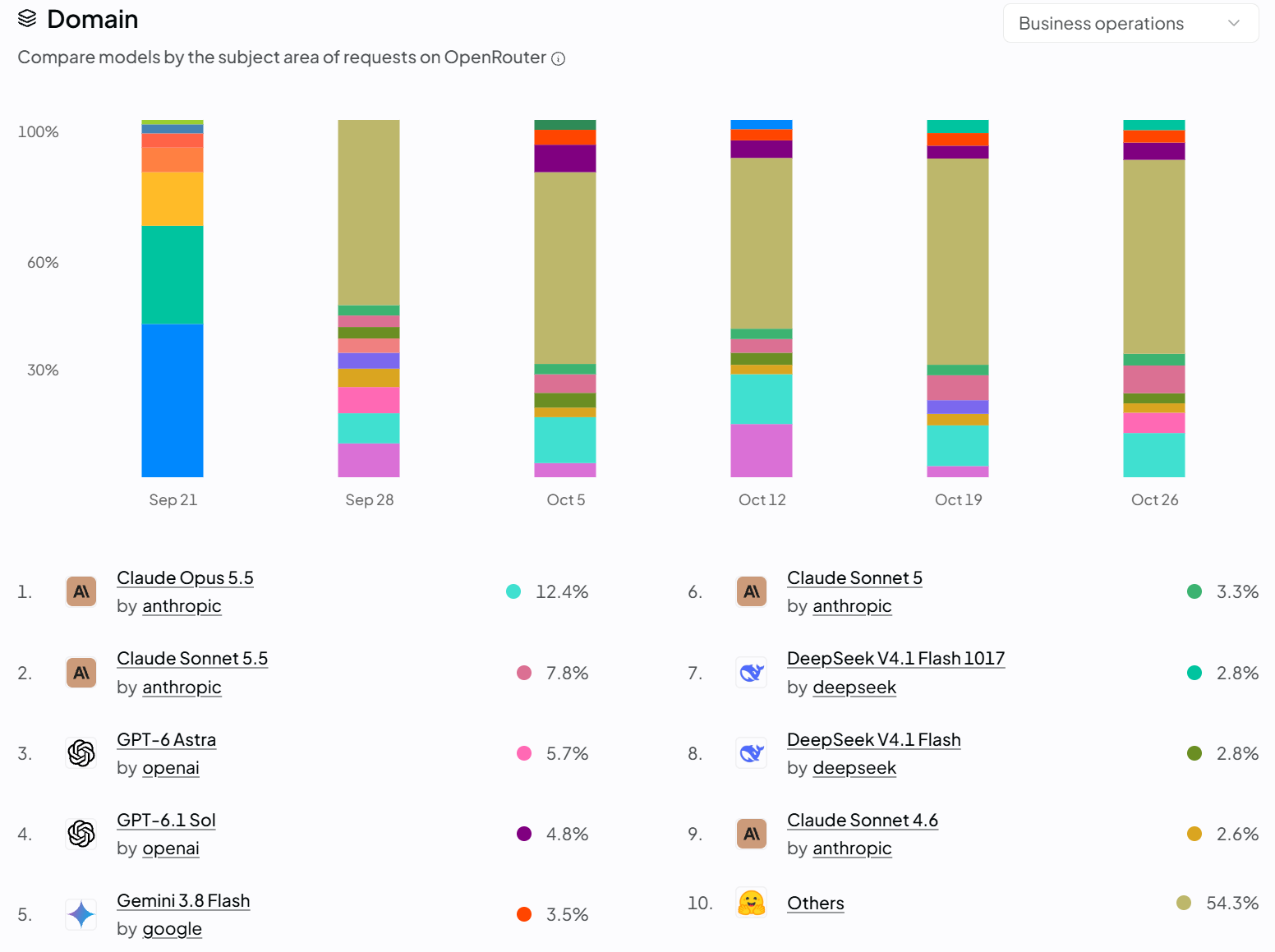
AI for business operations: Claude Opus 5.5 is most used in this sample (12.4%)
Leading entries: Claude Opus 5.5 12.4%; Claude Sonnet 5.5 7.8%; GPT-6 Astra 5.7%. Others: 54.3%.
Enterprises route different workloads for planning, operations, research, documents and automation. These shares do not measure installed enterprise seats.
AI for science & engineering: Claude Sonnet 5.5 is most used in this sample (24.2%)
Leading entries: Claude Sonnet 5.5 24.2%; Claude Opus 5.5 12.8%; Kimi K3 10.1%. Others: 25.2%.
A particularly concentrated AI function in this sample, although research quality must be validated separately using subject-specific benchmarks and human review.
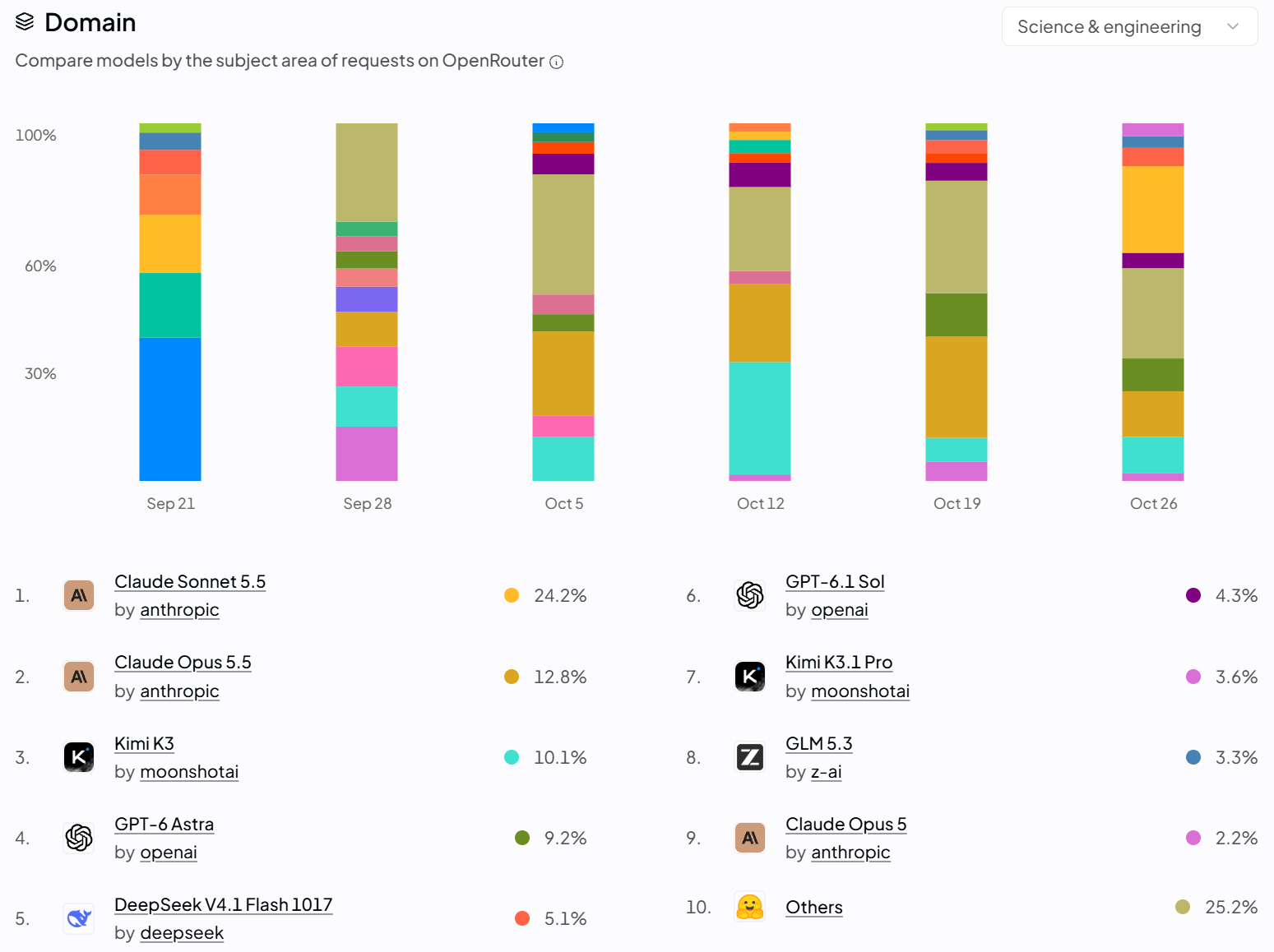
AI for gaming: Claude Opus 5.5 is most used in this sample (9.5%)
Leading entries: Claude Opus 5.5 9.5%; Gemini 3.8 Flash 9.3%; Gemini 4 Argon 6.5%. Others: 53.7%.
Game development, game help, virtual characters and player creativity are different segments; there is no single model-for-gaming conclusion.
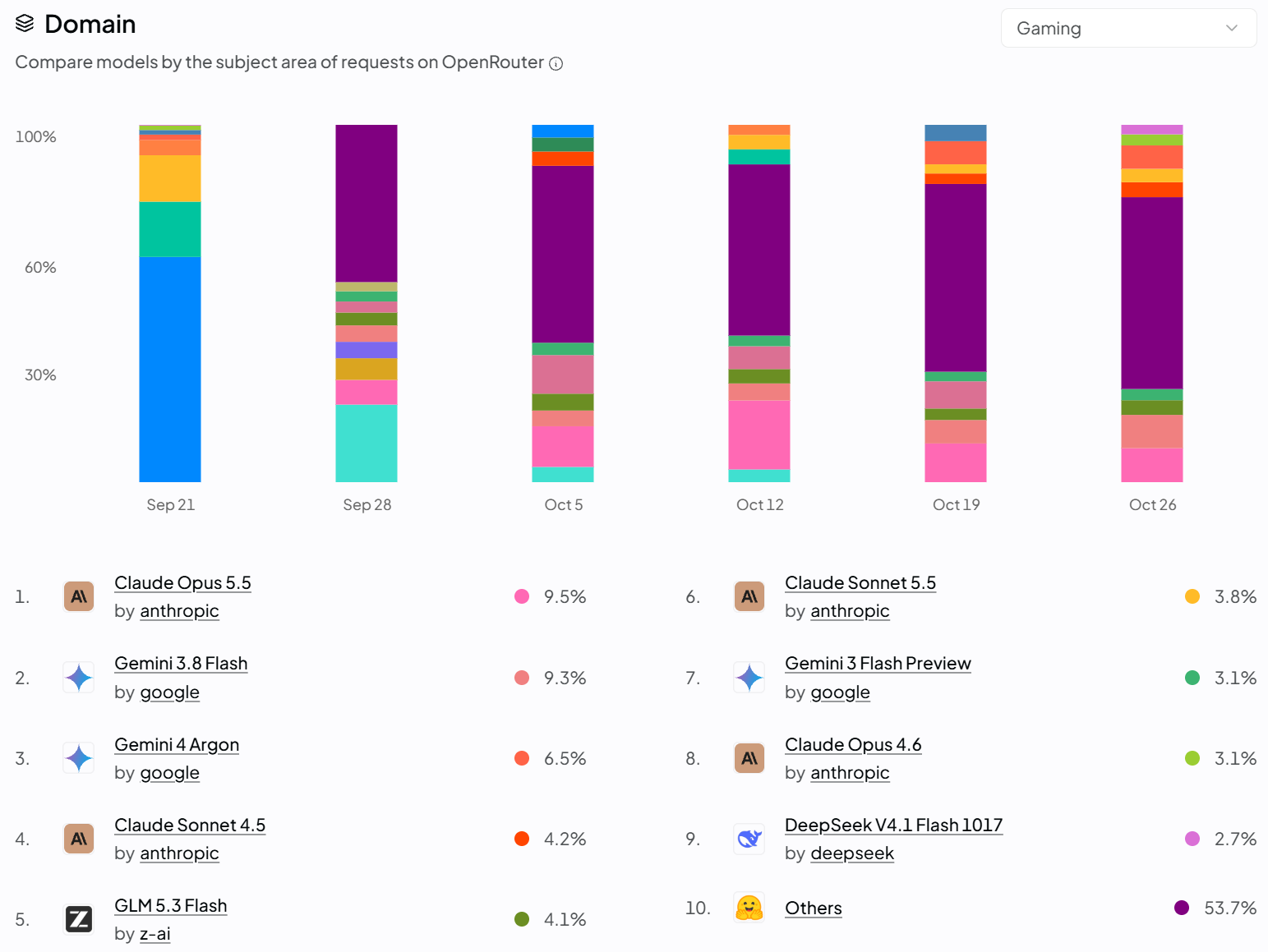
AI for finance: Claude Opus 5.5 is most used in this sample (10.2%)
Leading entries: Claude Opus 5.5 10.2%; GPT-6 Astra 6.7%; Claude Sonnet 5.5 5.9%. Others: 54.5%.
Financial questions cover arithmetic, explanation, compliance and markets. Popularity does not demonstrate financial accuracy or regulatory suitability.
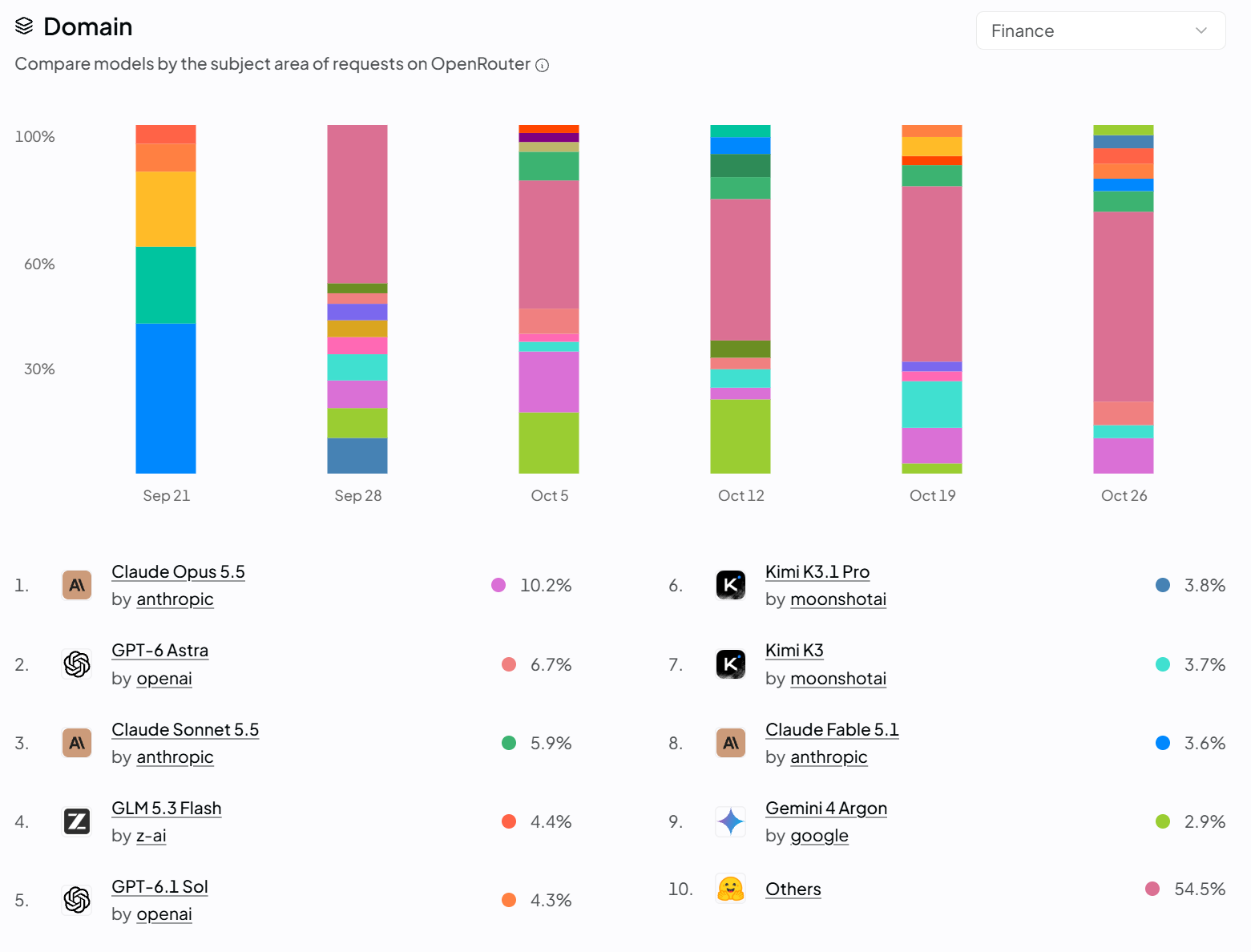
AI for health & wellness: Claude Sonnet 4.6 is most used in this sample (18.9%)
Leading entries: Claude Sonnet 4.6 18.9%; GPT-5.6 Sol 5.9%; Claude Opus 5.5 5.5%. Others: 48.2%.
The visible leader is not enough evidence to claim superior medical safety. Clinical benchmarks, human oversight and provider policies matter.
AI for legal: GPT-5.6 Luna is most used in this sample (23.4%)
Leading entries: GPT-5.6 Luna 23.4%; Claude Sonnet 5.5 6.9%; Claude Opus 5.5 5.8%. Others: 40.9%.
A striking departure from several Claude-leading AI specialties. This is observed OpenRouter routing, not proof that a particular model is the best lawyer or legal research assistant.
AI for education: Claude Opus 5.5 is most used in this sample (9.4%)
Leading entries: Claude Opus 5.5 9.4%; Claude Sonnet 5.5 5.8%; GPT-6.1 Sol 5.1%. Others: 55.8%.
Tutoring, lesson generation and school administration may require different tools. Time on task and learning outcomes are not measured here.
AI for customer service: Claude Sonnet 5.5 is most used in this sample (6.1%)
Leading entries: Claude Sonnet 5.5 6.1%; Gemini 3 Flash Preview 5.3%; Claude Opus 5.5 5.2%. Others: 60.4%.
This is the largest Others share among the 17 supplied AI specialties. It could reflect cost-optimized support bots, long-tail endpoints and function-specific workflows, not necessarily better specialist models.
AI for marketing & advertising: Claude Opus 5.5 is most used in this sample (17.0%)
Leading entries: Claude Opus 5.5 17.0%; GPT-6.1 Sol 8.2%; Claude Sonnet 5.5 7.3%. Others: 47.2%.
For SEO/GEO agencies, creative generation, analytics, client research and planning may produce different model preferences. The category tells us where developers route requests, not which model influences customer purchases.
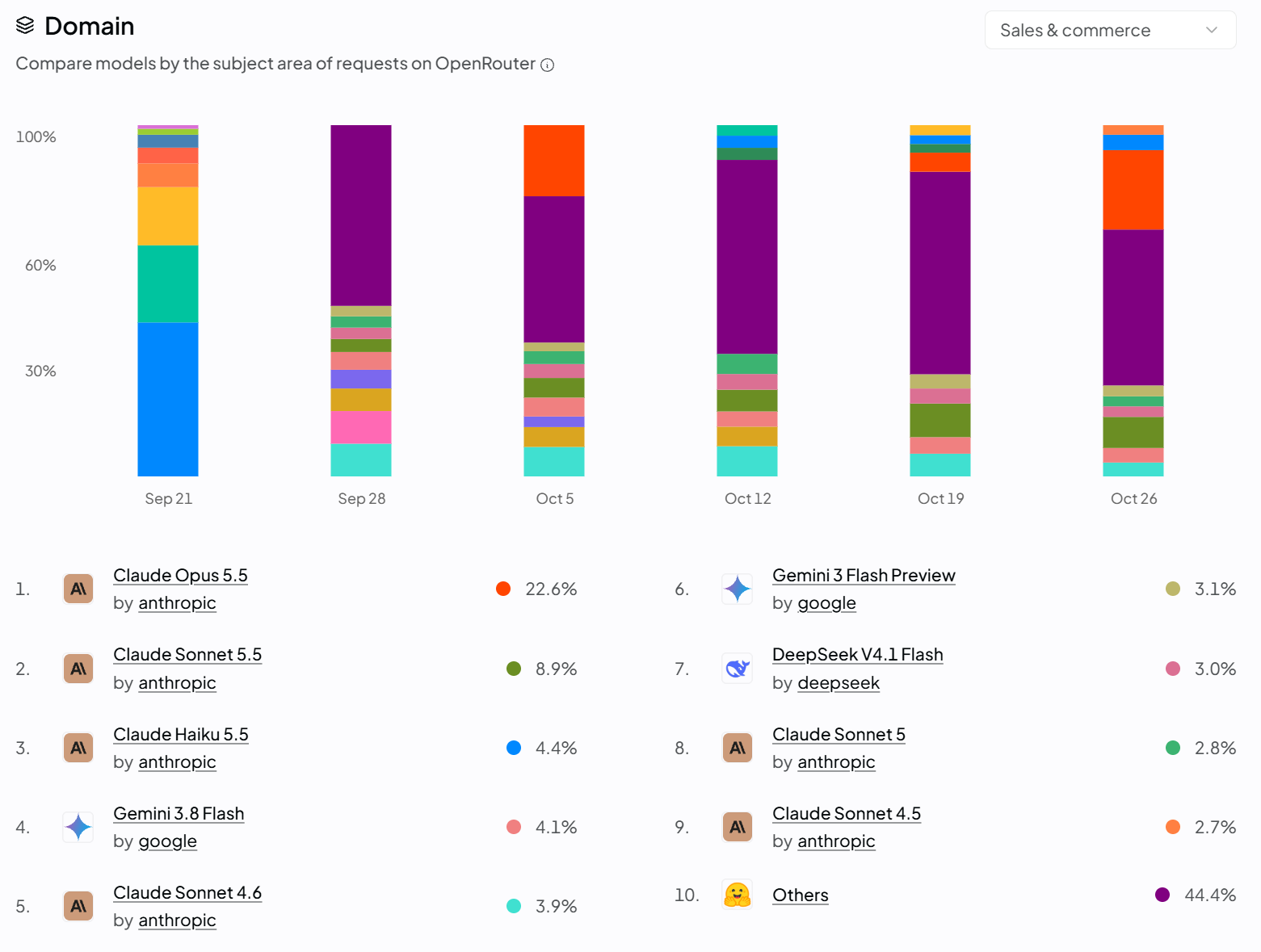
AI for sales & commerce: Claude Opus 5.5 is most used in this sample (22.6%)
Leading entries: Claude Opus 5.5 22.6%; Claude Sonnet 5.5 8.9%; Claude Haiku 5.5 4.4%. Others: 44.4%.
Strong Claude leadership in this snapshot, but shopping assistants, retail catalog enrichment and sales automation are different surfaces.
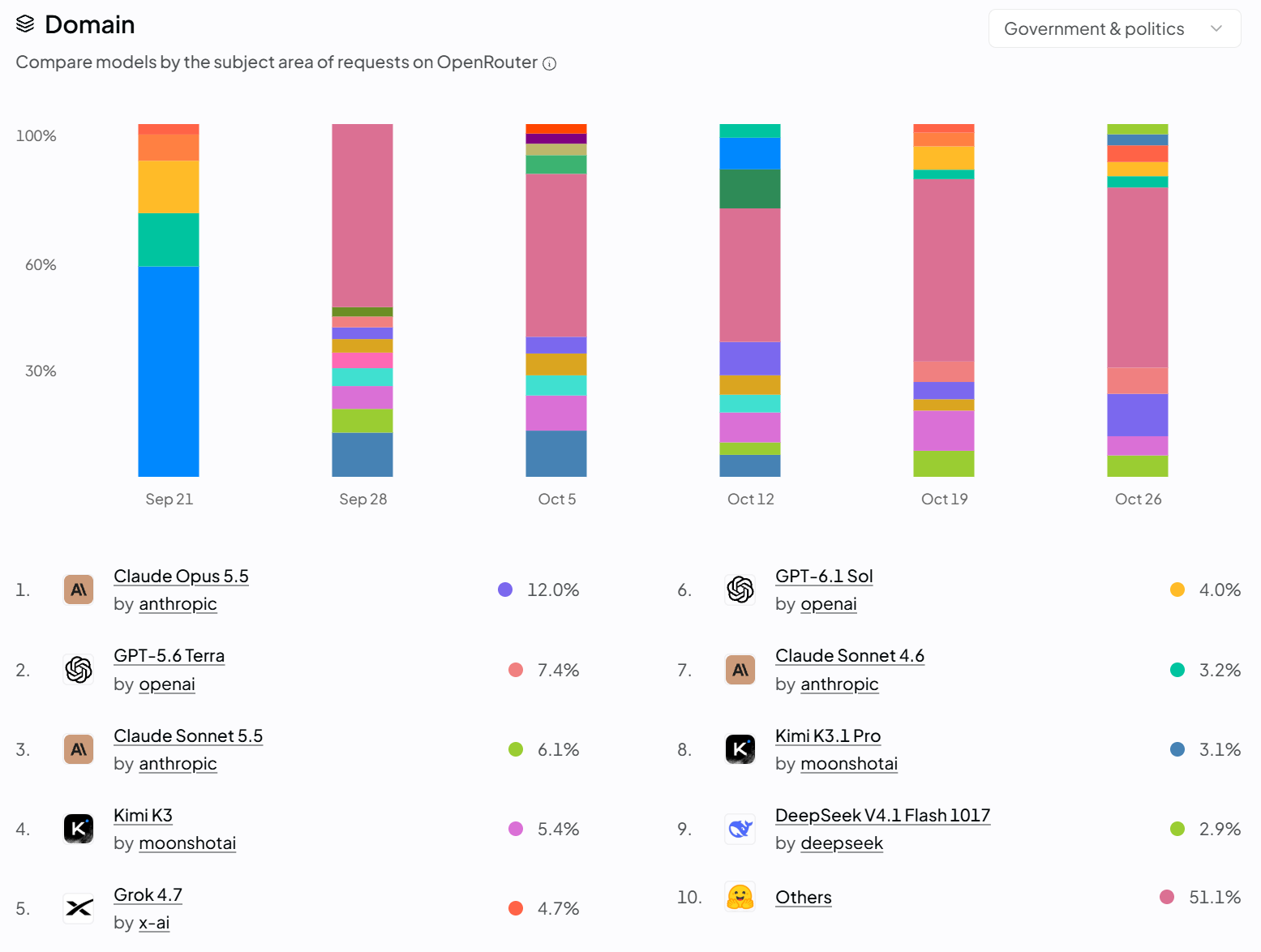
AI for government & politics: Claude Opus 5.5 is most used in this sample (12.0%)
Leading entries: Claude Opus 5.5 12.0%; GPT-5.6 Terra 7.4%; Claude Sonnet 5.5 6.1%. Others: 51.1%.
This describes requests about the topic, not adoption by government agencies or political views of model users.
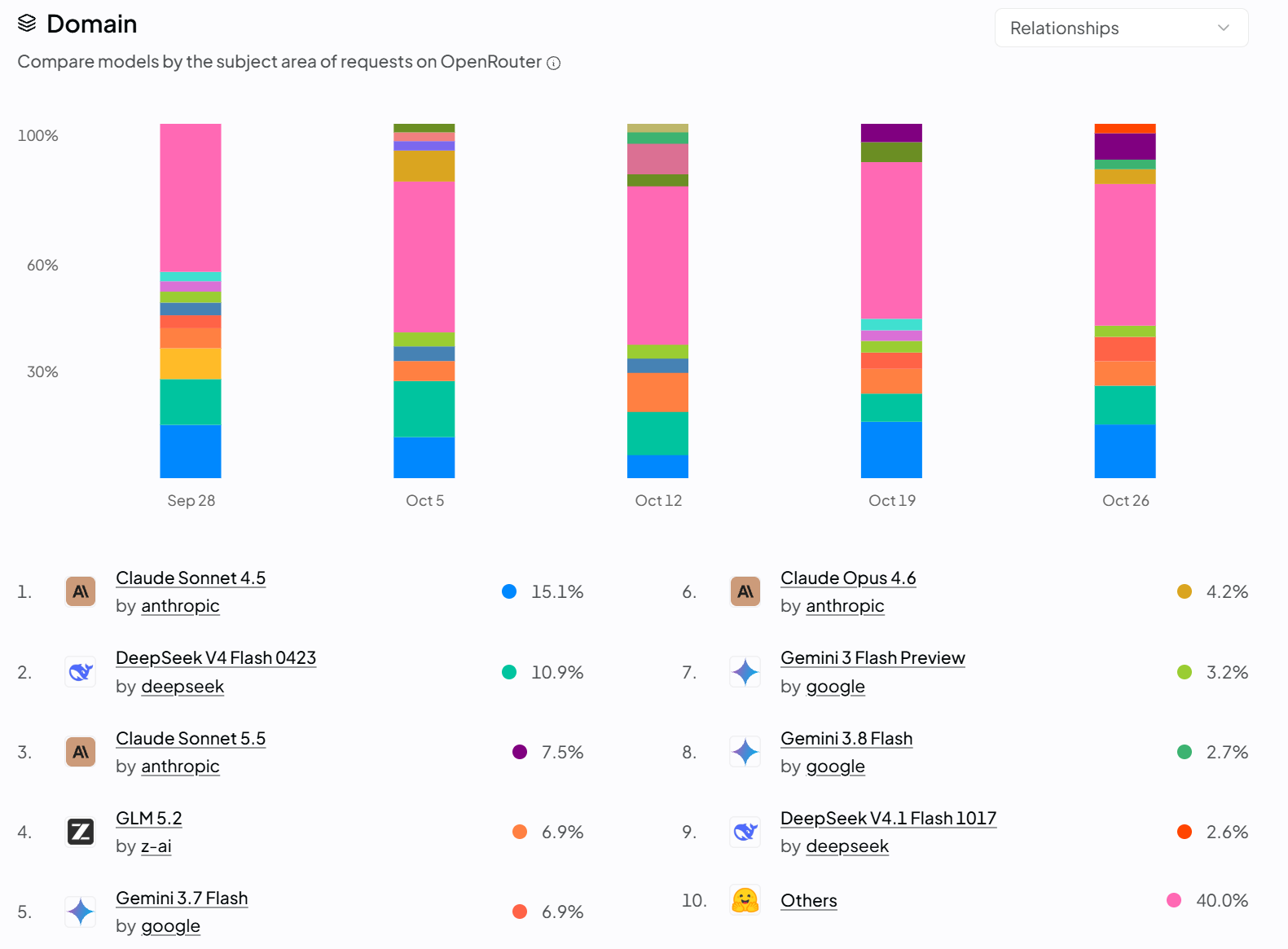
AI for relationships: Claude Sonnet 4.5 is most used in this sample (15.1%)
Leading entries: Claude Sonnet 4.5 15.1%; DeepSeek V4 Flash 0423 10.9%; Claude Sonnet 5.5 7.5%. Others: 40.0%.
A lower Others share does not automatically mean a mature market. Roleplay and advice may be served by a few high-volume apps using particular endpoints.
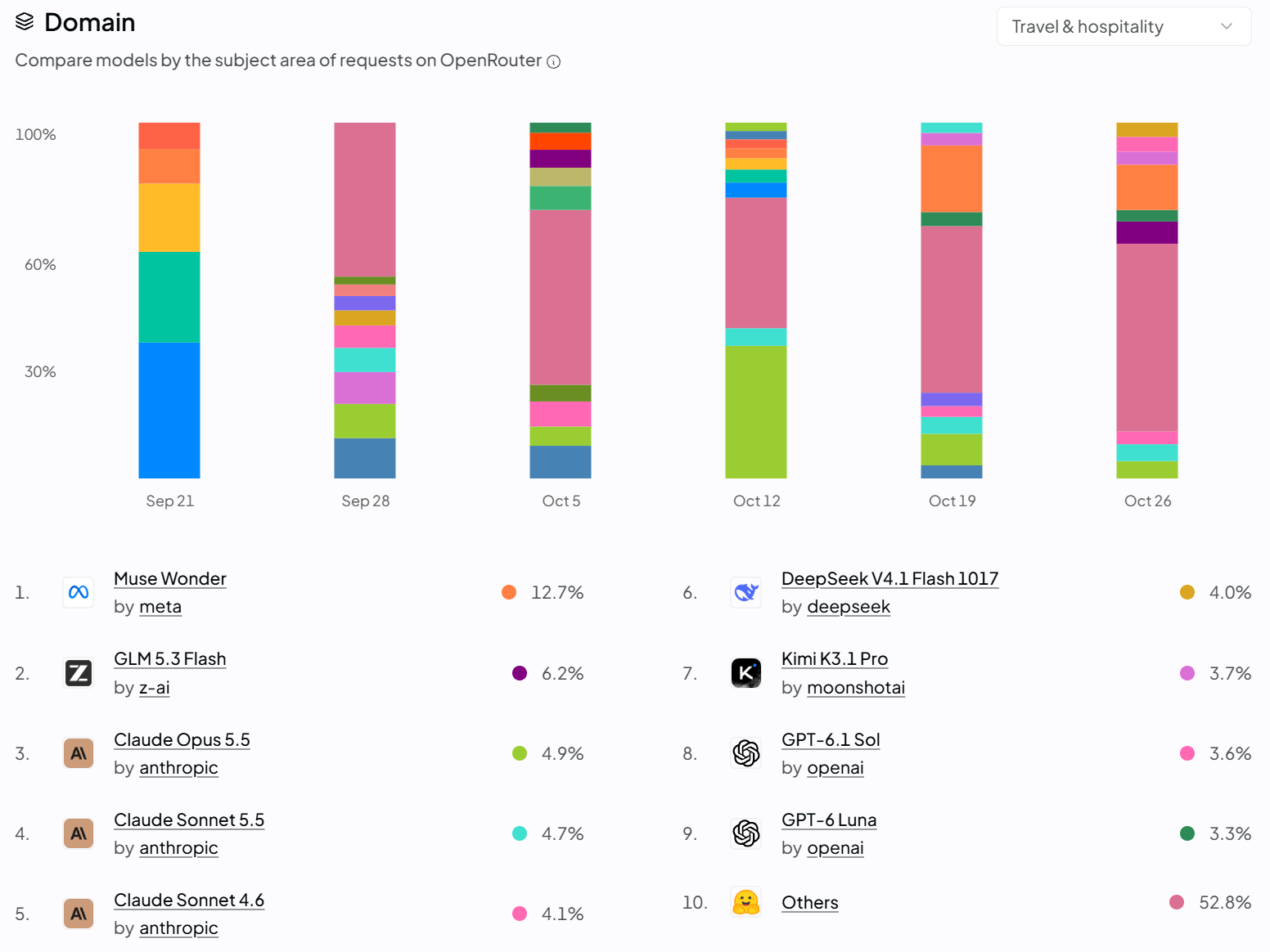
AI for travel & hospitality: Muse Wonder is most used in this sample (12.7%)
Leading entries: Muse Wonder 12.7%; GLM 5.3 Flash 6.2%; Claude Opus 5.5 4.9%. Others: 52.8%.
The unusual leader shows why interface and application context matter. It does not imply Muse Wonder is the leading consumer travel-planning assistant worldwide.
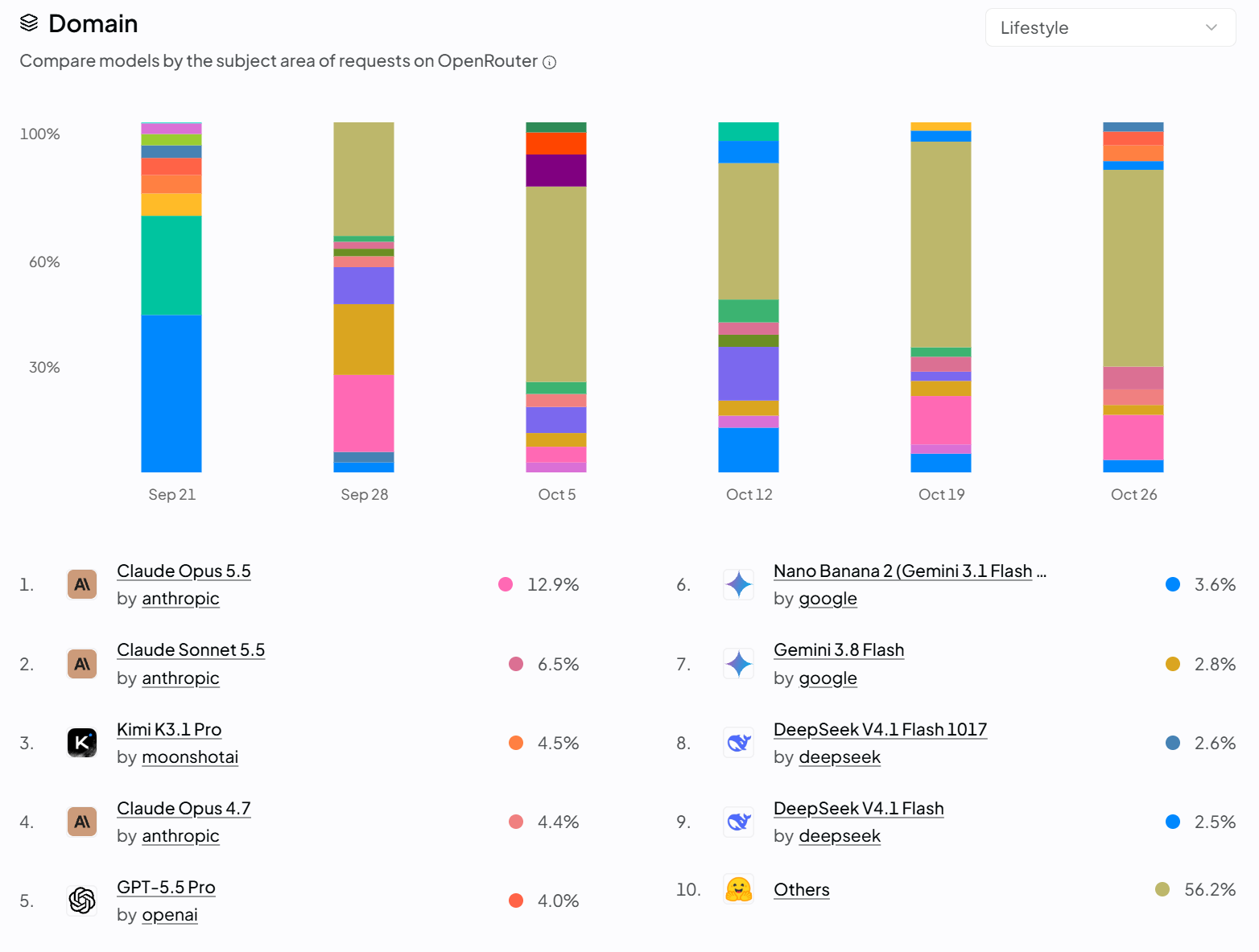
AI for lifestyle: Claude Opus 5.5 is most used in this sample (12.9%)
Leading entries: Claude Opus 5.5 12.9%; Claude Sonnet 5.5 6.5%; Kimi K3.1 Pro 4.5%. Others: 56.2%.
Broad lifestyle workloads span shopping, creative content, fitness and relationships. Subject categories hide heterogeneous intent.
What independent research supports—and what it challenges
Anthropic’s occupational data: real task concentration, different sample
The Anthropic Economic Index studies what people use Claude for across different occupations and task types. Its evidence supports the proposition that AI workloads vary dramatically by profession and can involve augmentation or automation. But its sample is Claude-specific. It cannot establish Claude’s cross-vendor market share in law, finance or marketing, and it does not validate OpenRouter’s specific percentages.
ChatGPT research: consumer questions aren’t equivalent to API workloads
The NBER/OpenAI research on how people use ChatGPT identifies substantial consumer use around information seeking, practical guidance, and writing. It shows why a high-volume developer API leaderboard can look nothing like a consumer chatbot study. A popular consumer assistant may matter most for brand discovery, even when a different underlying model handles more agentic tokens elsewhere.
AI Index and industry adoption: deployment is not recommendation visibility
Broader reporting, including the Stanford AI Index, tracks AI’s business penetration, capabilities and deployment economics. It provides context for proliferating AI uses but cannot translate this OpenRouter sample into a global model market-share ranking. A company’s internal copilot may be heavily used yet never recommend an external law firm or retailer to a shopper.
Benchmarks must be independent of adoption
A model’s popularity can result from favorable contracts, integration defaults, price, or the automation framework driving requests. For legal, health, science and finance, independent evaluations need expert-graded performance, up-to-date reference material, hallucination rates and safety controls. The most-used model is not necessarily the most accurate, safest or best for a particular user.
How this should change GEO and AEO strategy
For Seattle Organic SEO and companies operating in competitive industries, the key distinction is model usage vs. recommendation exposure. An internal accounting copilot, a private coding model and a consumer-facing search assistant can all use generative AI but have radically different implications for marketing.
- Segment prompts by buyer journey and AI function. Build discovery, comparison, qualification and purchase-intent pathways for each industry.
- Identify the actual front-end. Does the buyer ask ChatGPT, Gemini, Google AI Mode, Claude, Perplexity, an industry-specific assistant or an embedded shopping tool? A model name alone is insufficient.
- Track provider and model independently. Assistants can change underlying models and routing without users realizing it.
- Measure citation and selection outcomes. Track whether your brand is included, linked, accurately characterized, compared and ultimately chosen.
- Publish verifiable business information. Keep location facts, credentials, service detail, product specifications, policies, reviews and evidence current.
- Retest over time. Record changes in model shares, citation sources and business recommendations instead of treating this October snapshot as a permanent ranking.
An ongoing observatory: will a few models dominate each industry?
We plan to revisit these 17 OpenRouter AI specialties regularly. The interesting question is not merely whether Claude, OpenAI, Google, DeepSeek, Moonshot or new providers gain token share. It is whether their positions converge toward a few dominant models, fragment into specialist ecosystems, or rotate rapidly as pricing and performance shift.
For each update, we’ll compare leader share, combined top-three and top-nine share, Others share, new model entrants, model-family changes and real-world task suitability—while preserving the original snapshots. When possible, we’ll add independent evidence from direct API usage, app adoption, surveys and benchmark results. We will also separate model usage from traffic to the consumer interfaces that actually drive GEO/AEO opportunities.
The working hypothesis: Some general models will become increasingly ubiquitous, while AI function-specialized and cost-optimized models remain important behind the scenes. But it is too early to declare that every professional field will consolidate around one ChatGPT-like winner. The exciting part is watching whether it happens at all.
Where to go next
Start with our original October 2026 AI model usage and GEO/AEO strategy report, then use this deep dive to decide which industry-specific systems deserve testing. Contact Seattle Organic SEO if your organization wants to map its commercial AI conversation pathways and benchmark where your brand appears.
Three different AI leaderboards—and why they disagree
“Most used AI model” is not a single measurable claim. An API router records routed workloads. A website-audience service estimates people or browsers visiting a domain. A brand-visibility test observes what an assistant says in response to prompts. These are different units, not competing answers to the same question. Our Top Websites by Unique Users 2026 analysis demonstrates this distinction for web reach; the OpenRouter snapshots in this report describe routed activity within selected function categories, not the number of lawyers, marketers, patients or consumers using each model.
| What is ranked? | Unit of analysis | What it helps you decide | What it cannot establish |
|---|---|---|---|
| Model share by function | OpenRouter traffic within a labeled workload | Which infrastructure patterns to investigate | Consumer brand recommendation share |
| Website reach | Estimated monthly unique visitors | How large the accessible audience may be | How many people searched for your service |
| Brand inclusion | Responses to a recorded prompt sample | Whether descriptions and recommendations are accurate | A universal or permanent AI ranking |
A better GEO experiment for any of the 17 specialties
Pick a service, not a model. For example, a Seattle bookkeeping firm might test “who handles monthly accounting and sales-tax reconciliation for a small retailer?” across consumer-facing AI interfaces. Record the exact question, test date, citations, firms mentioned and whether the answer recognizes service boundaries. Then separately test whether the firm’s own pages explain fees, deliverables and client fit. Our AI search and customer behavior research shows why this decision-stage evidence matters more than a raw model leaderboard.
Boundary of these findings: The OpenRouter screenshots are a dated sample from October 31, 2026. Rankings may have changed. Workload shares do not measure model quality or the demographics of end users. We have not independently verified the source provider’s classification of its 17 categories, and we do not infer popularity among all consumers or among practitioners in those fields.
Editorial accountability
Analysis by the Seattle Organic SEO editorial team. Method: compare the reported workload rankings with distinct evidence about public website reach and real-world consumer decision behavior; explicitly separate observation from inference. The source citations and data limitations are listed in “Sources and how we vetted these findings.” Additional editorial review: November 17, 2026. The original screenshots and conclusions remain attributed to their October 2026 observation period.
Continue reading: Top Websites by Unique Users in 2026 · AI Search and Customer Behavior · Seattle’s Construction Pipeline: Using Local Data Carefully.
Sources and how we vetted these findings
Primary dataset: OpenRouter rankings — 17 screenshots supplied on October 31, 2026, showing function rankings and weekly share bars. These are not independently audited network logs. The snapshots may change as model catalogs and traffic change.
Independent triangulation: Anthropic Economic Index (real-world Claude interactions classified by occupation and task), NBER, How People Use ChatGPT (consumer ChatGPT message classification), Stanford AI Index 2026 (broader adoption context), OpenRouter Data API (retrievable platform ranking datasets), and Google Search Central (reliable content and search foundations). These measure different populations, so they are used to test the framing rather than force an apples-to-apples percentage comparison.
Research limitations: OpenRouter reflects routed traffic, not all model usage. Model share in a subject category is not a controlled benchmark of model performance. The screenshots do not disclose AI function-classification validation, exact denominator, geography, active human time, user identities, or whether one application generated large volumes of requests. “Others” is the sum of models outside a displayed leaderboard, not a single specialist model. Some subject categories overlap. OpenRouter routing can be shaped by price, speed, provider availability and product design. Our inferences are labeled accordingly.
Written by the Seattle Organic SEO Team. Founded in 2010, our team combines over 30 years of client experience across search marketing, analytics and digital strategy. About Seattle Organic SEO.