
2027 research series — methodology edition, published November 2026. Which Seattle businesses get discovered in Google’s organic listings, the Google Maps local pack, and AI-powered answers? These are three different discovery experiences. They can overlap, but winning one does not guarantee visibility in another.
Research status: This first edition publishes our study design, comparison framework and criteria for interpreting findings. It is not a completed 2027 rankings survey. We have not yet collected and validated the full cross-platform dataset, so we do not name winners or show fabricated percentages. The research results section below will be updated only after observations are collected and checked.
Why Seattle needs a search visibility report across three platforms
Traditional search reports often reduce visibility to a list of ranking positions. That misses two realities for Seattle service businesses. First, customers searching for a nearby provider may act directly from a Google Business Profile without visiting the website. Second, conversational AI answers may recommend a company or cite an article without reproducing a familiar ten-blue-links ranking.
A strong measurement approach therefore distinguishes organic appearance, local-pack appearance, and AI answer inclusion. It also considers the difference between a brand being named, its website being cited, and a lead actually contacting the business.
The three discovery surfaces we will compare
| Surface | What we will record | Why it matters |
|---|---|---|
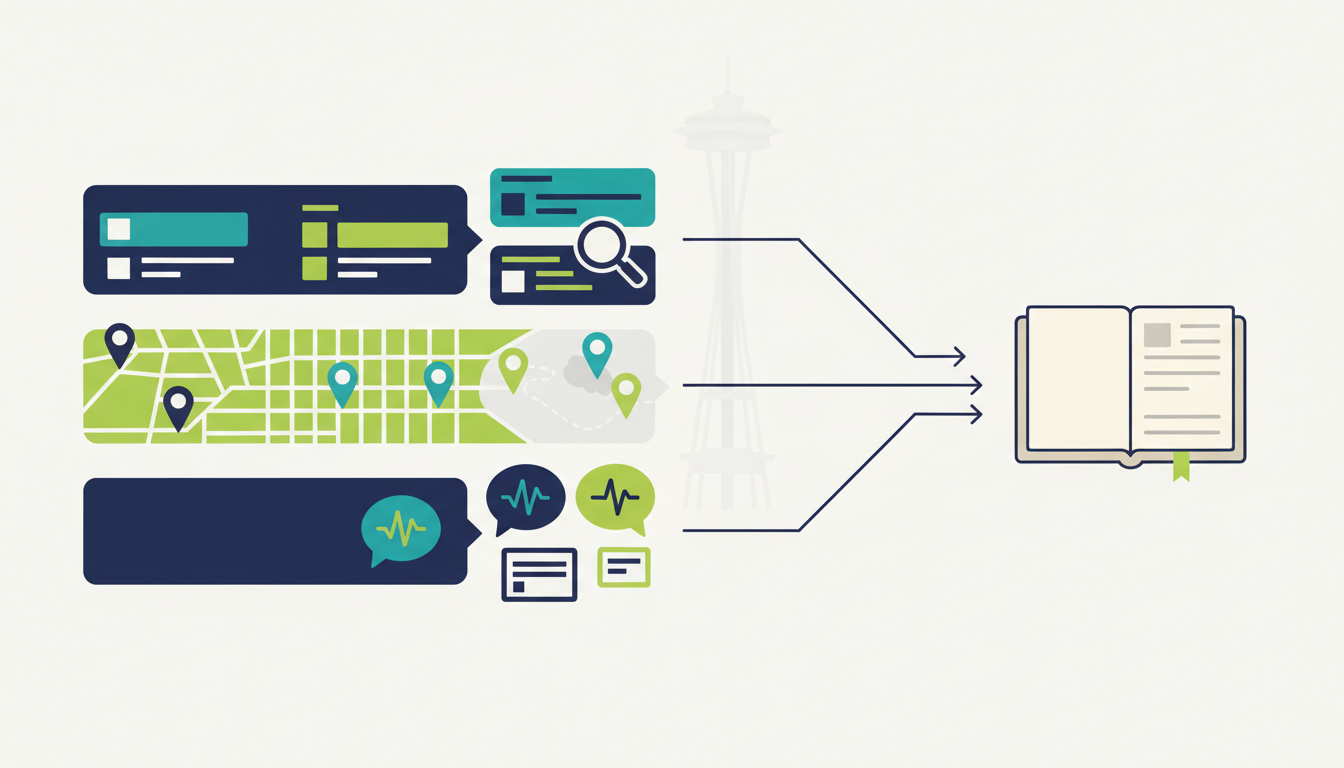
| Google organic search | Top visible non-ad results and domains for a defined query | A website can appear prominently without winning the local pack. |
| Google Maps / local pack | Businesses visible for the query at a specified search location | Maps results are location-sensitive and may drive calls and directions. |
| AI answers | Named businesses, visible source links, answer wording and repeatability | An answer may recommend an entity without citing its own website. |
Study scope: Seattle’s high-value local service searches
For the first collection, we propose a fixed sample of 30 searches spanning three industries: legal services, dentistry and home services. These sectors offer distinct purchasing behavior, competition and location sensitivity. The sample is intended to be repeatable rather than a complete census of Seattle demand.
| Industry | Illustrative query themes | How we’ll avoid an unfair comparison |
|---|---|---|
| Legal | Personal injury lawyer, immigration lawyer, employment lawyer | Keep legal specialties separate; do not compare a specialized practice with every lawyer. |
| Dental | Emergency dentist, dental implants, family dentist | Separate urgent-care intent from elective and routine services. |
| Home services | Emergency plumber, HVAC repair, roofing contractor | Account for urgency, service radius and nearby search locations. |
For each selected query we will log the exact text, test date and local time, search location, device/context and capture method. Search terms will use real customer wording and avoid leaning solely on “best” queries, which can favor comparison publishers over providers.
How we will collect Google organic and Google Maps observations
- Run the same predefined query set for each measured Seattle search location, documenting how location was established.
- Separate sponsored results from unpaid organic results and from the Maps/local-pack module.
- Record which businesses are visible and which URLs own the cited pages; identify directories separately from service providers.
- Repeat the observation on multiple dates rather than treating one SERP screenshot as permanent rank.
- Keep the raw observations, screenshots where permitted and collection timestamps for reproducibility.
Google explains that local ranking depends mainly on relevance, distance and prominence. Accordingly, the analysis will not equate a missing Maps appearance in one neighborhood with a citywide penalty or invisible listing.
How we will test AI-generated recommendations
AI systems introduce more variability than a conventional results page. We will run a fixed list of prompts across selected answer products, with prompt versions, model/product names, dates, settings and any available location context documented. A recommendation will count as a brand mention only when the business is explicitly named; a source citation requires an observable link to a source. These are different metrics.
- Use repeated prompt runs, where feasible, to assess stability instead of treating one response as universal.
- Capture whether a business is recommended, listed merely as an alternative, or named critically.
- Document whether the answer provides a supporting citation to that business, a third-party directory or no visible citation.
- Track factual errors, such as inaccurate locations, services or invented credentials, separately from visibility.
- Do not interpret absence from a small prompt sample as evidence that the assistant never recommends a business.
Google’s AI search guidance states that pages eligible for AI features follow the same foundational search requirements. Meanwhile, Bing Webmaster Tools AI Performance measures citation activity in supported Microsoft AI surfaces; that is useful but is not an exhaustive record of every AI answer.
How we will calculate and present findings
| Metric | Plain-English definition | Important limitation |
|---|---|---|
| Organic presence | Share of sampled queries with the business’s website in the recorded organic set | Not the same as all SEO traffic or total search demand. |
| Maps presence | Share of sampled query-location observations where the business is visible in the defined Maps view | Changes with search location and context. |
| AI recommendation presence | Share of tested prompt runs that explicitly recommend the business | Sensitive to the prompt sample, model and date. |
| Citation presence | Share of tested runs with a visible link to the business’s site | A mention can occur without a citation and vice versa. |
| Cross-surface overlap | Cases where the same business appears in more than one surface | Correlation is not proof that one surface caused another. |
We will not calculate a single “AI authority score” and present it as an official Google or ChatGPT ranking signal. Any composite index, if published, will show its formula, inputs and caveats. We will also identify whether the sampled result is a location, brand, individual practitioner, directory or publisher, because these entities serve different user needs.
What Seattle businesses can learn before the rankings are collected
- Do not optimize only for one results page. Check how customers discover you through organic search, local listings and answer engines.
- Keep your company facts correct. Make genuine services, locations, contact information and credentials easy to verify on your website and third-party profiles.
- Measure qualified inquiries. A mention in an AI response is useful context, but calls, bookings and sales establish whether visibility produces business value.
- Use local observations. A “Seattle rank” without search location, device and date is an incomplete claim.
- Prefer evidence to slogans. Agencies should explain which queries were tested and what actual results show.
Results dashboard: what is available today
Status as of November 2026: The cross-platform 2027 dataset has not been collected, validated or published. Therefore no “top Seattle businesses” ranking or YoY improvement number is asserted here. This page is the protocol and publication home for the research. Once a dated dataset exists, it can support industry-by-industry results, location differences, overlap analysis, and downloadable methodology notes.
For comparison-focused readers, our Seattle SEO companies guide discusses agency evaluation, while our Seattle GEO services explain how we approach AI search discoverability. Those pages serve separate purposes from an original market measurement report.
Frequently asked questions
Is this a list of the best Seattle businesses?
Not yet. It is a transparent research protocol for comparing publicly observable appearances. Any future rankings will describe a defined sample, not a universal judgment of service quality.
Do Google Maps rankings and Google organic rankings match?
Not necessarily. They rely on different interfaces and context. A business could appear in one and not the other for the same phrase.
Can ChatGPT rankings be tracked like Google rankings?
You can measure repeatable prompt-based observations, but responses may differ between sessions and dates. Label those observations as samples and record the circumstances.
Why study Seattle businesses instead of national rankings?
Local customers often search with geography, urgency, neighborhood and service expectations. A Seattle-focused method can account for those details instead of assuming a national search result reflects local customer experience.
Bring the findings back to your business
For an audit of where your Seattle-area company appears today, explore local SEO, GEO services, or contact Seattle Organic SEO. We focus on factual, measurable improvements—not unsupported promises of a particular rank.
Methodology references: Google local ranking factors · Google AI search website guidance · Bing Webmaster Tools AI Performance.