
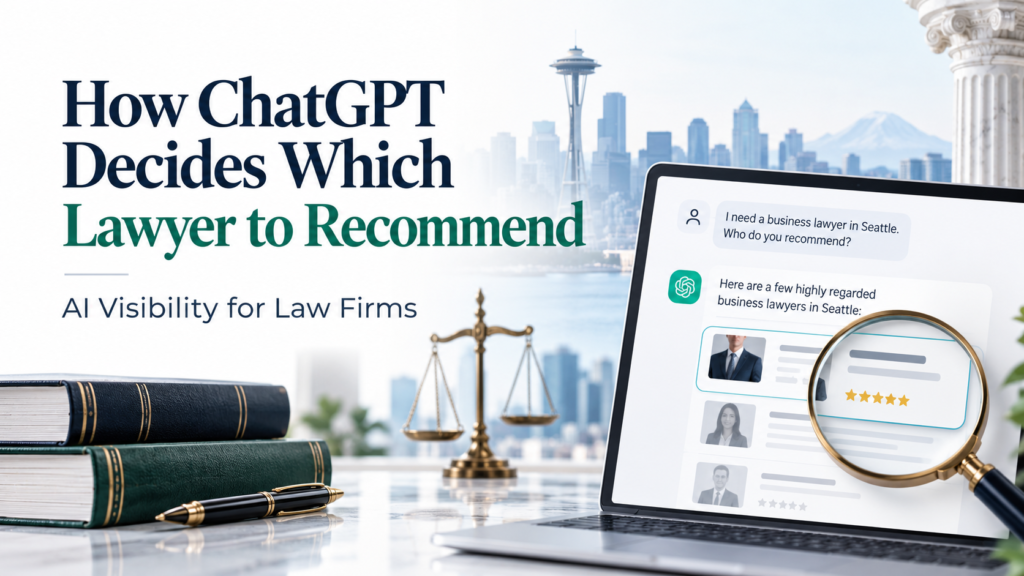
How Does ChatGPT Decide Which Lawyer to Recommend?
A Microsoft employee in Seattle opens ChatGPT and types:
“Who is a good Seattle employment lawyer for someone reviewing a severance package with unvested RSUs and a noncompete?”
ChatGPT responds with several attorneys or law firms.
Why those lawyers?
Why not the firm ranking first on Google? Why not the attorney with the most reviews?
Why not the law firm spending heavily on SEO?
The most important thing to understand is this:
OpenAI does not publish a formula assigning fixed weights to reviews, backlinks,
Avvo profiles, legal directories, schema markup or Google rankings.
What OpenAI does document gives law firms a much more useful framework.
When ChatGPT determines that a question would benefit from current web information,
it can search the web. ChatGPT Search may rewrite a user’s original question into
more-targeted searches, review those results, conduct additional searches, use
location information when relevant, and synthesize information from the sources it finds.
For law firms, that changes the optimization problem.
You are no longer trying only to rank a page for “Seattle employment lawyer.”
You are trying to create enough clear, accessible and verifiable evidence across the web
that an AI system can reasonably connect one of your attorneys to the specific legal
situation a potential client is describing.
That is the heart of AI visibility for law firms.
The Short Answer: ChatGPT Is Matching a Situation, Not Merely a Keyword
Traditional SEO trained law firms to think in keywords.
Someone searches:
Seattle employment lawyer
Google returns pages.
But an AI conversation can begin somewhere very different:
“I was laid off by a Seattle technology company. They gave me 21 days to sign my
severance agreement. I still have unvested RSUs and there is a noncompete clause.
What type of attorney should I talk to?”
That prompt contains much more context than a conventional keyword search.
- Location: Seattle and Washington
- Practice area: employment law
- Client side: employee rather than employer
- Industry: technology
- Matter: layoff and severance
- Compensation: RSUs or equity
- Contract issue: noncompetition agreement
- Urgency: a signing deadline
The most relevant attorney is therefore not necessarily the website that ranks highest
for the broad phrase “employment lawyer Seattle.”
The stronger informational match may be a lawyer whose digital footprint repeatedly
connects that person with:
employee-side employment law + Seattle + technology employees + severance agreements
+ RSUs + noncompetes
Traditional SEO often asks:
Which page should rank for this keyword?
AI visibility increasingly asks:
Which identifiable lawyer or firm has the strongest discoverable evidence connecting
it to this particular situation?
What OpenAI Actually Confirms About ChatGPT Search
This is where law firms should be careful about articles claiming to know the exact
“ChatGPT ranking factors.”
OpenAI does not disclose a lawyer-specific formula.
ChatGPT Can Search the Web
When current information would improve the answer, ChatGPT can use web search.
That matters for law firms because attorneys change firms, laws change, office locations
change, new cases are published and reviews accumulate.
One Prompt Can Become Multiple Searches
OpenAI says ChatGPT Search may rewrite a user’s original question into one or more
targeted queries and may conduct additional searches after reviewing the initial results.
So a question such as:
“Who is a good Seattle employment lawyer for a Microsoft employee reviewing a severance
package and noncompete?”
could conceptually lead to searches around:
- Seattle employment attorney severance noncompete
- Washington noncompete employee lawyer
- Seattle tech worker severance attorney
- employment attorney RSU severance Seattle
every query ChatGPT generates. What is documented is that the user’s original prompt does
not necessarily equal the search queries ChatGPT ultimately performs.
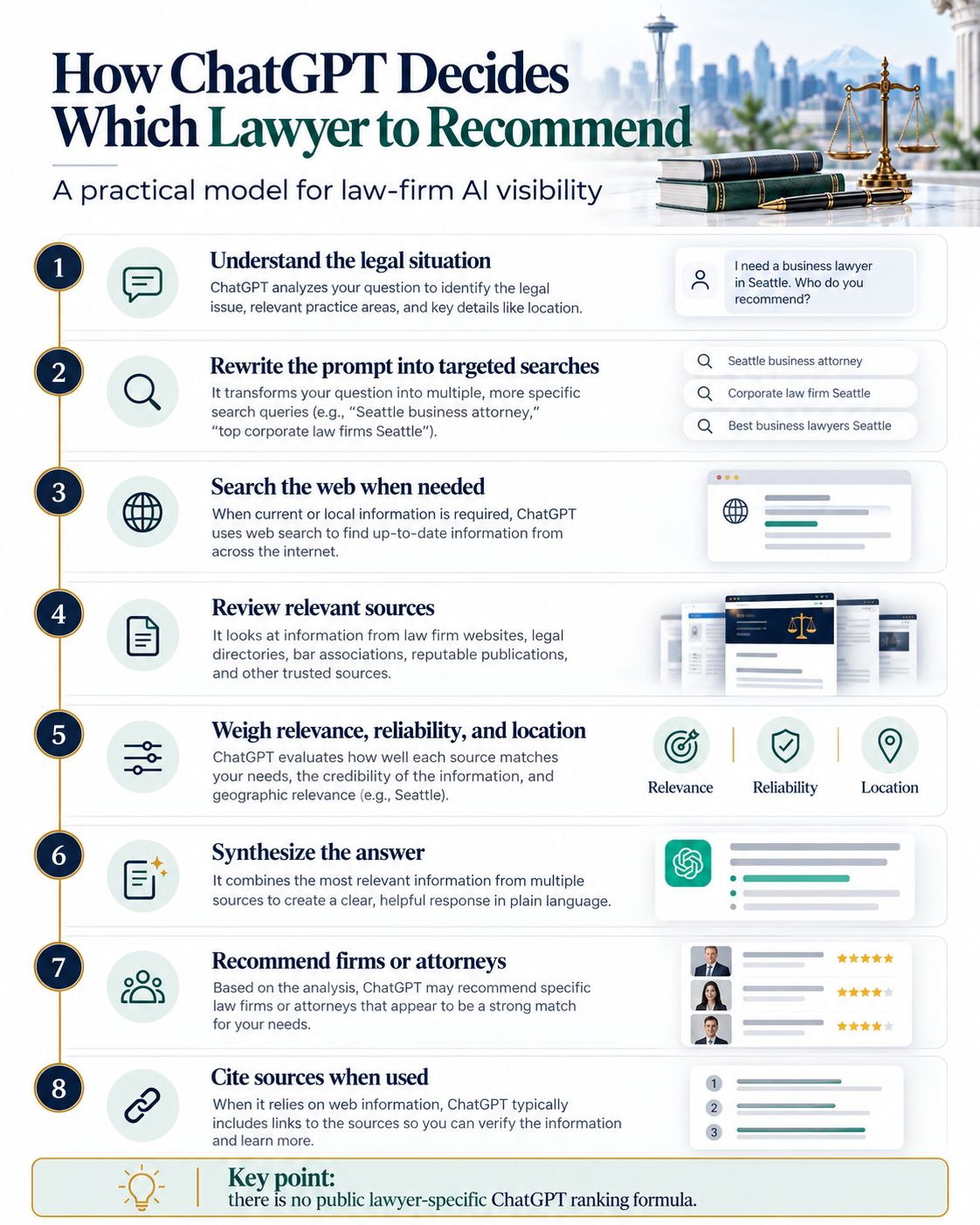
The Law Firm Recommendation Evidence Stack
A useful way to think about lawyer recommendations is what we call the
Law Firm Recommendation Evidence Stack.
It is not an official OpenAI algorithm.
It is a strategy framework based on what OpenAI documents about search and what law firms
can actually control.
corroboration → local relevance → synthesized answer
Layer 1: ChatGPT Has to Understand the Client’s Problem
“I need an employment attorney” is far less specific than:
“I’m a Microsoft employee in Redmond. I’ve been offered severance, I have unvested stock
and my agreement contains a noncompete.”
The second question creates more potential relevance signals.
A firm with substantive content about these topics gives a search system more evidence:
- executive severance agreements
- technology layoffs
- Washington noncompete law
- stock options
- RSUs
- restrictive covenants
- release agreements
- compensation negotiations
Layer 2: Query Fan-Out Creates More Opportunities to Be Relevant
A prospective client does not need to type the keyword your law firm optimized.
“My employer eliminated my position and offered me four months of salary if I sign
something by Friday.”
The user never says severance attorney.
But the situation clearly involves severance.
Instead of asking only:
Which 100 keywords do we want to rank for?
law firms should also ask:
Which 100 situations do our best clients describe before they realize they need us?
Layer 3: ChatGPT Needs Retrievable Evidence
When web search is involved, ChatGPT needs public sources it can retrieve.
- law-firm website pages
- attorney biographies
- practice-area pages
- legal directories
- state bar profiles
- Google Business Profiles
- reviews
- published articles
- interviews
- conference speaker pages
- podcasts
- news coverage
- professional organizations
15 points, or Google reviews are worth 10 points.
Firm A vs. Firm B: Which One Is Easier for an AI System to Understand?
| Firm A | Firm B |
|---|---|
| Generic “Employment Law” page | Detailed employee-side employment page |
| Short lawyer biography | Attorney bio specifying executive and technology matters |
| “Serving Washington” | Seattle, Bellevue and Redmond practice context |
| Basic contact page | Washington credentials clearly documented |
| Few substantive articles | Current Washington noncompete guide |
| No severance content | Detailed severance-agreement resource |
| No equity content | Article about RSUs after termination |
| Few independent references | Consistent professional profiles and interviews |
This does not prove ChatGPT will recommend Firm B.
It means an information-retrieval system has considerably more evidence available from
which to connect Firm B to the client’s problem.
Layer 4: Your Website Makes Claims; the Web Can Corroborate Them
Suppose your website says:
“Jane Smith is a leading Seattle employment lawyer for technology executives.”
That tells a search system how your firm describes Jane Smith.
Now imagine the broader web also contains:
- Jane’s Washington bar information
- employment-law directory profiles
- a CLE biography identifying her employment practice
- an interview about technology layoffs
- articles about severance agreements
- a podcast about restrictive covenants
- reviews describing related client matters
Entity-to-topic corroboration:
Your website establishes the entity.
Your content establishes what the entity knows.
Independent sources help corroborate the association.
Layer 5: Location and Jurisdiction Matter More Than a City in the Title Tag
These are meaningfully different requests:
- employment lawyer
- Seattle employment lawyer
- Bellevue employment attorney
- Washington noncompete attorney
- lawyer for a Microsoft employee in Redmond
Local optimization therefore involves much more than repeating “Seattle” in a headline.
The firm’s content should clearly establish:
- where attorneys are licensed
- where they actually practice
- which state law applies
- which courts, agencies and statutes matter
- which communities or industries they legitimately serve
Layer 6: Situation-Specific Content Becomes the Evidence
Many legal sites still follow:
That structure still matters.
But it doesn’t explain every situation in which one of your lawyers may be relevant.
A Seattle employment firm might support a broad employment page with resources on:
- negotiating severance after a layoff
- release-of-claims provisions
- noncompete agreements in Washington
- RSUs after termination
- unvested stock options
- executive compensation
- confidentiality provisions
- WARN Act questions
- technology-company layoffs
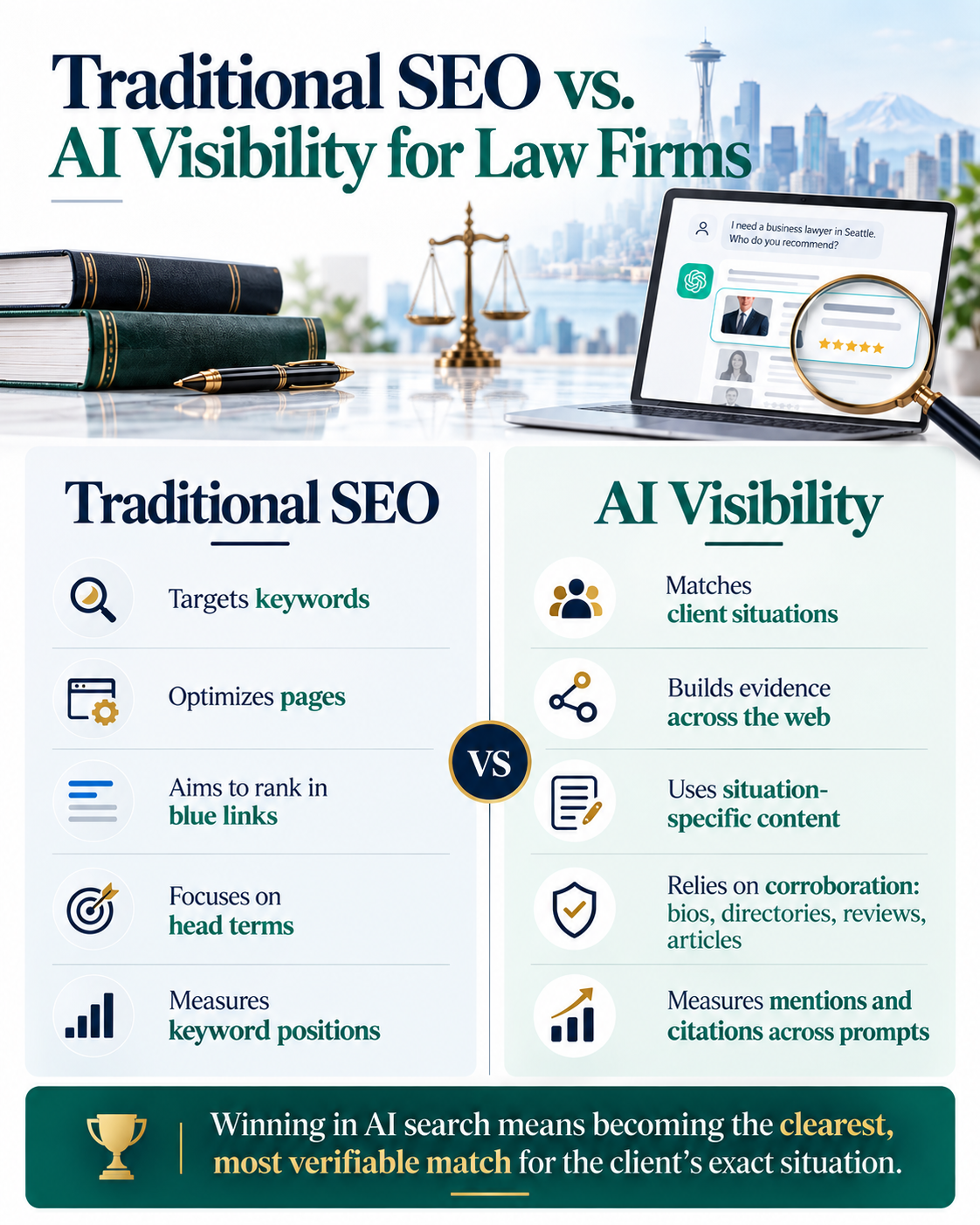
Traditional SEO vs. AI Visibility
Layer 7: Third-Party Sources Can Reinforce the Attorney Entity
An attorney interview isn’t only PR.
A CLE biography isn’t only business development.
A legal-directory profile isn’t only reputation management.
A podcast isn’t only social content.
Each can become a public document associating:
Layer 8: Your Website Has to Be Eligible for ChatGPT Search
Before buying an expensive GEO platform, check something much more basic:
Can ChatGPT Search actually retrieve your website?
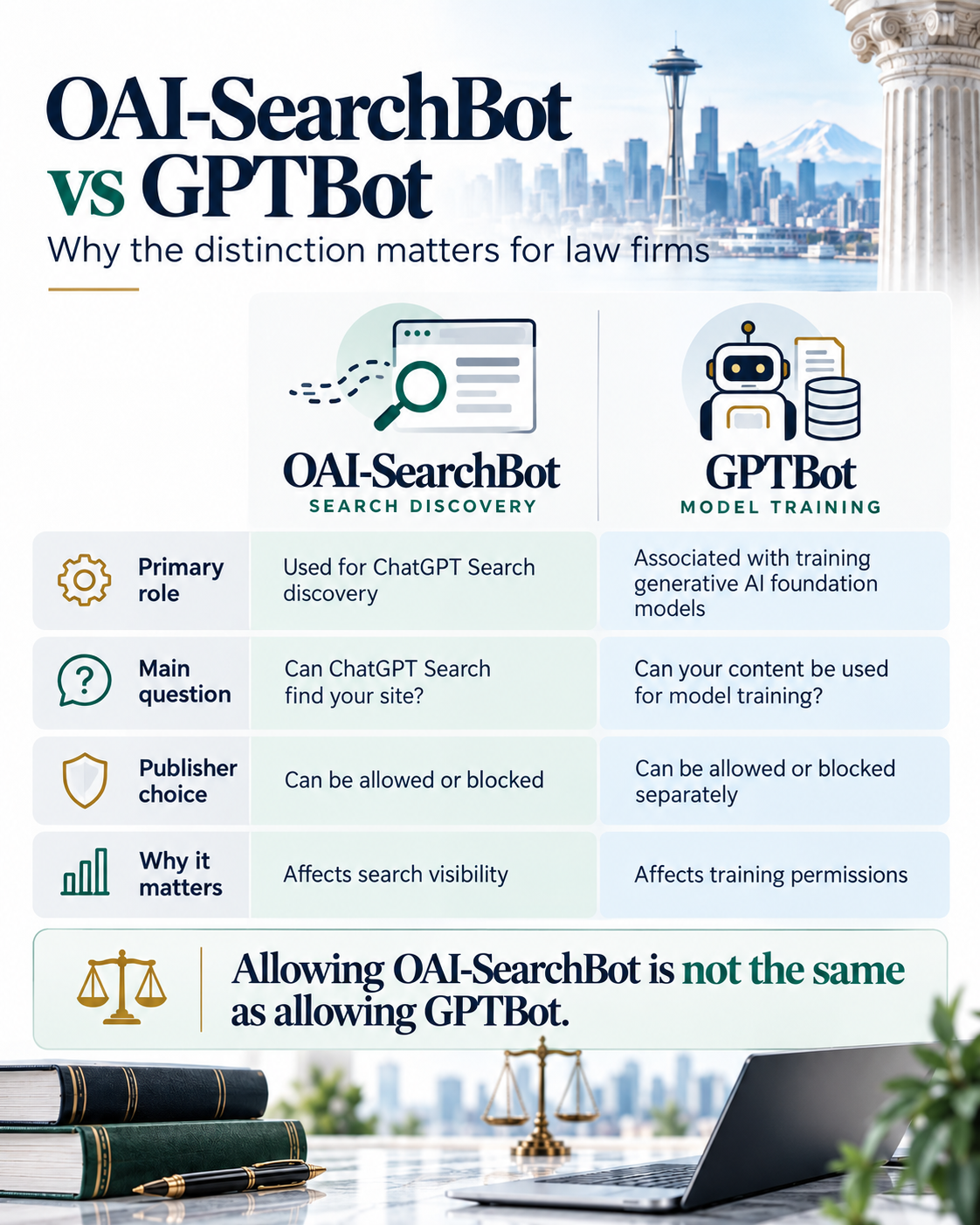
OpenAI identifies OAI-SearchBot as the crawler used for ChatGPT Search
discovery.
This is separate from GPTBot, which relates to potential model training.
For a law firm, review:
- robots.txt
- firewall rules
- CDN bot protection
- noindex directives
- canonical tags
- crawl access to attorney bios
- crawl access to practice pages
- crawl access to articles
What Is Documented, What Is Observed and What Is Still Speculation?
Documented by OpenAI
- ChatGPT can search the web
- queries can be rewritten
- additional searches can be performed
- general location may be used
- sources may be cited
- OAI-SearchBot is used for search discovery
- placement is not guaranteed
Reasonable Strategy Based on Those Facts
- publish situation-specific content
- strengthen attorney biographies
- make jurisdiction and location explicit
- maintain accurate third-party profiles
- earn relevant outside mentions
- keep changing legal information updated
- measure visibility across multiple prompts
Claims We Still Cannot Make Reliably
- “You need exactly 50 reviews.”
- “Avvo counts twice as much as Justia.”
- “Adding five schema types increases recommendation odds by 32%.”
- “Ranking #1 in Google automatically makes you #1 in ChatGPT.”
ChatGPT Does Not Have a Permanent “#1 Lawyer” Position
Run these three prompts:
- “Recommend a Seattle employment lawyer.”
- “Who handles severance agreements for technology employees in Seattle?”
- “I’m a Microsoft employee in Redmond with unvested RSUs and a noncompete in my severance agreement. Which type of attorney should I call?”
They are not simply keyword variations.
They express different needs and potentially trigger different searches.
The Four Metrics Law Firms Should Track
1. Recommendation Share
Across a defined group of prompts, how often is your firm named?
If you test 20 prompts and appear in eight, your recommendation share for that test set
is 40%.
2. Citation Share
When sources are cited, how often does your website appear?
3. Prompt Stability
Does the firm remain visible when the wording changes?
4. Source Diversity
Which sources appear when your firm is mentioned?
- your website
- a legal directory
- a publication
- a review platform
- a bar profile
The 20-Prompt Law Firm AI Visibility Test
Do not begin by asking ChatGPT:
“Tell me about Smith & Jones LLP.”
You supplied the entity.
Instead, test situations in which the firm should legitimately be discovered.
| Prompt | What It Tests |
|---|---|
| Recommend Seattle employment lawyers who represent employees. | Broad category visibility |
| Who reviews severance agreements for tech workers in Seattle? | Situation-specific relevance |
| What type of lawyer should I contact if I’m laid off with unvested RSUs? | Problem recognition |
| Seattle attorney for a noncompete in a severance agreement. | Issue + geography |
| Which Seattle employment lawyers publish useful information about Washington noncompete law? | Content authority |
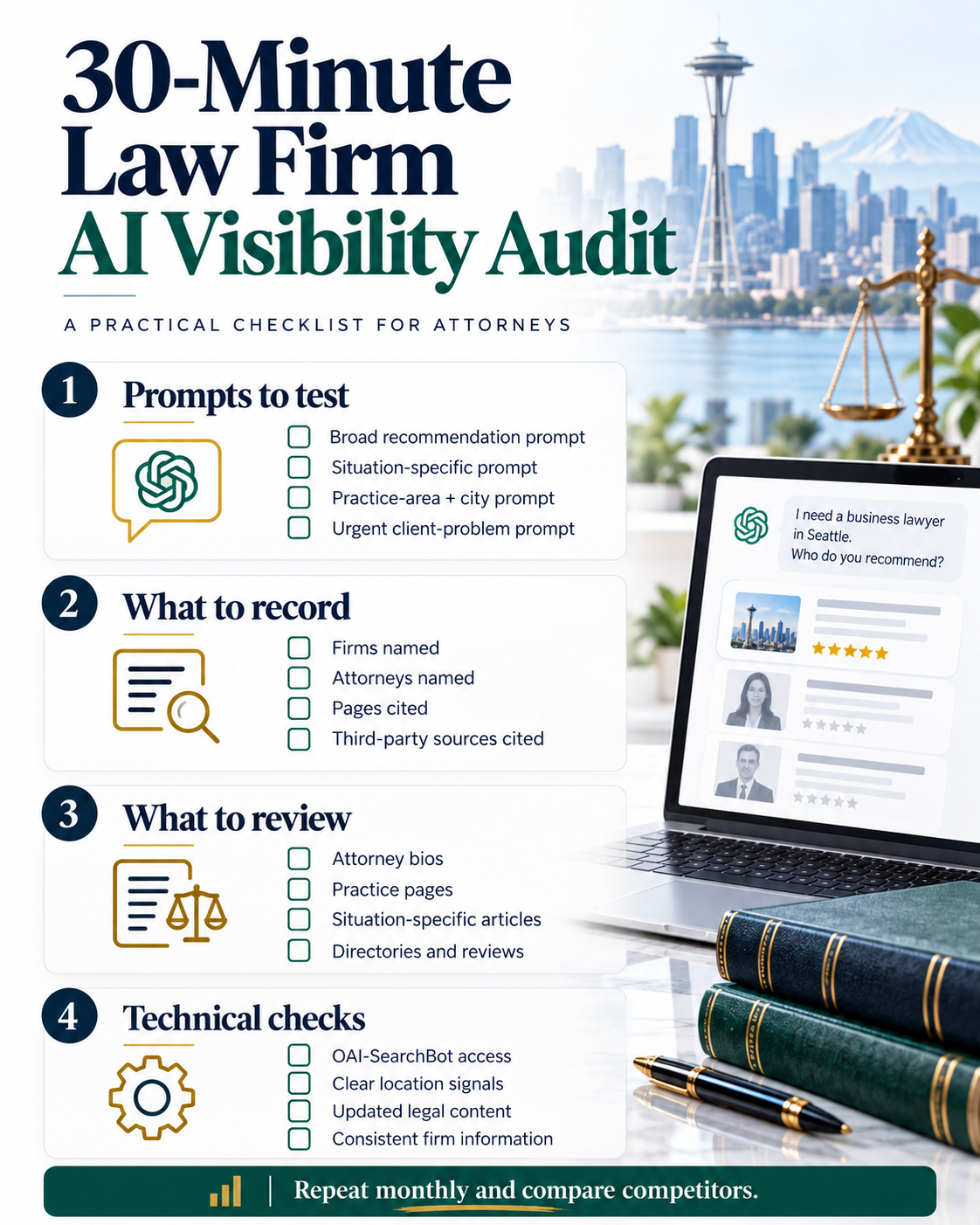
Track Actual ChatGPT Traffic Too
Prompt testing measures visibility.
Analytics measures traffic.
OpenAI says ChatGPT Search referral URLs can include:
Law firms should separate:
- AI mentions
- AI citations
- ChatGPT referral sessions
- consultation conversions from ChatGPT referrals
What Should Law Firms Do First?
The priority order is less glamorous than most GEO sales pitches.
First, make your firm understandable.
A machine should be able to determine:
- who your attorneys are
- where they are licensed
- where they practice
- which clients they represent
- which matters they handle
- which industries they understand
- which legal situations they write about
Then make those claims supportable.
Publish genuinely useful client-situation content. Strengthen attorney biographies.
Update inconsistent directory information. Keep legal content current. Earn legitimate
outside mentions. Clarify local and jurisdictional relevance. Make important pages
accessible to search crawlers.
None of this guarantees a ChatGPT recommendation.
That is exactly the point.
The objective is not to manipulate a secret ranking formula. The objective is to create
the clearest, strongest and most verifiable body of public evidence possible for the
legal situations in which your attorneys should legitimately be relevant.
Frequently Asked Questions
How does ChatGPT decide which lawyers to recommend?
There is no publicly disclosed lawyer-ranking formula. When web search is used,
ChatGPT Search may rewrite a request into targeted searches, retrieve information,
incorporate relevant location context and synthesize an answer from the sources it finds.
How can I get my law firm recommended by ChatGPT?
There is no submission form or guaranteed method. Start by making important pages
crawlable, publishing content around specific client situations, strengthening attorney
biographies, maintaining accurate third-party profiles and measuring visibility across
a consistent prompt set.
Does ranking #1 on Google mean ChatGPT will recommend my law firm?
No published OpenAI rule connects a specific Google ranking position with a ChatGPT
recommendation. Traditional SEO can still help make information discoverable, but AI
answers can synthesize multiple sources and multiple searches.
Do reviews affect ChatGPT lawyer recommendations?
Reviews create public information about the firm and its clients’ experiences, but
OpenAI has not published a lawyer-specific weighting formula for review count, rating
or review text.
Are Avvo, Justia or Super Lawyers ChatGPT ranking factors?
They may provide useful third-party attorney information, but OpenAI has not published
fixed weights for individual legal directories.
Does schema markup help law firms appear in ChatGPT?
Structured data can help machines interpret information, but no documented schema type
guarantees a ChatGPT recommendation.
Should a law firm allow OAI-SearchBot?
If a firm wants its public website content eligible for ChatGPT Search discovery,
OAI-SearchBot should not be blocked. Crawl eligibility does not guarantee placement.
Is OAI-SearchBot the same as GPTBot?
No. OAI-SearchBot relates to search discovery, while GPTBot is a separate crawler
associated with potential model-training use.
Can I track visitors who come from ChatGPT?
Yes. ChatGPT Search referrals can include utm_source=chatgpt.com,
allowing traffic to be identified in platforms such as Google Analytics.
The Bottom Line
The most important change in lawyer search is not that Google disappeared.
It hasn’t.
The change is that the query itself is becoming a conversation.
A prospective client who once searched:
Seattle employment lawyer
can now ask:
“I was laid off by Microsoft. I have five days to sign a severance agreement, some of my
RSUs haven’t vested yet, and there’s a noncompete clause. What should I do and what kind
of lawyer should I talk to?”
That is not really a keyword anymore.
It resembles the beginning of an intake conversation.
The law firms positioned to benefit from this shift will be the firms that make it easy
for search systems and prospective clients to understand:
- who they help
- where they help them
- which situations they handle
- which laws they understand
- why their attorneys are relevant to the question
The objective is no longer simply “rank the page.” It is to become the clearest and most
verifiable answer to the client’s situation.
Want to Know What ChatGPT Finds When Someone Looks for a Lawyer Like You?
Seattle Organic SEO measures how law firms appear across AI search—not simply whether a
firm shows up in one favorable screenshot.
Our law-firm AI visibility audits examine:
- the prompts prospective clients actually use
- the firms and attorneys AI systems recommend
- the sources those systems cite
- the competitors appearing instead of your firm
- content gaps that may make your attorneys difficult to understand
- technical issues that may prevent your content from being discovered
If your law firm wants to understand where it currently appears—and where competing firms
are being recommended instead—request a free AI visibility audit from Seattle Organic SEO.
(206) 210-3398 | hello@seattleorganicseo.com
Primary Sources
OpenAI — Searching the web with ChatGPT
Explains query rewriting, additional searches, location use, citations,
OAI-SearchBot eligibility and the fact that placement is not guaranteed.
OpenAI — Publishers and Developers FAQ
Explains OAI-SearchBot access, GPTBot controls and ChatGPT referral tracking.
“`