
AI visibility · Research checked October 29, 2026
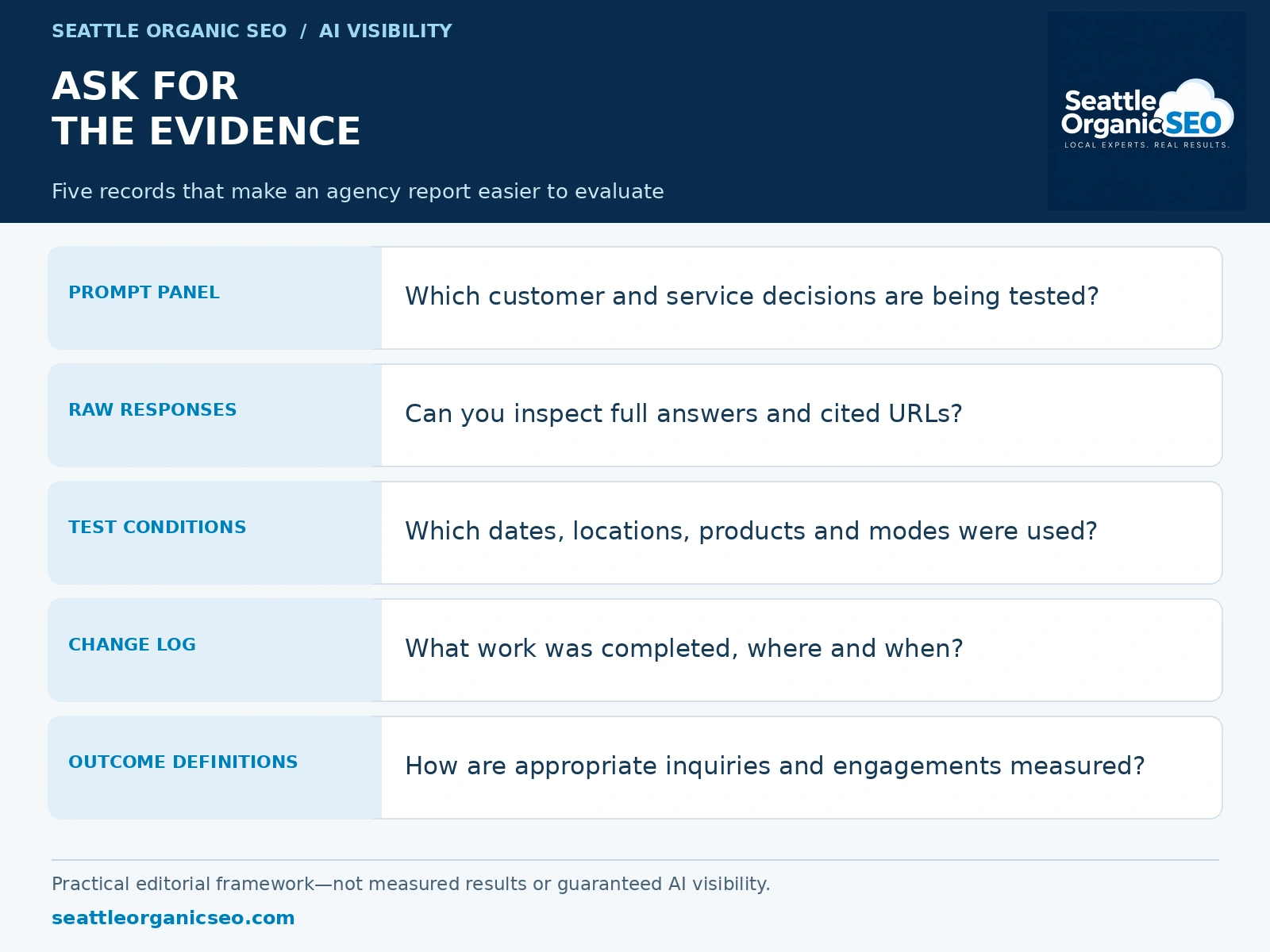
Before you approve another AI visibility budget, ask your agency to open the evidence behind its report. Start with the exact questions tested, the full answers and the sources. Then ask what changed and what the agency believes that change means.
A capable team should be able to walk you through that conversation. It may also need to say “we do not know yet.” That is reasonable when it explains what remains uncertain and how the next test could help.
You are paying for better decisions and useful work. You should be able to inspect both. A dashboard, a new acronym and a confident explanation do not settle whether the agency measured the thing you care about.
Seattle Organic SEO offers SEO and GEO services. We benefit when businesses decide they need help. That makes it important to publish a standard clients can apply to us as well as to anyone else.
Ask what the metric actually counts
A business can be mentioned without being recommended. A page can be cited without anyone clicking it. A visitor can arrive without becoming an appropriate inquiry. A single “visibility” number can hide all of those differences.
| Metric | What it can show | What it cannot establish alone |
|---|---|---|
| Brand mentions | The name appeared in observed answers | That the answer endorsed the business |
| Explicit recommendations | The answer presented the business as an option | How many real customers saw or acted on it |
| Own-domain citations | A URL appeared as a supporting source | Clicks, leads or revenue |
| Factual accuracy | Checked claims agreed with reliable information | That the answer was widely distributed |
| Referral sessions | Observable visits attributed to a source | Every assisted or later visit |
| Qualified inquiries and clients | Meaningful business outcomes | The share caused by the agency’s work |
Ask for the numerator and denominator. Which prompts, platforms, dates and completed runs produced the number? If a score combines several measures, ask for its formula and weights. A proprietary score can be an organizational tool, but it still needs an explanation you can evaluate.
Ask who chose the questions
The prompt panel should connect to your customers and services. A long list of broad informational questions can produce an attractive report while missing the decisions that lead to a consultation or booking.
Ask which questions came from inquiry themes, which came from research and which were generated as hypotheses. None of those sources has to be hidden. The problem begins when a proposed prompt is presented as a measured customer behavior without evidence.
Check for prompts that supply the preferred result. Naming your business and asking why it is a strong option measures something different from unbranded discovery. Both can be useful. They should appear in separate parts of the report.
Ask to see repeated observations
A single screenshot can demonstrate that an answer occurred. The next question is whether it recurs under relevant conditions. Ask how many times the team ran the prompts, whether sessions were fresh and how it handled location, personalization, search mode and product changes.
Follow-up conversations are useful for studying a journey, but their answers depend on earlier turns. A thoughtful report separates those from independent standalone tests. It also includes failed runs and explains exclusions rather than silently dropping awkward observations.
Google’s documentation notes variation between AI experiences and their responses. That is one reason a report should state its observation conditions instead of treating an answer as a fixed universal position.
Ask what was changed on your behalf
You should receive a change log clear enough to connect recommendations with actual work: which pages, which statements, which technical settings, which external sources and which dates. “We optimized your entity” needs to be translated into something inspectable.
A useful entry could say that the team rewrote a service page to clarify scope and fees, verified that the rendered text was accessible, added relevant internal links and requested correction of an outdated profile. It should identify the actual URLs and explain why those actions were selected.
The work may have benefits beyond AI recommendations. Clearer pricing can reduce unsuitable inquiries. A corrected contact route can help any visitor. A good agency can explain those benefits without attributing every subsequent improvement to GEO.
Want a second opinion on your AI visibility reporting?
Bring the report and the business questions you need it to answer. We can discuss the evidence, measurement gaps and practical next steps.
Ask what the tools can—and cannot—observe
Microsoft’s AI Performance documentation describes citation reporting across supported Bing, Copilot and partner experiences. It explicitly distinguishes those counts from ranking or prominence. That is useful evidence within a defined scope, rather than a complete record of every assistant or customer.
Ask the agency which tools it uses, what those tools actually collect and where manual checks add context. If the report claims to cover “all AI,” ask how that coverage was established. If it claims prompt volume, ask whether the number is observed, modeled or borrowed from traditional search demand.
You do not need to understand every technical detail. You do need an answer to a practical question: what decisions does this data support, and where would relying on it be misleading?
Ask how results connect to the business
Start with an agreed definition of a qualified inquiry. For one business that could mean a suitable consultation request. For another it could mean a private-event inquiry with a feasible date, group size and budget. A form submission can be too broad to judge success.
Ask how the team follows those inquiries into attendance, proposals or engagements. Discuss what can be recorded without collecting unnecessary sensitive information. Keep the inquiry date so outcomes can be reviewed after a longer sales cycle.
Then ask the attribution question directly: what evidence suggests the improvement came from this work, and what else changed? Seasonality, promotions, staff response time, competitors and platform updates all deserve consideration. A before-and-after comparison can support a hypothesis without settling causation.
Eight questions to bring to your next agency meeting
- Which customer and service decisions does our prompt panel represent?
- Can we inspect the full answers, sources and observation conditions?
- How do you separate mentions, recommendations, citations and business outcomes?
- What was our baseline, and how repeatable were the results?
- Which specific changes did you make, where and when?
- What can your tools observe, and what do they miss?
- What happened to qualified inquiries and the engagements we actually want?
- What is the next decision this evidence supports: continue, change, expand or stop?
Use these as conversation starters. They are not a validated agency certification or a reason to dismiss a team because one report is incomplete. The quality of the explanation, willingness to share evidence and response to gaps will tell you more than a polished sales answer.
Be cautious about claims that outrun the method
An agency promising a specific recommendation position should explain how it could control a system whose answers can vary. A claim that a special file, a schema change or a particular text layout guarantees citations needs equally strong supporting evidence.
Google’s guidance on generative AI search continues to emphasize foundational SEO and useful content, and says its Search features do not require special AI text files or markup. Work on structured information may still be useful, but that is different from proving a guaranteed citation effect.
The reasonable standard is proportionate evidence. A limited observation can justify a limited conclusion and a practical experiment. It cannot support a universal promise merely because the presentation looks technical.
What a useful monthly review can look like
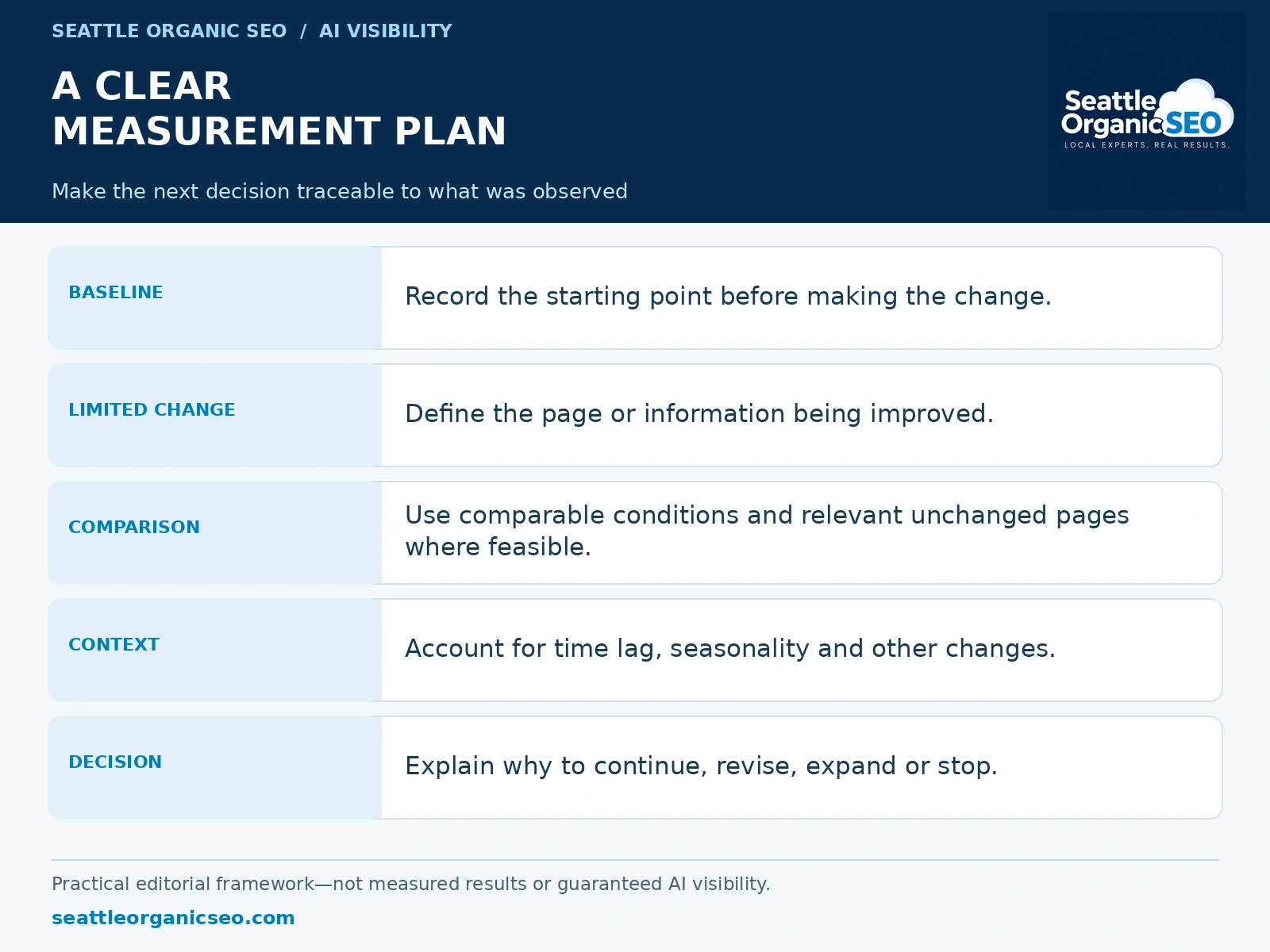
Ask the team to organize the meeting around decisions rather than a tour of software screens. Start with the business objective, review the work completed and inspect the evidence that bears on the next choice. A concise report can be more useful than a large deck when every important claim is traceable.
The opening should explain the observation window and any changes in conditions. Did the platform or mode change? Were the same prompts used? Were any runs excluded? Is there enough time for a sale or appointment to have completed? These details determine how confidently you can compare the current result with the baseline.
Next review the work log. Choose one material page or source change and inspect it together. Confirm that the published wording is accurate, that the change reached the intended page and that the team checked the next step a visitor would take. Completion should mean something more specific than a task being marked green.
Then examine the relevant outcomes. Keep factual accuracy, citations, recommendations and qualified inquiries separate. Look at the prompts and services behind the aggregate before deciding whether the average represents progress. A gain concentrated in unrelated informational questions may be interesting without addressing the original business objective.
End the meeting with the next action, its owner and the evidence that will be reviewed. If the recommendation is to expand the budget, ask which finding supports that choice. If the recommendation is to keep observing, ask what would make the additional observation useful and when the team will make another decision.
How to review an apparent win
Imagine a hypothetical agency reporting that a client’s recommendation rate improved after a content update. Before discussing the conclusion, ask to see the exact panel and the completed observations. This is a teaching example, not a claim about a real campaign.
Check whether the team changed the prompt mix, started naming the client in discovery questions or moved to a different product mode. A larger number can result from a different test. If conditions changed for a legitimate reason, the report should explain the break in comparability rather than joining both periods into a seamless trend.
If the test remained comparable, look for other changes. Did a competitor close, did the client gain significant independent coverage, or did the platform change how it presents local results? You may not be able to isolate every influence. Recording plausible alternatives makes the interpretation more useful, not less.
Finally, ask what the observed gain changes about the business. It may justify a larger test or support continuing a useful page improvement. It may still be too early to connect the observation with appropriate inquiries. The report can acknowledge a promising signal without converting it into a result it has not measured.
Keep the evidence portable if you change agencies
Ask what you will retain when the engagement ends: the agreed prompt panel, dated observations, cited URLs, change log, measurement definitions and access to accounts your business owns. Clarify export options for any proprietary tools before they become the only place your history exists.
You do not need every internal working note. You do need enough material to understand the work performed, compare future observations and avoid rebuilding a baseline from scratch. Client-facing documentation should be part of the service scope, with practical arrangements for access and handover.
Also distinguish platform access from proof. A report can be portable and still use a weak research design. A team can use expensive software and still fail to define a qualified inquiry. The buying decision should consider the method, the explanation and the work delivered together.
This is a reasonable standard for an ongoing marketing relationship. It allows the owner to ask informed questions, gives the agency a clearer brief and creates a shared record of what the team learned. That record becomes more valuable when circumstances change and someone has to decide which part of the program deserves to continue.
What competent uncertainty looks like
A useful update might say: “The revised page is accessible and its fee explanation is accurate. Own-page citations increased within our fixed test panel. Qualified inquiries have not changed enough to interpret. We are continuing the same observation window and checking a comparable unchanged page.”
That is an illustrative reporting statement, not one of our client results. It is useful because you can identify what was checked, what was observed and what remains unknown. It also gives the next action a reason.
Compare that with an unexplained claim that your brand is now “AI optimized.” You deserve to know what happened and what your money is helping the team learn or improve.
An agency does not need perfect access to every customer journey to do valuable work. It does need a defensible method, clear limits, useful changes and an honest conversation about outcomes. Hold us to that standard too.
Sources and scope
- Google: AI features and your website
- Google: generative AI optimization guidance
- Microsoft: AI Performance reporting
The examples and proposed tests in this article are illustrative. They are not client case studies, measured findings about a named business, or evidence that a particular change will produce AI recommendations.
Written by the Seattle Organic SEO Team
The Seattle Organic SEO team combines more than 30 years of hands-on client experience across SEO, paid media, email marketing and affiliate marketing. Our team has worked for leading technology companies, including Amazon, Expedia and Google-acquired DoubleClick. We bring that experience to source-based research, transparent analysis and practical guidance for Seattle businesses. Learn more about our team and approach.
Get a clearer view of what your AI visibility work is doing
Seattle Organic SEO can help define a baseline, review the evidence and connect the next practical changes to the business outcomes you care about.