
AI visibility · Research checked October 29, 2026
A prospective customer asks an AI assistant whether your business offers a particular service. The answer says no. You do offer it. The customer may never reach the page that could have corrected the mistake.
That is a hypothetical example, but it identifies a practical problem worth checking: a business can be discoverable and still be described inaccurately. A cheerful brand mention can contain a wrong price, an outdated address, a former employee or a service claim the business cannot support.
Before you spend heavily on getting mentioned more often, examine what the mentions actually say. Visibility that misrepresents your business can send the wrong inquiries and create expectations your team has to unwind.
Audit claims, not the overall impression
“It sounds positive” is too generous a test. Break the response into individual factual statements and compare each with a reliable record. You may find accurate descriptions beside unsupported assumptions in the same paragraph.
| Claim to check | What it can affect | A useful reference |
|---|---|---|
| Services and exclusions | Whether the inquiry fits | Current approved service information |
| Prices and fee structure | Affordability and expectations | A current fee policy or itemized quote process |
| Location and hours | Whether someone can reach you | Verified operational records and public profiles |
| Credentials and personnel | Trust and suitability | Current professional records and team information |
| Eligibility and availability | Whether someone should contact you | Actual practice or business policies |
| Booking and contact routes | Whether the next step succeeds | A tested booking or inquiry process |
Include statements about what you do not provide. If your practice does not offer a procedure, or your consultancy does not implement the recommendations it sells, ambiguity can generate work for your team before it generates any value.
Use your own name deliberately
A brand-accuracy audit is one place where naming the business is appropriate. You are testing what the assistant says when asked about that entity. Keep those results separate from whether it recommends you in an unbranded search.
- “What services does [Business] offer in [location]? Cite current sources.”
- “How does [Business] explain its pricing and fees? Say when information is unavailable.”
- “Who is [Business] suitable for, and what limitations can you verify?”
- “Where is [Business], and how can someone request an appointment or consultation?”
- “Which factual claims in your answer are directly supported by the linked pages?”
Try a realistic follow-up too. For a hypothetical accounting firm: “Does the monthly package include tax planning and responding to notices?” For a restaurant: “What can you verify about this kitchen’s process for dietary requests?” Keep private financial, clinical and legal information out of the test.
A citation can point to a page that does not support the claim
Open the link and locate the actual supporting text. A source attached to a paragraph may support the business address while saying nothing about the fee or service guarantee in the next sentence. The presence of a citation is a starting point for checking.
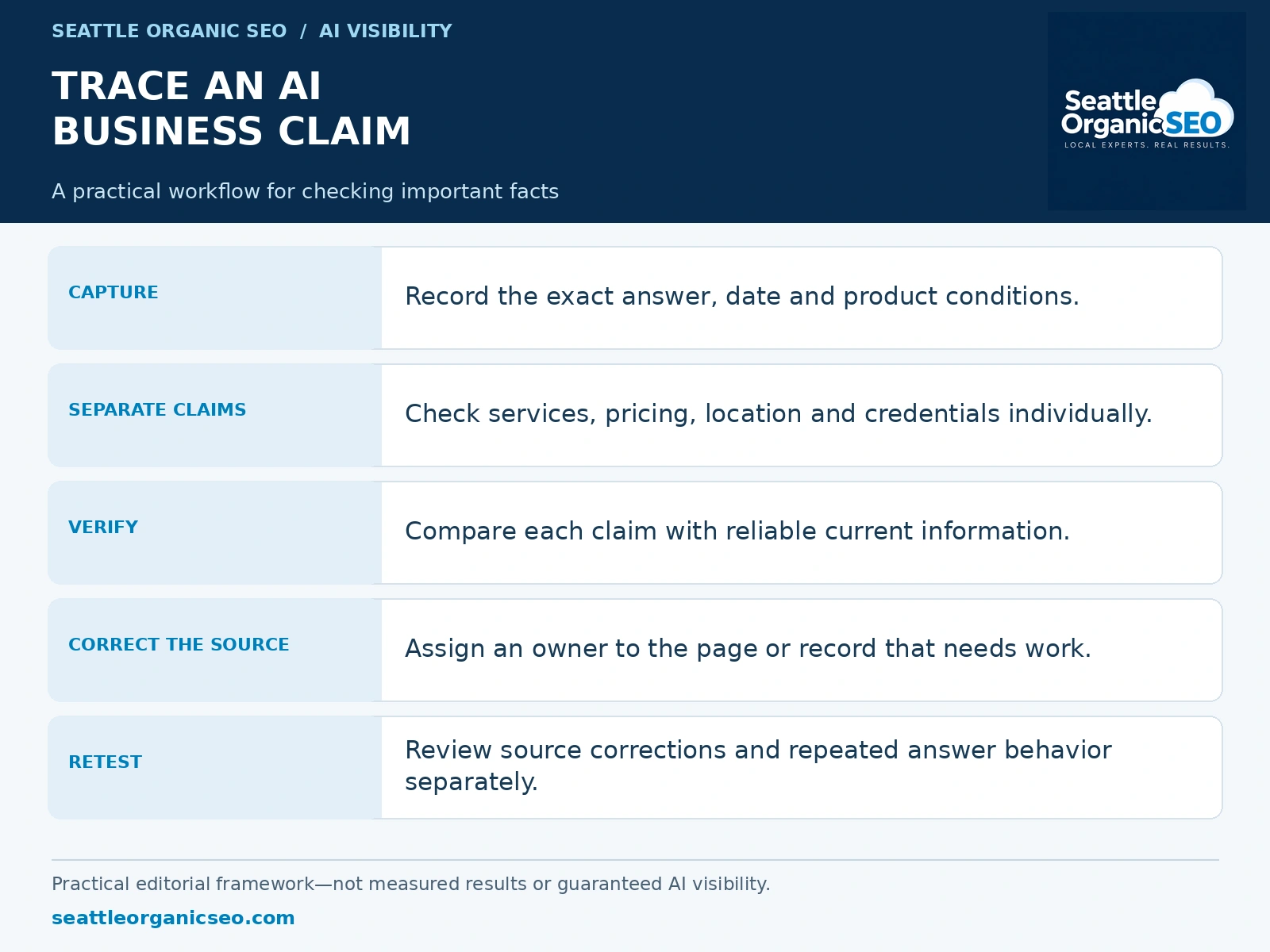
Label each factual statement as verified accurate, verified inaccurate, outdated, conflicting or unverified. An unverified claim is not automatically false. An old claim is not necessarily still true. Those distinctions tell you what evidence you need next.
| Record | Why it matters |
|---|---|
| Exact claim and response date | Makes the error reproducible enough to investigate |
| Product, mode and conversation context | Helps explain different answers |
| Linked source and relevant passage | Shows what was actually available |
| Authoritative current fact | Establishes the correction |
| Owner of the source | Identifies who can change it |
| Business consequence | Sets a reasonable priority |
Fix the source you control first
A website can contradict itself without anyone noticing. The service page explains one fee arrangement. An old PDF shows another. A former team member remains on a location page. A cached promotion is still reachable through an internal link.
Choose a person to own each important fact. Put the current explanation where customers would expect it. Reconcile contradictory pages, maintain useful historical context when necessary and remove misleading internal links. Redirect genuinely replaced pages to relevant replacements rather than sending everything to the homepage.
Google’s guidance for its AI search features emphasizes readable text, discoverable pages, current business information and structured data that agrees with the visible content. These are sound places to investigate inconsistency. They are not a promise that an assistant will immediately adopt your correction.
If the problem is incomplete information, explain the missing distinction. “Prices vary” might be true and still leave the central buying question unanswered. A useful fee page can explain what the quote includes, what changes it and how the customer gets a reliable estimate.
What is AI telling people about your business?
We can review factual claims, trace the available sources and prioritize corrections to information that affects customer decisions.
Then work through third-party sources
You may control your business profile but not a directory’s editorial description. You may be able to request a correction from a publisher but not compel one. Keep a record of the actual source owner, the requested correction and the supporting evidence.
Start with material inaccuracies in relevant sources. An incorrect booking link deserves attention. A low-quality page no customer or test ever encounters may deserve much less. Do not turn an accuracy project into an endless search for every mention of your name.
When a source is accurate but unfavorable, investigate the substance. A legitimate complaint or disclosed limitation is not an error to be erased. Better service, clearer policies and a thoughtful response may be the appropriate business work.
What if you cannot trace the error?
Sometimes the answer offers no useful citation. Sometimes the apparent source is current but the response still gets a detail wrong. Do not invent a technical explanation because the client expects one.
Record the uncertainty. Use the product’s available feedback or reporting channel when appropriate. Improve the authoritative information you control, then repeat the test in fresh conversations. A correction entered into one conversation does not demonstrate a change in what other users will receive.
The surrounding research reinforces the need to specify the setting. Ahrefs’ October 2026 study of ChatGPT responses observed both search-backed and non-search answers in its dataset. Its findings describe that particular sample and period; they should not be treated as a permanent rule for all modes or users.
Prioritize consequences before counting errors
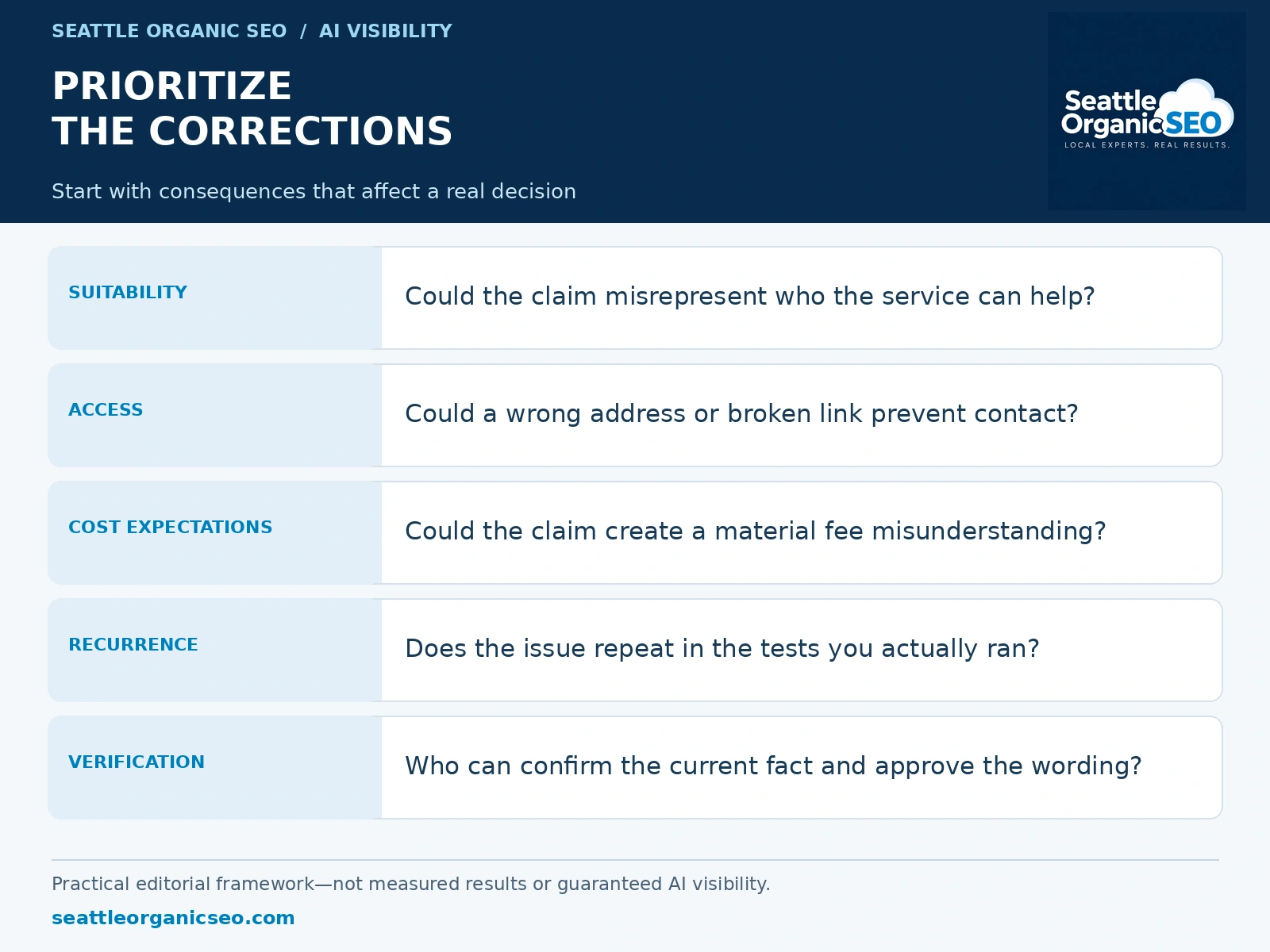
A wrong medical credential, an inaccurate eligibility statement or a broken contact route may deserve immediate investigation. A minor descriptive adjective usually does not deserve the same attention. Have the appropriate qualified person review corrections involving professional services and regulated claims.
A useful triage order is: could the claim mislead someone about suitability or safety; could it prevent a legitimate inquiry; could it create a financial misunderstanding; and how often is it appearing in the tests you actually ran?
That last question is about your observed sample. It does not establish how many real customers saw the error. Keep the distinction visible when reporting urgency.
Build a fact ledger your team can maintain
A practical accuracy project starts with a short ledger of important facts. For each item, record the approved wording, the person responsible for confirming it, the public page where it belongs and the date it was last checked. Include relevant exceptions. “Appointment requests are reviewed on business days” is more precise than an unqualified promise of immediate availability.
Keep the ledger focused on decisions customers actually make. A law firm might maintain jurisdictions, practice areas, consultation terms and the point at which representation begins. An optometry practice might maintain appointment types, fitting fees, access information and the correct route for urgent concerns. A restaurant might maintain current menus, service charges, reservation terms and its process for dietary requests.
The ledger is an internal reference for maintaining consistent information. It is not a special file you must publish for AI systems. Its value is organizational: the next employee editing a page can find the approved policy instead of guessing or copying an old version from a search result.
Assign responsibility for changes, too. When a person leaves, a service changes or a location moves, update the authoritative page and review the places that repeat the fact. A quarterly review may catch slow drift, but an operational change should trigger a check when it happens.
This is where an accuracy audit becomes useful beyond a marketing exercise. It gives your team a way to keep the facts coherent after the initial cleanup. Without that owner and process, the next website edit can recreate the same contradiction.
Work through a pricing error without promising control of the assistant
Imagine a hypothetical consultancy whose old PDF describes a free diagnostic conversation. The current offering is a paid assessment with a defined deliverable. An assistant presents the old arrangement as current. This example is invented to illustrate a correction workflow; it is not a report about a real firm.
First confirm the actual offer with the business owner. Then inspect the old document and the current service page. Decide whether the PDF should remain available as historical material, be clearly marked as outdated, or be replaced with an appropriate redirect. Make the current assessment, fee basis and deliverable unambiguous on the service page.
Next check the links people can still follow to the old document, including relevant external sources. Ask source owners to update inaccurate descriptions where appropriate. Maintain a record of the request and the evidence supplied, rather than assuming a third party has made the change because an email was sent.
Repeat the original question after the source work, keeping the observation conditions as comparable as possible. If the assistant still gives the old answer, record whether it cites the PDF, another page or nothing traceable. That is a finding for the next investigation. It does not justify promising that another edit will force a particular answer.
Brief the sales team while the correction work is underway. If an inquiry arrives expecting a free deliverable, the team needs a clear, respectful explanation of the current offering. Correcting a public record and handling a real misunderstanding are related tasks with different owners and timelines.
Define what a resolved issue means
Use separate statuses for source work and answer behavior. “Our service page has been corrected” is one completed task. “The external directory accepted the update” is another. “The inaccurate claim stopped appearing within our repeated tests” is an observation with a defined scope. None should silently stand in for the others.
For issues involving credentials, eligibility, safety or professional scope, have an appropriately qualified person confirm the correction. For ordinary operational details, use the person who can verify the policy. That review can be brief, but the final public wording should agree with how the business actually operates.
Keep an exception log for claims that cannot yet be verified. An assistant might assert a feature you have never offered, with no identifiable source. You can publish an accurate description of your real offering and use available reporting channels, while stating honestly that the origin of the incorrect claim remains unknown.
Revisit recurring issues as part of a defined maintenance review. Compare the exact claim, the sources used and the test conditions over time. A successful project leaves your team with a manageable process for maintaining the record and a better way to identify consequential inaccuracies when they reappear.
Measure whether the record improves
Keep the original claims and dates. Repeat a fixed set of questions under comparable conditions and report how often the factual errors recur. Note changed sources and whether the assistant searched. Keep a separate log of customer complaints or misdirected inquiries that could plausibly relate to the same issue.
Allow for delay and variation. Updating a page today does not tell you when a particular system will retrieve it, or whether it will use it. The audit should end with an owner and a follow-up date for each material correction.
Accurate business information is a worthwhile operational asset even when you cannot isolate an AI effect. It helps your staff, customers and other referral sources explain what you actually do. That gives the work a practical value beyond the next screenshot.
You do not need an assistant to describe your business in glowing language. You need people to receive information they can trust when deciding whether to contact you.
Sources and scope
The examples and proposed tests in this article are illustrative. They are not client case studies, measured findings about a named business, or evidence that a particular change will produce AI recommendations.
Written by the Seattle Organic SEO Team
The Seattle Organic SEO team combines more than 30 years of hands-on client experience across SEO, paid media, email marketing and affiliate marketing. Our team has worked for leading technology companies, including Amazon, Expedia and Google-acquired DoubleClick. We bring that experience to source-based research, transparent analysis and practical guidance for Seattle businesses. Learn more about our team and approach.
Protect the facts customers use to choose you
Ask Seattle Organic SEO about a brand accuracy audit covering your website, relevant external sources and repeated AI-answer checks.