
If you’ve been hiding under a rock, you probably will not know that artificial intelligence (AI) has started to take over the world across all sectors. ChatGPT is now the 4th most trafficked website (as of Sep 2025 @SEMRush): 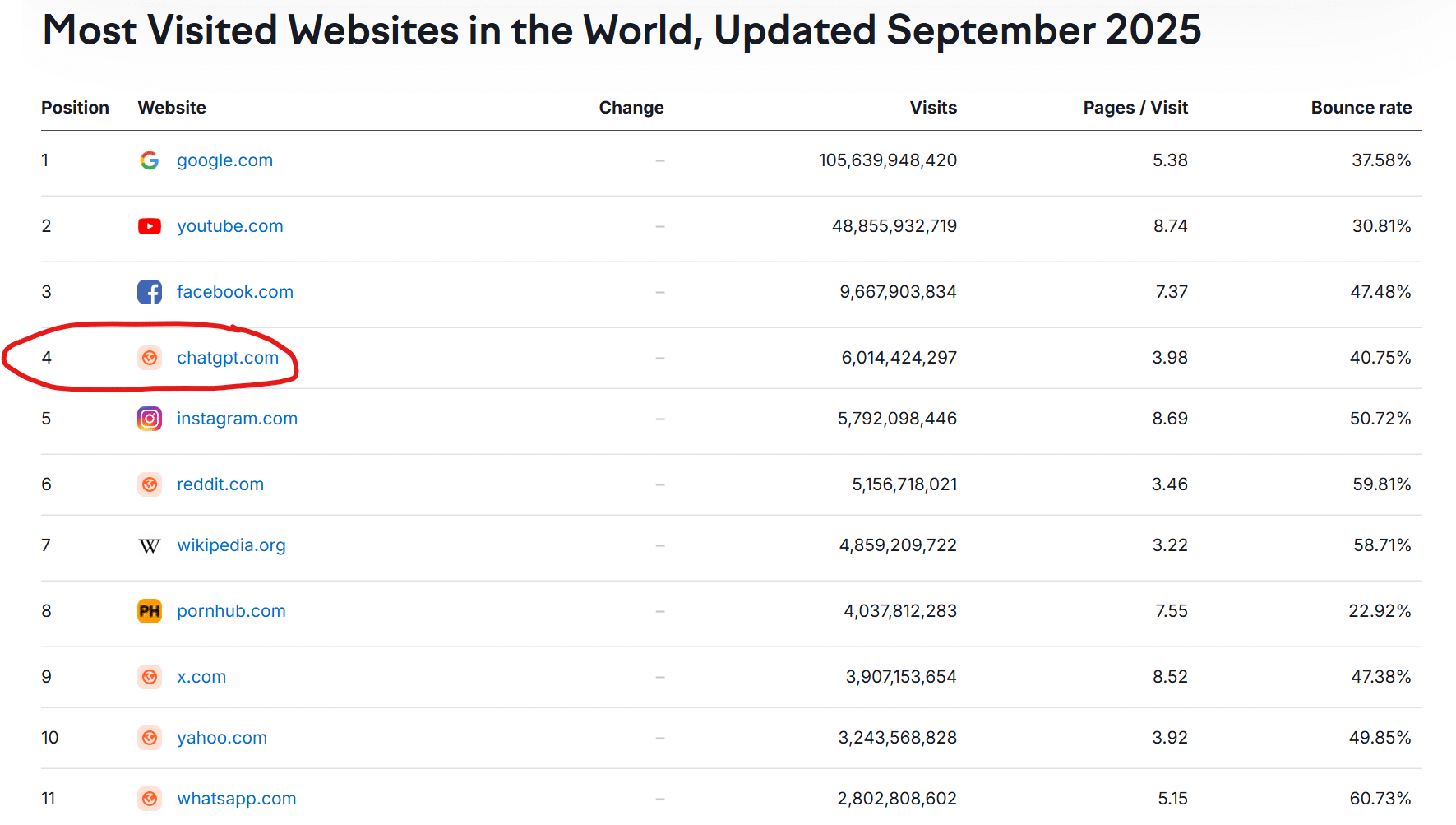
As a result, there’s been a significant trend towards figuring how to leverage this hype. One of those supporting trends is all the nomenclature around the topic. So, here’s the most complete breakdown covering AEO, AI-driven ranking factors, AI-search behaviors, and optimization frameworks.
🟦 AEO — Answer Engine Optimization
AEO is the practice of optimizing content so AI assistants, LLMs, and answer engines choose your content as the source for an instant answer.
Core AEO Principles
-
Structured, direct answers (first ~50 words)
-
Conversational question/answer formats
-
Authority signals (EEAT + author identity + credentials)
-
Evidence-rich content (stats, steps, citations)
-
Semantic search alignment (entity-first writing)
-
LLM-friendly formatting
-
Multi-perspective coverage (completeness)
-
Zero-click resilience strategy
🟦 AI SEO (AEO + Generative Search Optimization)
Here are ALL the major AI SEO concepts grouped by category.
⭐ 1. AI-Search Optimization Fundamentals
1.1 GSO – Generative Search Optimization
Optimizing content for generative AI search results, not just blue links.
1.2 LLM-SEO (Large Language Model SEO)
Optimizing so LLMs select your content as a training-signal-quality source.
1.3 AIO – AI Information Optimization
Ensuring information is structured so AI parsers can easily ingest it.
1.4 CIO – Conversational Intent Optimization
Writing content so it matches how humans ask LLMs questions, not Google queries.
1.5 PRO – Prompt-Response Optimization
Structuring pages to align with the way LLMs break down instructions and prompts.
⭐ 2. AI Engine-Specific Optimization Types
2.1 ChatGPT SEO
Optimizing to appear in:
-
ChatGPT’s “Search Responses”
-
ChatGPT’s “Suggested Sources”
-
GPT’s browsing summaries
2.2 Perplexity SEO
Optimizing for:
-
Citations
-
Depth-first knowledge graphs
-
Multi-source synthesis
2.3 Google Gemini SEO
Optimizing for:
-
AI Overviews
-
Contextual inline citations
-
Fact-heavy summaries
2.4 Brave Leo SEO
Optimizing for:
-
Privacy-first citation models
-
Content credibility scoring
2.5 Claude SEO
Optimizing for:
-
High-quality, structured reasoning content
-
Ethics/accuracy signals
2.6 DeepSeek SEO
Optimizing for:
-
Technical depth
-
Dense, fact-driven sources
-
Multi-lingual entity mappings
⭐ 3. AI-Friendly Content Structuring Concepts
3.1 QSF — Question Structure Format
Creating headings using full questions:
-
“How much does ___ cost?”
-
“What is the best way to ___?”
LLMs prefer Q&A blocks.
3.2 MRE — Multi-Response Enrichment
Adding:
-
lists
-
steps
-
definitions
-
examples
-
case studies
-
templates
These maximize LLM surface area.
3.3 MECE Content Architecture
Mutually Exclusive, Collectively Exhaustive sections — LLMs love this clarity.
3.4 Entity-First SEO
Focus on:
-
people
-
organizations
-
locations
-
products
-
concepts
-
identifiers (IDs, SKUs, schema IDs)
Entities are the foundation of AI knowledge graphs.
3.5 Triple-Verified Claims
LLMs prefer content that includes:
-
Statistic
-
Source type
-
Explanation
⭐ 4. AI Ranking Factors (2025)
4.1 Data Integrity Score
Accuracy, citations, factuality.
4.2 Author Knowledge Graph
Your brand and authors mapped to topics across the web.
4.3 Trust-Weighted Signals
Association with:
-
universities
-
.gov
-
.org
-
industry bodies
-
high-authority brands
4.4 Temporal Freshness
LLMs boost content that signals:
-
updated recently
-
time-bound (e.g., “2025 guide”)
-
trends
4.5 Multi-Format Reinforcement
Content that appears:
-
YouTube
-
PDF guides
-
social posts
-
podcasts
becomes more “trusted” in AI inference.
⭐ 5. AI-Technical SEO Concepts
5.1 Structured Data for AI (SD4AI)
Schema markup optimized for LLM ingestion:
-
FAQ
-
HowTo
-
QAPage
-
Person/Organization enriched
-
Product + Reviews + Pros/Cons
5.2 LLM Feeder Blocks
Small blocks of content designed for AI summarization:
-
Tables
-
Definitions
-
Bullet lists
-
Comparisons
5.3 Vector Semantic Optimization
Aligning content to vector search using:
-
synonyms
-
embeddings
-
paraphrased intent variants
5.4 KI (Knowledge Indexability)
How easily an AI system can convert your content into knowledge graph entries.
5.5 Linking for AI
Internal linking tailored to:
-
semantic clusters
-
topic graphs
-
intent flows
⭐ 6. AI-Oriented Distribution Concepts
6.1 LCT – LLM Content Training Exposure
Publishing in places that LLMs crawl & scrape most:
-
Reddit (public)
-
Wikipedia
-
Medium
-
Product review sites
-
GitHub
-
Public blogs
-
X/Twitter threads
-
News sites
6.2 Source Proximity Optimization (SPO)
Being cited next to authoritative domains increases chance of inclusion.
6.3 AI-Agent Findability
Optimizing so AI personal agents find/choose your brand.
⭐ 7. AI Competitive Concepts
7.1 LLM Surface Area Expansion
Creating more entry points for AI systems to quote you.
7.2 Multi-Intent Capture
Covering all variants:
-
beginner
-
expert
-
technical
-
action steps
-
purchasing intent
-
troubleshooting
7.3 Answer Density
Your content should contain more answers per 100 words than competitor pages.
⭐ 8. Future-Proof AI SEO Concepts
Semantic Traceability
LLMs prefer content with clear lineage:
-
who wrote it
-
what data was used
-
how conclusions were reached
Model-Ready Explainability
Content structured like:
-
reasoning
-
decision trees
-
step-by-step breakdowns
Synthetic Reinforcement
Using AI agents to simulate user behavior (ethically) to improve ranking signals.
So, what’s next after learning about this? How about a full AEO playbook?
For more blog posts in this series about “AI, AEO & the Future of Marketing in the AI Age”:
- AI & Marketing in 2026: How Artificial Intelligence Is Redefining Strategy, Tools, and Results
- Should We Use AI in Content Marketing?
- How AI Search Engines Rank Content (Beyond Keywords & Backlinks)
- Vector Search Explained for SEO Teams (And How to Optimize for It)
- Entity-First SEO: Optimizing for Knowledge Graphs & AI Memory
- Search Without SERPs: How Zero-Click & Answer-Only Results Change SEO