Entity-First SEO: Optimizing for Knowledge Graphs & AI Memory
17 min read
Entity-First SEO: Optimizing for Knowledge Graphs & AI Memory
Entities, relationships, and authority signals
The evolution from keyword-based to entity-based search represents one of the most profound shifts in how search engines and AI systems understand content. While most SEO professionals still think in terms of keywords and topics, modern AI systems think in terms of entities—distinct people, places, things, concepts, and the relationships between them.
Google’s Knowledge Graph contains billions of entities and their relationships. AI systems like ChatGPT maintain entity understanding across conversations. Perplexity builds entity-rich answers that connect concepts, organizations, and people. Understanding and optimizing for entity-based search is no longer optional—it’s foundational to modern SEO success.
This guide explores what entities are, how knowledge graphs work, how AI systems use entity understanding, and most importantly, how SEO teams can optimize for entity-first search to build authority, improve rankings, and establish brand prominence in AI memory.
Understanding Entities: Beyond Keywords to Things
Before diving into optimization strategies, we need a clear understanding of what entities are and how they differ from traditional keyword concepts.
What Are Entities in Search?
An entity is a distinct, identifiable thing or concept that exists independently. Entities have:
Unique Identity: Each entity is singular and distinguishable. “Apple Inc.” is a distinct entity from “apple (fruit)” despite sharing the same word.
Attributes: Entities possess characteristics that define them. Apple Inc. has attributes like founded date (1976), founders (Steve Jobs, Steve Wozniak, Ronald Wayne), headquarters location (Cupertino, California), and industry (technology).
Relationships: Entities connect to other entities through meaningful relationships. Apple Inc. is connected to Steve Jobs (founder), iPhone (product), NASDAQ (stock exchange), and countless other entities.
Context Independence: Entities maintain meaning regardless of context. “Tesla” refers to the same company entity whether mentioned in an article about electric vehicles, stock markets, or Elon Musk.
Entities vs. Keywords: The Critical Distinction
Keywords are text strings that may or may not refer to entities:
“Apple” as a keyword could mean:
Apple Inc. (entity: technology company)
Apple (entity: fruit)
The Apple Records (entity: record label)
Big Apple (entity: nickname for New York City)
Entity understanding resolves this ambiguity by recognizing which specific entity the content discusses based on context.
Search engines have evolved from matching keyword strings to understanding which entities content discusses and how those entities relate to user intent.
Types of Entities
Search engines and AI systems recognize multiple entity types:
People: Individuals, both living and historical (Elon Musk, Marie Curie, Taylor Swift)
Organizations: Companies, institutions, government bodies (Microsoft, Harvard University, United Nations)
Locations: Places at all scales (Paris, Yosemite National Park, Coffee Shop on Main Street)
Products: Specific products and product lines (iPhone 15 Pro, Tesla Model Y, Photoshop)
Events: Specific occurrences (Super Bowl LVIII, COVID-19 pandemic, Moon landing)
Concepts: Abstract ideas and topics (artificial intelligence, democracy, photosynthesis)
Creative Works: Books, movies, songs, artworks (The Great Gatsby, Inception, Mona Lisa)
Other Entities: Diseases, medical treatments, chemical compounds, biological species, and countless other categorizable things
Each entity type has characteristic attributes and relationship patterns that AI systems understand and utilize.
Knowledge Graphs: The Foundation of Entity Understanding
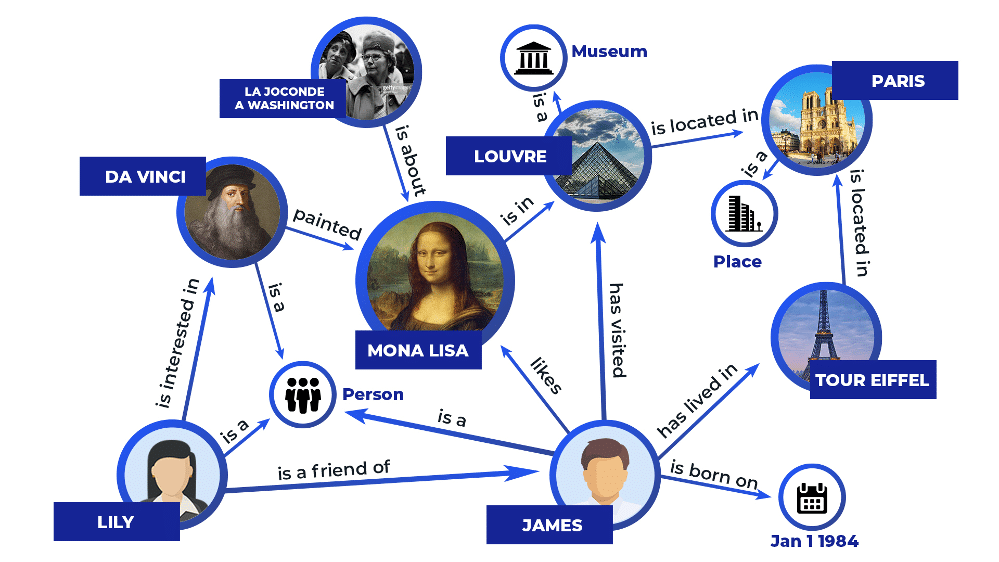
Knowledge graphs are massive databases that store entities and their relationships in structured formats. Understanding how they work is essential for entity optimization.
How Knowledge Graphs Are Structured
Knowledge graphs use a triple structure: Subject – Predicate – Object
Examples:
Apple Inc. – founded by – Steve Jobs
Steve Jobs – birth date – February 24, 1955
iPhone – manufactured by – Apple Inc.
Apple Inc. – headquarters location – Cupertino, California
These triples form a vast network where entities (nodes) connect through relationships (edges), creating a web of semantic meaning.
Major Knowledge Graphs
Several significant knowledge graphs power modern search and AI:
Google Knowledge Graph: Contains over 500 billion facts about 5 billion entities. Powers Google Search features like knowledge panels, featured snippets, and increasingly, AI overviews.
Wikidata: Open knowledge graph with over 100 million entities. Many AI systems use Wikidata as a reference source for entity information.
DBpedia: Structured information extracted from Wikipedia, containing millions of entities with extensive relationship mapping.
Microsoft Satori: Powers Bing’s entity understanding and knowledge panel features.
Enterprise Knowledge Graphs: Many organizations build proprietary knowledge graphs for internal AI systems, customer support, and information retrieval.
How AI Systems Use Knowledge Graphs
AI systems leverage knowledge graphs in multiple ways:
Entity Disambiguation: When content mentions “Jordan,” the system uses context (basketball, shoes, country, river) to identify the correct entity.
Relationship Understanding: AI recognizes that if content discusses Tesla and Elon Musk together, it’s likely discussing the company-CEO relationship.
Inference and Reasoning: If content mentions “the iPhone 15 launch event,” AI can infer relationships to Apple Inc., Tim Cook, California, and related product entities without explicit statement.
Query Understanding: When users search “who founded Tesla,” AI understands this queries a founder-company relationship for a specific entity.
Answer Synthesis: AI pulls entity attributes from knowledge graphs to construct answers: “Tesla was founded by Martin Eberhard and Marc Tarpenning in 2003, with Elon Musk joining shortly after as chairman.”
Entity Recognition and Extraction
For your content to contribute to and benefit from knowledge graphs, AI systems must first recognize the entities you discuss.
Named Entity Recognition (NER)
AI systems employ Named Entity Recognition to identify entities in text:
Surface Form Detection: Identifying text spans that might be entities (“Apple,” “New York,” “quantum computing”)
Classification: Categorizing potential entities by type (person, organization, location, concept)
Linking: Connecting detected entities to specific entries in knowledge graphs (linking “Apple” in context to Apple Inc. entity, not fruit entity)
Attribute Extraction: Identifying entity attributes mentioned in text (“founded in 1976” becomes an attribute of Apple Inc.)
Improving Entity Recognition in Your Content
Help AI systems accurately recognize entities:
Use Full Entity Names Initially: First mention should use complete, official names: “Apple Inc.” rather than just “Apple,” “Amazon Web Services (AWS)” before using “AWS”
Provide Disambiguating Context: Include context that clarifies which entity you’re discussing: “Apple, the technology company based in Cupertino” versus “apple, the fruit”
Maintain Consistent Naming: Use consistent entity references throughout content. Don’t alternate randomly between “Google,” “Alphabet,” and “the search giant”
Include Entity Identifiers: When relevant, include unique identifiers: stock symbols (AAPL), official designations, or other standard identifiers
Link to Authoritative Sources: Link entity mentions to authoritative sources (company websites, Wikipedia, official databases) that help confirm entity identity
Building Entity Authority
Not all entity mentions carry equal weight. AI systems evaluate entity authority—how credible and authoritative a source is about specific entities.
What Is Entity Authority?
Entity authority represents how much search engines and AI systems trust your content as a reliable source of information about specific entities.
High entity authority means:
AI systems cite your content when discussing those entities
Knowledge graphs may incorporate information from your content
Your content ranks highly for entity-related queries
You appear in knowledge panels and entity-focused features
Factors That Build Entity Authority
Topical Consistency: Regularly publishing quality content about specific entities or entity categories builds authority. A site consistently covering artificial intelligence entities (companies, researchers, technologies) develops AI-entity authority.
Relationship Density: Content that accurately describes entity relationships demonstrates deep understanding. Discussing how OpenAI relates to Microsoft, GPT-4, Sam Altman, and AI safety shows comprehensive entity knowledge.
Attribute Accuracy: Providing accurate, up-to-date entity attributes (founding dates, locations, specifications) builds trust in your content as an entity information source.
Primary Source Status: Being the authoritative source for certain entities (your own company, your products, your team members) establishes baseline authority that can extend to related entities.
External Validation: When other authoritative sources cite your entity information, link to your content, or reference your descriptions, your entity authority strengthens.
Structured Data Implementation: Schema.org markup and other structured data explicitly signal entity information to search engines, reinforcing your authority on those entities.
Entity Authority Optimization Strategies
Claim Your Entity: For brands and individuals, claim and optimize your knowledge panel, Google Business Profile, and other entity-defining properties.
Become the Primary Source: Create the most comprehensive, accurate resources about specific entities—products you sell, people in your organization, concepts you specialize in.
Build Entity Clusters: Create content networks that comprehensively cover entity clusters—all related products, all team members, all service locations, all related concepts.
Update Entity Information: Maintain current, accurate information about key entities. When attributes change (new CEO, new product launch, updated specifications), update your content promptly.
Document Entity Relationships: Explicitly describe how entities relate: “John Smith, CEO of TechCorp, previously worked at Google and holds a PhD from MIT.”
Schema Markup: Explicit Entity Signaling
Schema.org markup provides the most direct way to communicate entity information to search engines and AI systems.
Core Entity Schema Types
Implement appropriate schema types for entities you discuss:
Organization Schema: For companies, nonprofits, educational institutions
json
{
“@context”:“https://schema.org”,
“@type”:“Organization”,
“name”:“TechCorp Inc.”,
“url”:“https://techcorp.com”,
“logo”:“https://techcorp.com/logo.png”,
“foundingDate”:“2020-01-15”,
“founder”: {
“@type”:“Person”,
“name”:“Jane Smith”
},
“address”: {
“@type”:“PostalAddress”,
“streetAddress”:“123 Innovation Drive”,
“addressLocality”:“San Francisco”,
“addressRegion”:“CA”,
“postalCode”:“94103”
}
}
Person Schema: For individuals (team members, authors, executives)
Article Schema: Explicitly identify entities discussed in content
json
{
“@context”:“https://schema.org”,
“@type”:“Article”,
“headline”:“How AI Transforms Customer Service”,
“author”: {
“@type”:“Person”,
“name”:“Jane Smith”
},
“about”: [
{
“@type”:“Thing”,
“name”:“Artificial Intelligence”
},
{
“@type”:“Thing”,
“name”:“Customer Service”
}
],
“mentions”: [
{
“@type”:“Organization”,
“name”:“OpenAI”
},
{
“@type”:“Product”,
“name”:“ChatGPT”
}
]
}
Advanced Schema Implementation
Nested Entities: Show entity relationships through nested schema structures that mirror knowledge graph relationships.
SameAs Properties: Use sameAs to link your entity to authoritative external identifiers (Wikipedia, Wikidata, social profiles, official registrations).
AboutPage Schema: Create dedicated entity pages with AboutPage schema that comprehensively describe entities.
Event Schema: For events, conferences, webinars that become entities in knowledge graphs.
Review and Rating Schema: Entity-associated reviews contribute to entity understanding and knowledge panel displays.
Optimizing Content for Entity Association
Beyond schema markup, content optimization should facilitate strong entity associations.
Entity-Centric Content Structure
Entity Introduction Sections: Dedicate clear sections to introducing and defining key entities early in content.
Entity Attribute Tables: Use structured tables to display entity attributes (specifications, features, characteristics).
Entity Comparison Sections: Explicitly compare related entities, helping AI understand entity relationships and distinctions.
Entity Timelines: For entities with temporal dimensions, create timelines showing entity evolution and key milestones.
Entity Relationship Mapping
Explicit Relationship Statements: Clearly state entity relationships: “X is the founder of Y,” “Product A is manufactured by Company B,” “Concept C relates to Theory D.”
Relationship Context: Provide context for relationships: “While both competitors in cloud computing, Amazon Web Services and Microsoft Azure take different approaches to…”
Network Diagrams: Visual representations of entity relationships can be parsed by AI vision systems and reinforce relationship understanding.
Cross-Linking Strategy: Internal linking between entity-focused pages creates explicit relationship signals. Link company pages to founder pages, product pages to manufacturer pages, concept pages to related concept pages.
Entity-Rich Anchor Text
Descriptive Entity Anchors: Use full entity names in anchor text: “Read more about [Apple’s M-series processors]” rather than generic “click here”
Relationship-Describing Anchors: Anchor text that describes relationships: “Steve Jobs, co-founder of Apple” rather than just “Steve Jobs”
Attribute-Including Anchors: Include key attributes in link context: “Tesla, the electric vehicle manufacturer based in Austin, Texas”
Knowledge Panel Optimization
Knowledge panels are the ultimate expression of entity prominence—Google’s public declaration that you are a recognized entity.
Obtaining a Knowledge Panel
Not all entities automatically receive knowledge panels. To increase likelihood:
Establish Notability: Entities need sufficient notability—coverage in independent, reliable sources. Build press coverage, industry recognition, and third-party mentions.
Wikipedia Presence: While not required, Wikipedia articles significantly increase knowledge panel probability. For entities meeting Wikipedia’s notability standards, create or improve Wikipedia articles.
Wikidata Entry: Create or enhance your Wikidata entry with comprehensive attributes and relationships. Many knowledge panels pull directly from Wikidata.
Consistent NAP: For local entities, maintain consistent Name, Address, Phone across directories, citations, and profiles.
Knowledge Graph Verification: Use Google’s entity feedback tools to suggest corrections or claim your entity.
Optimizing Existing Knowledge Panels
If you have a knowledge panel:
Claim and Verify: Use Google’s verification process to gain some control over knowledge panel content.
Complete All Fields: Ensure all available attributes are populated—social profiles, official website, description, images, contact information.
Monitor and Correct: Regularly review knowledge panel information for accuracy. Submit corrections when errors appear.
Rich Media: Ensure high-quality images, logos, and other media assets are available for knowledge graph use.
Maintain Consistency: Information in your knowledge panel should match information on your website, social profiles, and structured data.
Personal Brand as Entity
For executives, thought leaders, authors, and professionals, optimizing your personal entity is increasingly important.
Building Personal Entity Authority
Professional Website: Maintain a personal website with comprehensive About page and structured Person schema.
Consistent Profiles: Maintain consistent information across LinkedIn, Twitter, professional directories, and other platforms. Use identical name formatting, profile photos, and biographical information.
Content Authorship: Publish bylined content on authoritative platforms. Use author schema and rel=author markup.
Speaking and Appearances: Document speaking engagements, conference appearances, podcast interviews—all entity activities that build authority.
Research and Publications: Academic publications, patents, whitepapers establish expertise entity associations.
Media Coverage: Third-party coverage in reputable publications builds entity recognition and authority.
Connecting Personal and Organizational Entities
Employment Relationships: Clearly establish and update employment relationships through schema, LinkedIn, and website content.
Founder/Leadership Roles: Highlight founder, board member, or executive positions that create strong personal-organizational entity bonds.
Spokesperson Status: Regular representation of your organization builds association between your personal entity and organizational entity.
Entity SEO for Different Entity Types
Different entity types require specialized optimization approaches.
Advanced Schema Implementation: Deploy sophisticated structured data
Nested entity relationships
SameAs properties to authoritative sources
Event and action schema
Review and rating schema
Phase 4: Measurement and Refinement (Month 7-12)
Establish Entity KPIs: Implement tracking for entity metrics
Knowledge panel monitoring
Entity mention tracking across AI platforms
Citation frequency analysis
Entity ranking performance
Continuous Optimization: Refine based on performance data
A/B test schema implementations
Update entity information regularly
Expand high-performing entity content
Address entity gaps and inaccuracies
Scale Successful Tactics: Expand entity optimization across content portfolio
Template entity-optimized content structures
Systematize entity markup
Document entity optimization guidelines
Train team on entity-first thinking
Common Entity SEO Mistakes to Avoid
Mistake 1: Inconsistent Entity References
Problem: Alternating between different names/terms for the same entity confuses AI systems.
Solution: Establish and maintain consistent entity naming conventions. Create a style guide specifying preferred entity references.
Mistake 2: Ignoring Entity Disambiguation
Problem: Failing to clarify which entity you’re discussing when names are ambiguous.
Solution: Always provide disambiguating context for ambiguous entity names, especially on first mention.
Mistake 3: Incomplete Schema Markup
Problem: Implementing minimal schema without leveraging available properties and relationships.
Solution: Use comprehensive schema that documents entity attributes, relationships, and context fully.
Mistake 4: Static Entity Information
Problem: Failing to update entity information as attributes change.
Solution: Implement regular audits and updates for entity content, especially for rapidly evolving entities.
Mistake 5: Neglecting Entity Relationships
Problem: Documenting entities in isolation without showing how they relate to other entities.
Solution: Explicitly document and link entity relationships through content, schema, and site structure.
The Future of Entity-Based Search
Entity understanding will continue deepening across search and AI systems:
Multi-Modal Entity Recognition
AI systems will increasingly recognize entities across images, video, audio, and text—creating richer entity understanding from multimedia content.
Dynamic Entity Relationships
Knowledge graphs will capture temporal and conditional relationships—understanding how entity relationships change over time or in different contexts.
Personalized Entity Graphs
Search and AI systems may build personalized entity graphs based on individual user interactions, preferences, and context.
Entity-Based Personalization
Content and search results increasingly personalized based on entity preferences, relationships, and history.
Predictive Entity Association
AI systems will predict likely entity interests and associations, surfacing content about entities before explicit queries.
Thinking in Entities, Not Just Keywords
The shift to entity-based search represents search engines and AI systems finally understanding content the way humans do—as discussions of specific things, people, places, and concepts connected through meaningful relationships.
For SEO teams, this shift requires fundamental changes in how we conceptualize content, measure success, and optimize for discovery. Keywords remain relevant as the language that references entities, but the underlying optimization target is entity understanding, entity authority, and entity relationships.
The brands and creators that thrive in this entity-first era will be those who:
Establish clear entity identities through consistent naming and comprehensive definition
Build deep entity authority through specialized, accurate, regularly updated content
Document entity relationships explicitly through content and structured data
Optimize for how AI systems recognize, understand, and retrieve entity information
Start your entity optimization today by auditing your core entities, implementing comprehensive schema markup, creating entity hub pages, and building content that establishes your authority on the entities that matter most to your business.
In the knowledge graph era, the question isn’t just “what keywords do you rank for?”—it’s “what entities do search engines and AI systems associate with your brand, and how authoritative do they consider you on those entities?”
Master entity-first SEO, and you master the future of search.
If you would like to read more about AI, AEO & the Future of Marketing in the AI Age, check out: