Published April 14, 2026 | Local SEO | 8 min read
Plain English for business owners who are confused — and honestly should be, because barely anyone explains this right.
Let’s say you run a plumbing company. You’ve spent money on SEO. You rank well on Google. Customers find you. Life is good.
Then someone on your team says, “We need to be doing GEO now.” And you smile and nod, and the moment they walk out of the room, you type it into Google like every sane person would.
Here’s the thing: most of what comes up is written for marketers, not for you. So let’s fix that.
The phone book vs. the front desk person
Here’s the simplest way to think about it:
For decades, SEO has been about showing up when someone searches Google. You optimize your website, build links, get reviews — and Google ranks you somewhere on page one. Someone searches “plumber in Seattle,” sees your listing, clicks it. That’s SEO working.
GEO — which stands for Generative Engine Optimization, though the name barely matters — is about showing up when someone asks an AI. ChatGPT. Perplexity. Google’s AI Overview. The little box that now sits above the search results and just… answers the question directly.
When someone types “what should I look for in a plumber” into one of these tools and it gives them a two-paragraph answer, whose business do you think gets mentioned?
That’s what GEO determines.
Why this matters even if your SEO is great
This is the part most articles skip, so pay attention.
Being ranked number one on Google does not mean you show up in AI answers. These are completely separate systems. A brand-new page with the right structure can become a primary AI citation within weeks of being published — regardless of how old the domain is or how many backlinks it has. Meanwhile, a page that’s ranked on Google for three years might never appear in a single AI response.
And the reason this matters more than it used to? Google searches are quietly changing what they deliver.
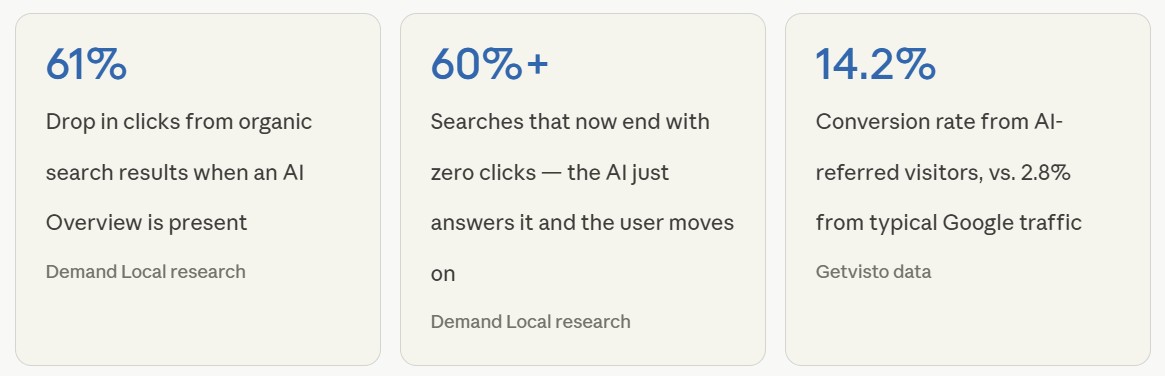
That last number deserves a second look. When someone finds your business through an AI citation — meaning an AI recommended you — they convert at a dramatically higher rate. The reason is simple: they’ve already been educated. By the time they get to your site, the AI has already explained what you do, why it matters, and why you’re worth considering. They’re not browsing. They’re ready.
So do you actually need both?
Most small businesses should be thinking about both — but they’re not the same investment, and right now, the gap between businesses doing GEO and businesses ignoring it is widening fast.
Traditional SEO is still worth doing. Google isn’t dead. But the way search traffic behaves is shifting. If six out of ten searches in your category are answered directly by an AI without anyone clicking through, and the people who do click through via AI recommendations convert five times better… that’s not a footnote. That’s the whole business case.
GEO is also different in how you do it. It’s less about keywords and more about clarity. AI systems pull from sources that are well-organized, direct, and easy to extract information from. That means your website content needs to actually answer questions — not hint at answers and make people dig. It means your About page should clearly explain what you do and who you serve. It means the language you use should match the way real people ask questions out loud.
If your site is full of vague language and optimized-to-death copy that sounds like no human being ever wrote it, AI engines are going to skip right past you and cite your competitor who just wrote a simple, clear page explaining how their service works.
What this looks like for a real Seattle business
Let’s go back to your plumbing company. Right now, someone in Ballard might open ChatGPT and ask: “How do I find a trustworthy plumber in Seattle who won’t overcharge me?” The AI gives a three-paragraph answer. If you’ve done GEO work, your business might be part of that answer. If you haven’t, it won’t be — even if you rank first on Google.
GEO isn’t magic and it isn’t complicated. It’s mostly about making sure your business is described clearly enough, in enough places, in the right format, that AI systems can confidently recommend you. The businesses getting this right right now are building a moat while everyone else is still debating whether AI is just a trend.
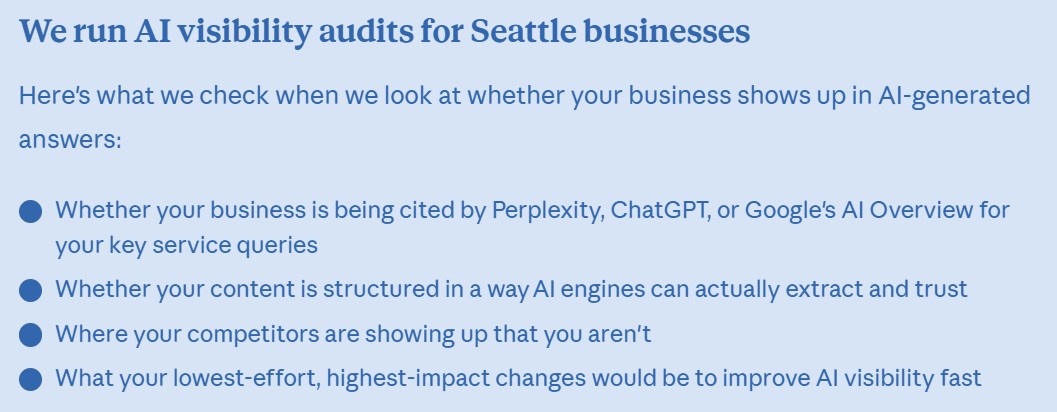
If you got this far and you’re thinking “I have no idea if my business is visible to AI search or not” — that’s exactly the right question to be asking, and it’s one we can answer pretty quickly.