
Published April 10, 2026 | Local SEO | 6 min read
If you’ve Googled a Seattle restaurant, plumber, or boutique lately on your phone and noticed the results look… different, you’re not imagining it.
Since January 2026, Google has been quietly rolling out what it calls the AI Local Pack — a replacement for the traditional 3-Pack that most local businesses have spent years optimizing for. And the numbers aren’t great for small business owners who haven’t heard about it yet.
Let’s break down exactly what changed, why it matters for Seattle companies specifically, and what you can do about it right now.
What Is the AI Local Pack?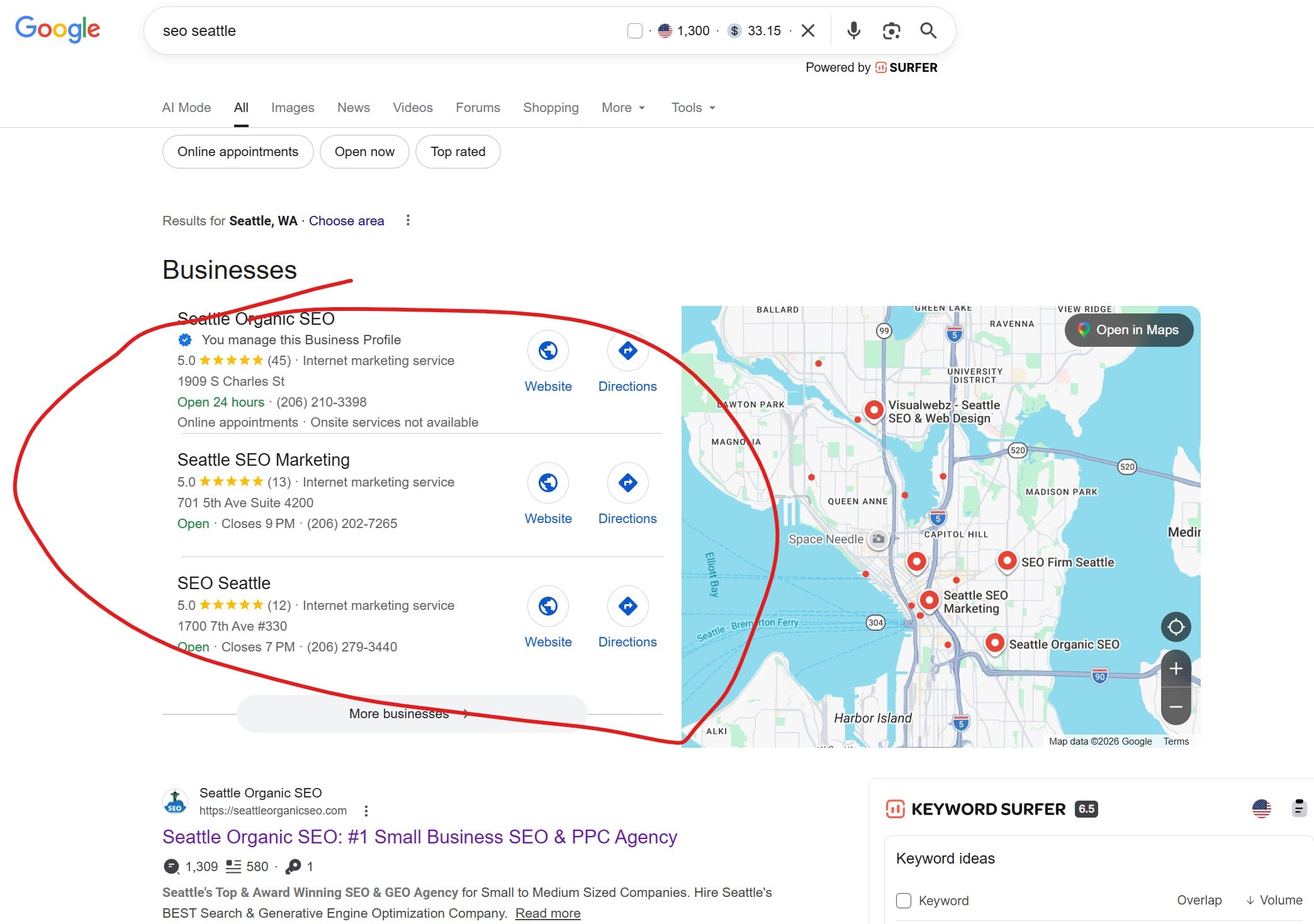
For years, local SEO revolved around one goal: land in Google’s Local 3-Pack — the three business listings that appear with a map at the top of a local search result. Those three spots drove a disproportionate share of clicks, calls, and foot traffic for local businesses.
The AI Local Pack changes that formula.
Instead of pulling from a standard database of nearby businesses and surfacing the top three, Google’s AI-powered system synthesizes information about businesses — reviews, website content, menu items, hours, service descriptions — and presents a curated, AI-generated summary of options. The map is often still there. But the list of businesses beneath it? Shorter, less predictable, and governed by rules most rank-tracking tools don’t even measure yet.
The Numbers Every Seattle Business Owner Needs to See
Here’s where it gets concrete:
- AI Local Packs surface 32% fewer unique businesses than traditional local packs. That means if the old system was showing your business 1 out of every 3 searches, you may now only appear 1 out of every 4.5 — without your rankings “dropping” in any way your current tools would detect.
- Google removed the ‘Call’ button from mobile 3-Pack results in January 2026. This is significant. That one-tap call button was responsible for a massive share of direct leads from local search — especially for service businesses like contractors, therapists, salons, and restaurants. It’s gone. Users now have to click through to your listing or website to find your number.
- Most rank-tracking tools don’t yet report AI Local Pack appearances. This is arguably the most dangerous part. Your BrightLocal dashboard or SEMrush local report might still show you ranking in positions 1–3 — but those rankings may be based on the old pack format. You could be losing AI Local Pack visibility right now and have no idea.
Why This Hits Seattle Differently
Seattle’s market has a few characteristics that make this shift particularly sharp.
High mobile search share. Seattle skews young, tech-forward, and heavily mobile. The AI Local Pack is currently a mobile-first rollout, which means your Seattle customers are more likely to encounter it than, say, customers searching from a suburb of Boise.
Competitive neighborhood markets. Capitol Hill, Ballard, Fremont, South Lake Union — these are dense commercial corridors where dozens of businesses compete for the same local queries. In the old 3-Pack, you had a roughly 1-in-20 chance of surfacing for a given search. In the AI Pack, that pool gets culled further by signals that go beyond proximity and star ratings.
Service businesses are getting hit hardest. The removal of the Call button disproportionately affects industries that relied on it — HVAC, plumbing, electricians, home cleaning, landscaping, mental health practices, and med spas. If your business runs on inbound phone calls, January 2026 was a silent revenue event you may not have connected to Google yet.
What Google’s AI Is Actually Looking For
This is where it gets interesting — and where early movers can gain real ground.
The AI Local Pack isn’t just a repackaged version of the old pack. It’s drawing from a fundamentally different set of inputs. Traditional local SEO was about signals: backlinks, citations, Google Business Profile completeness, review volume and velocity.
The AI Pack is about comprehension. Google’s system is reading your website, your reviews, your GBP posts, your Q&A section, and synthesizing a picture of what your business actually does and who it’s for. Businesses that describe themselves in clear, specific, natural language are outperforming businesses with technically optimized but sterile content.
A few things that appear to influence AI Local Pack inclusion:
- Specific service descriptions on your website and GBP (not just “HVAC services” but “emergency furnace repair in North Seattle”)
- Review content quality, not just quantity — reviews that mention specific services, staff names, and neighborhood references carry more weight
- Structured data markup (LocalBusiness schema) that helps Google understand your service area, hours, and specialties
- Answered questions in the GBP Q&A section, written in the same natural language your customers use
What to Do This Week
You don’t need to rebuild your entire SEO strategy. Start here:
1. Audit your Google Business Profile with AI in mind. Read your GBP description out loud. Does it sound like something a person would say, or like something written to game an algorithm? Rewrite it in plain language that answers: What do you do? Who do you serve? Where are you?
2. Check whether the AI Local Pack is showing for your key searches. Open an incognito browser on your phone, search for your top 3–5 keywords (e.g., “Seattle coffee shop Capitol Hill,” “emergency plumber Ballard”), and look at what you see. Is it a traditional pack or an AI-formatted result? Are you in it? 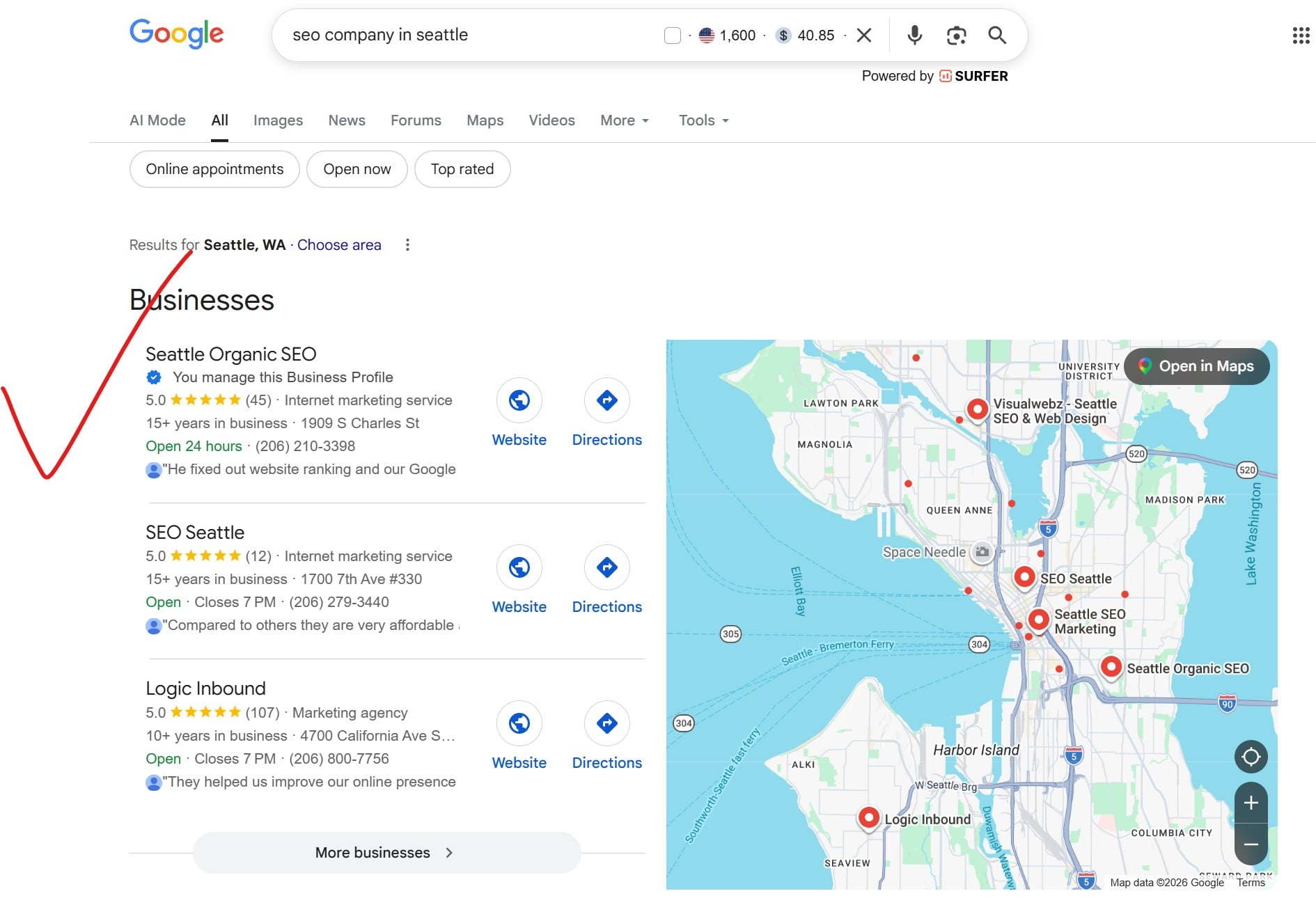
3. Update your website’s service pages. Each service you offer should have its own page (or at minimum its own section) with a clear, specific description. Include neighborhood names. Include the types of customers you help. Write for humans first.
4. Add LocalBusiness schema markup. If your website doesn’t have structured data, this is now more important than it was six months ago. A good web developer can implement this in an afternoon.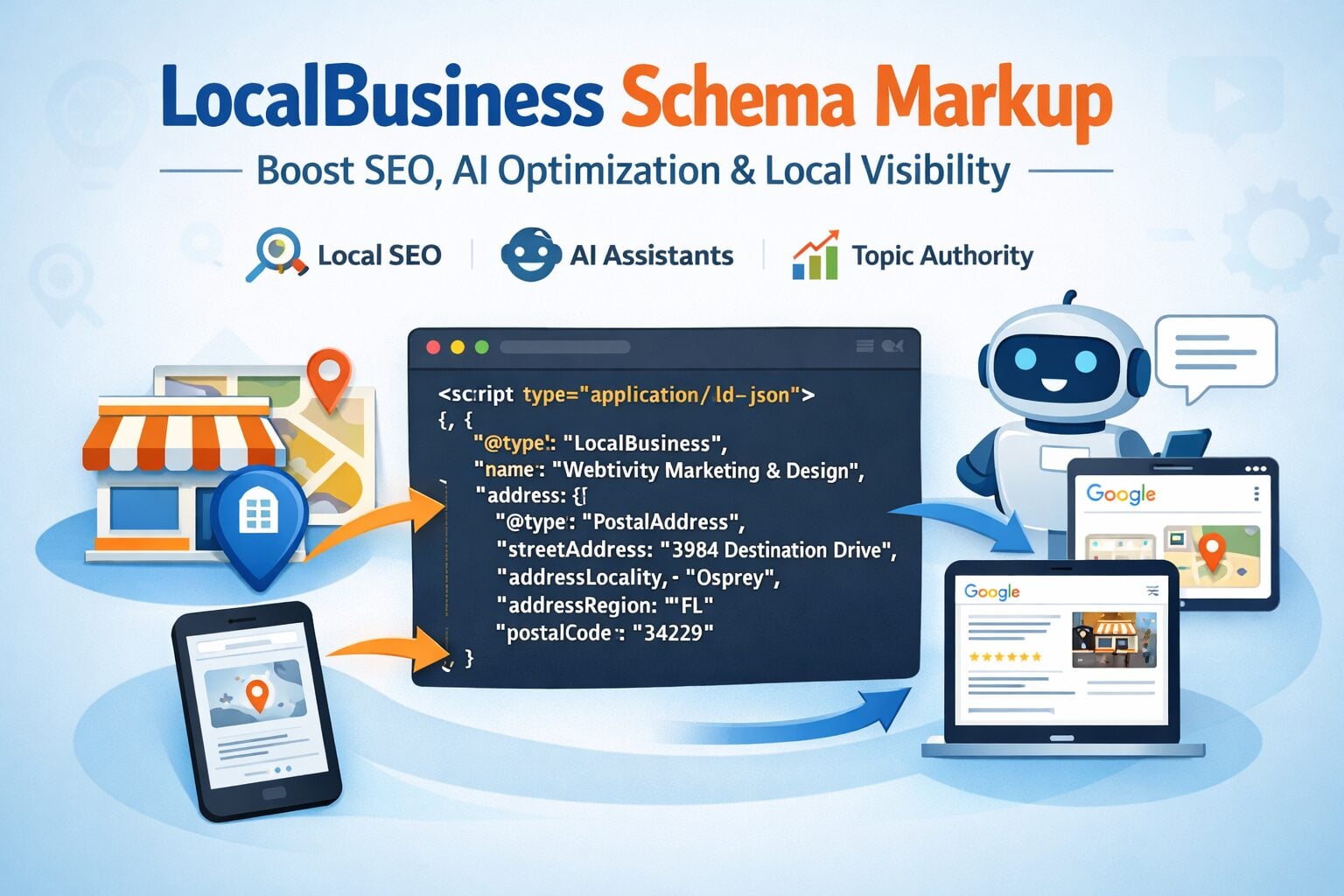
5. Respond to your reviews — and guide future ones. When a customer leaves a review, respond thoughtfully and mention the specific service they received. When asking for reviews, gently encourage customers to mention what they came in for and where they found you.
The Bigger Picture
The shift from the traditional Local Pack to the AI Local Pack is part of a broader pattern: Google is moving from ranking content to synthesizing it. The businesses that win in this environment won’t necessarily be the ones with the most backlinks or the most reviews. They’ll be the ones that have given Google the clearest, most specific, most human picture of what they actually do.
For Seattle small businesses, this is both a threat and an opening. Most of your competitors haven’t heard about this yet. Most of them are still optimizing for a pack that’s being phased out. If you move now, you’re not playing catch-up — you’re getting ahead.
Not Sure Where You Stand?
We’re offering a free AI visibility audit for Seattle businesses through the end of this month. We’ll check whether your business is appearing in AI Local Pack results for your most important searches, identify the specific gaps in your GBP and website that are likely costing you visibility, and give you a prioritized action list — no fluff, no upsell pressure.
Book your free AI visibility audit →
(Spots are limited — we can only take on a handful of these per month to keep the quality high.)
Questions about how the AI Local Pack affects your specific industry or neighborhood? Drop them in the comments below or reach out directly — we read everything.