
By Brandon Na, Seattle Organic SEO | Updated September 2026 | 15-minute read
A Seattle law firm can rank on page one of Google and still disappear when a potential client asks ChatGPT:
“Who are the best personal injury lawyers in Seattle, and which one should I call?”
That is a completely different search result.
Instead of ten blue links, AI may give the client three or four named firms, explain why each one is worth considering, and sometimes cite the websites it used to reach that conclusion.
If your competitors appear and you do not, you need to know why.
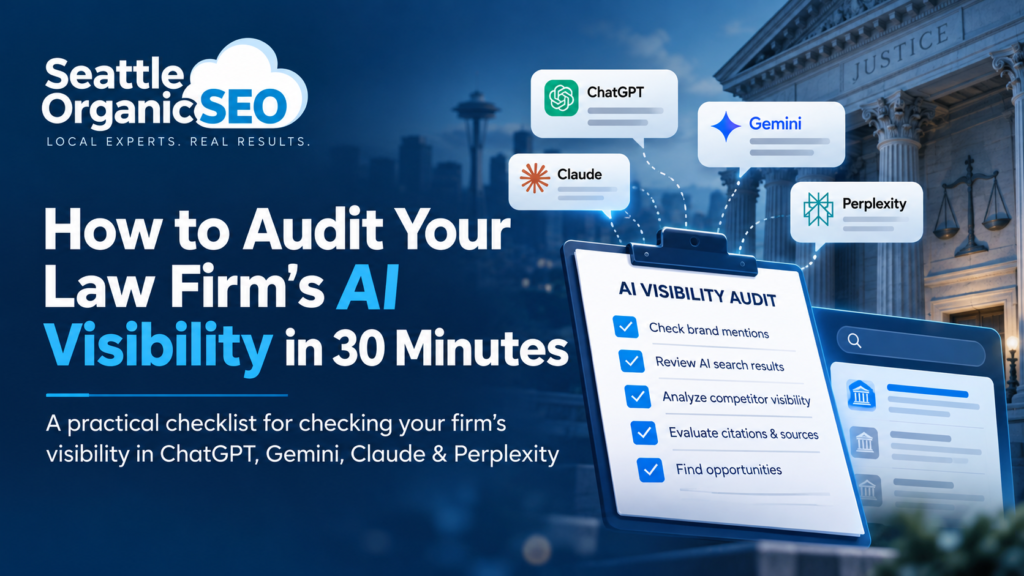
This 30-minute law firm AI visibility audit shows you how to test your firm across ChatGPT, Gemini, Claude, and Perplexity, identify which Seattle law firms are being recommended instead, inspect the sources behind those answers, and turn the results into a practical action plan.
You do not need expensive AI-monitoring software to start. Open four browser tabs, use the worksheet below, and follow the six steps.
What You Can Learn in 30 Minutes
By the end of this audit, you should know:
- Whether your firm appears in high-intent AI recommendation queries.
- Which competing Seattle law firms are mentioned most often.
- Whether AI systems accurately understand your attorneys, practice areas, and locations.
- Which websites, directories, reviews, and other sources appear to influence the answers.
- Where your firm’s online authority is weaker than the firms AI recommends instead.
- What to improve over the next 30 to 90 days.
If you want the broader strategy behind this, see our guide to AI SEO and Generative Engine Optimization. You can also review The AI Prompts Clients Use to Find Lawyers in Seattle to see the kinds of questions prospective clients are already asking.
Before You Start: Pick One Practice Area and One Market
Do not audit your entire firm at once.
A multi-practice firm may be visible for personal injury and almost invisible for employment law. A firm may be recognized in Seattle but not Bellevue. An individual lawyer may be well understood by name while the firm never appears in non-branded recommendations.
For your first audit, choose:
- One practice area: personal injury, immigration, employment, family law, criminal defense, estate planning, business litigation, or another core service.
- One market: Seattle, Bellevue, Tacoma, Redmond, Kirkland, or whichever city you most want to win.
- One valuable case type: optional, but especially useful for firms with broad practice areas.
Then open a fresh chat in each platform you want to test. For a basic benchmark, use ChatGPT, Gemini, Claude, and Perplexity.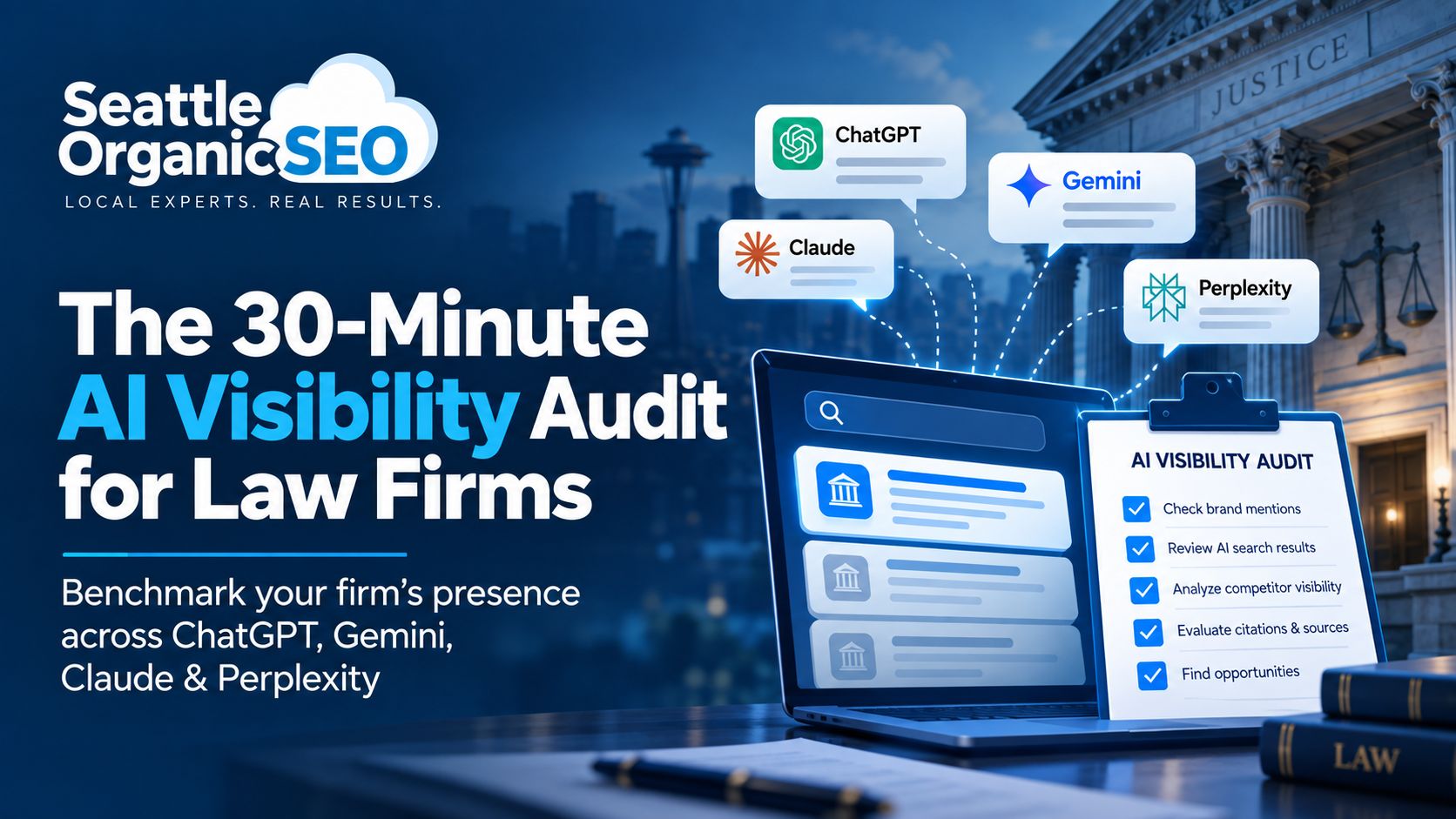
Step 1: Run High-Intent AI Searches — About 8 Minutes
Start with recommendation visibility. Do not mention your firm by name yet. You want to approximate what a prospective client might ask before they know your firm exists.
Replace the bracketed terms with your actual practice area, case type, and city:
- Who are the best [practice area] lawyers in [city]?
- Recommend a [practice area] attorney in [city].
- Which law firms are known for [practice area] in [city]?
- Who should I hire for [case type] in [city]?
- What law firm handles [case type] in [city]?
- Which [practice area] firms in [city] have strong reputations?
- Compare several well-known [practice area] firms in [city].
- I need a lawyer for [brief client situation]. Which firms in [city] should I research?
For each answer, record four things:
- Was your firm mentioned?
- Which firms were mentioned instead?
- What reason did the AI give for including those firms?
- Which sources or citations were shown?
Do not obsess over being listed first. AI answers are not static Google result pages. The more useful signal is consistency. If your firm appears repeatedly across several relevant prompts and multiple platforms, that tells you much more than one isolated mention.
Branded Visibility and Recommendation Visibility Are Not the Same Thing
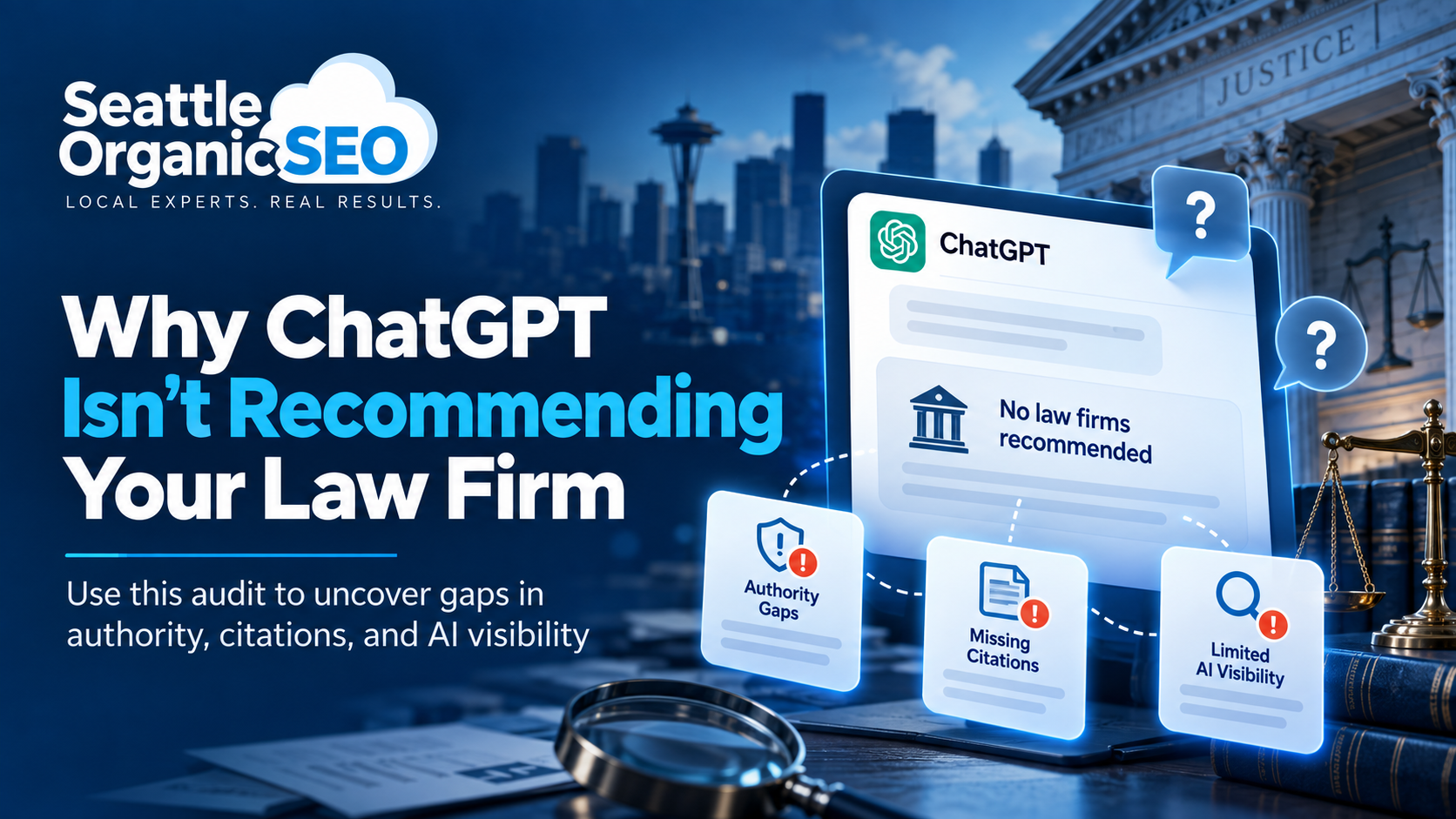
Why ChatGPT may not recommend a law firm despite having an online presence
This is one of the most important distinctions in the entire audit.
Branded visibility is when someone asks:
“What does ChatGPT know about Smith & Jones Law?”
Recommendation visibility is when someone asks:
“Which Seattle employment lawyers should I consider for a severance dispute?”
Your firm may perform well on the first question and poorly on the second.
If an AI system can summarize your firm only after someone gives it the name, that is useful for brand validation. But the bigger discovery opportunity is appearing when the prospective client does not already know you.
Step 2: Ask AI What It Knows About Your Firm — About 5 Minutes
Now test whether the platforms understand your firm accurately.
Run questions like these:
- What is [law firm name] known for?
- What practice areas does [law firm name] handle?
- Who are the attorneys at [law firm name]?
- Where is [law firm name] located and what areas does it serve?
- What evidence online suggests that [law firm name] is reputable?
- What appears to distinguish [law firm name] from competing firms?
Flag anything that is incomplete, vague, outdated, or wrong.
Pay particular attention to:
- Attorney names and roles.
- Practice areas.
- Office locations.
- Service areas.
- Credentials and years of experience.
- Languages spoken.
- Awards and professional recognition.
- Whether the model confuses your firm with another business with a similar name.
A strong result does not need to sound promotional. You want the AI to understand your firm accurately, specifically, and consistently.
Step 3: Audit the Sources Behind the Answers — About 5 Minutes
When an AI platform shows sources, inspect them.
You are trying to answer a simple question:
Which websites are repeatedly helping AI systems understand the legal market in your city?
Common source types include:
- Your law firm’s website.
- Attorney biography pages.
- Google Business Profile and review platforms.
- Legal directories such as Avvo, Justia, FindLaw, and Martindale-Hubbell.
- State and local bar association pages.
- Professional associations and awards.
- Local and industry news coverage.
- Podcasts, interviews, and expert commentary.
- Local chambers and respected business organizations.
Do not assume every mention is equally valuable. A copied directory listing is not the same as a detailed attorney biography, a strong independent review profile, credible news coverage, or an authoritative article that clearly connects an attorney with a legal issue and geographic market.
Quick Source Audit Checklist
Give yourself one check for each statement that is true:
- Your website clearly explains each important practice area.
- Each important attorney has a substantial, indexable biography.
- Your office locations and service areas are consistent across the web.
- Your Google Business Profile is complete and current.
- You have recent, substantive reviews where appropriate.
- Your major legal directory profiles are accurate and consistent.
- Your attorneys have credible third-party mentions, interviews, or professional recognition.
- Your site publishes useful original content that demonstrates subject-matter expertise.
Step 4: Compare Your Firm With the Competitors AI Mentions Most — About 4 Minutes
By now, you will probably notice that a few competitor names keep appearing.
Choose the three firms that appear most consistently and compare their public web footprints with yours.
Look beyond ordinary keyword rankings. Ask:
- Are their attorney bios more complete?
- Are their practice-area pages more specific?
- Do independent websites mention them more often?
- Are their reviews more recent or more descriptive?
- Do they have stronger local associations?
- Are they connected to the exact case types clients are asking about?
- Are the same attorneys, locations, and practice areas described consistently across multiple sources?
This is often where the biggest opportunity becomes obvious.
A competitor may not be doing anything mysterious for “AI optimization.” The firm may simply have a clearer, stronger, and better-corroborated public web presence.
Step 5: Calculate Your Law Firm AI Visibility Score — About 5 Minutes
Law firm GEO audit dashboard measuring AI search visibility and citations
Use the following 100-point framework as a practical internal benchmark. This is a Seattle Organic SEO diagnostic framework, not a score published by OpenAI, Google, Anthropic, or Perplexity.
| Category | Points | What You Are Measuring |
|---|---|---|
| Recommendation Visibility | 30 | How consistently your firm appears in non-branded, high-intent AI searches. |
| AI Knowledge Accuracy | 20 | How accurately AI systems understand your attorneys, services, location, and reputation. |
| Third-Party Authority | 20 | Reviews, directories, media coverage, professional recognition, and other external validation. |
| Attorney Entity Strength | 15 | How clearly individual attorneys are associated with expertise, credentials, topics, and your firm. |
| Practice + Location Association | 15 | How strongly your firm is connected online with the practice areas and markets you want to win. |
How to Interpret the Score
- 80–100: Strong visibility foundation. Focus on consistency, freshness, and expanding into additional high-value prompt families.
- 60–79: Competitive but uneven. Usually one or two authority, entity, or content gaps are holding the firm back.
- 40–59: Limited visibility. Your firm may be understood by name but is not appearing consistently in discovery prompts.
- Below 40: Major visibility gaps. Start with entity accuracy, attorney bios, local relevance, source consistency, and practice-area content.
The score is useful because it forces you to separate the problem into parts. A firm can have excellent website content and still underperform because there is too little independent corroboration. Another can have strong reviews but vague attorney bios. Another can be well known locally but weakly associated with the specific case type being searched.
Step 6: Turn the Audit Into a 90-Day Action Plan
Do not leave the audit as a spreadsheet full of observations.
Sort your findings into three buckets.
Fix Now
- Incorrect attorney names, office locations, or practice areas.
- Missing or thin attorney biographies.
- Major inconsistencies across your website, Google Business Profile, and legal directories.
- Practice pages that never clearly state who you help, where you help them, and with what legal problems.
Improve in the Next 30 Days
- Strengthen high-value practice pages.
- Add plain-English answers to the real questions your intake team hears.
- Improve internal linking between attorneys, practice areas, locations, and related legal topics.
- Complete and standardize major third-party profiles.
- Add appropriate structured data for your organization, attorneys, services, and content.
Build Over the Next 90 Days
- Earn more credible third-party mentions.
- Publish attorney-led expert content.
- Build location-specific content where the firm genuinely serves clients.
- Develop pages for important case types and high-intent client scenarios.
- Track the same prompt set over time so you can see whether visibility improves.
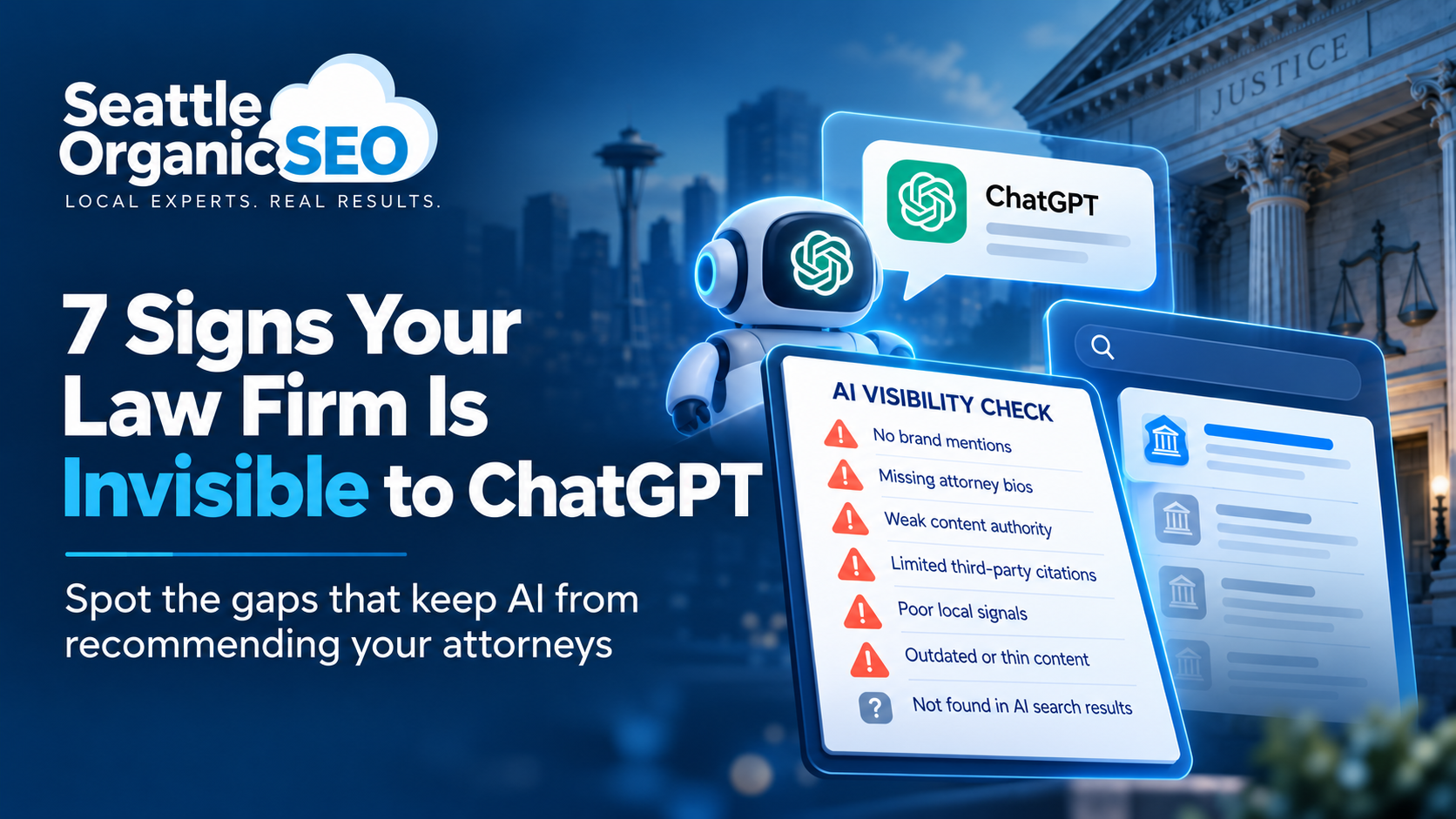 What Usually Keeps a Law Firm Out of AI Recommendations?
There is rarely one single cause. In most weak audits, we find a combination of problems:
- The firm says too little about individual attorneys.
- Practice pages are generic and could describe almost any firm.
- The website does not clearly connect the firm to specific cities, courts, agencies, or case types.
- Third-party profiles are thin, inconsistent, or outdated.
- There is little independent evidence supporting the claims made on the firm’s own website.
- The content answers keywords instead of the full questions prospective clients actually ask.
- Important information such as languages, consultation options, or service areas is difficult to verify.
That is why AI visibility work overlaps heavily with good SEO, local SEO, entity optimization, digital PR, review strategy, and strong legal content. The difference is the way you measure the outcome.
Do Schema and Structured Data Help Law Firm AI Visibility?
Structured data can help search engines better understand the entities and relationships represented on a page. It should support content that is already visible and accurate; it is not a substitute for useful content or third-party authority.
For law firms, useful schema can include:
- Organization or LegalService: for the firm.
- Person: for attorney biographies.
- Article or BlogPosting: for substantive articles like this one.
- BreadcrumbList: for page hierarchy.
- FAQPage: where the visible page content contains genuine matching questions and answers.
More important than simply adding markup is making sure the underlying information is consistent: attorney names, credentials, locations, practice areas, author identity, and the relationships between your attorneys and the legal topics they cover.
Should You Test ChatGPT, Gemini, Claude, and Perplexity Separately?
Yes.
Different AI products can use different models, retrieval systems, indexes, source-selection methods, personalization, and web-search behavior. A law firm may appear in one system and not another.
Use the same core prompts across all four platforms and track the patterns.
The objective is not to force identical answers. It is to understand where your visibility is strong, where it is weak, and which sources repeatedly influence the market.
How Often Should a Law Firm Run This Audit?
For most firms, quarterly is enough for a broad benchmark.
For highly competitive practice areas or firms actively investing in GEO and AI visibility work, run a smaller set of your highest-value prompts monthly.
Also rerun the audit after major changes such as:
- Launching a new practice area.
- Opening a new office.
- Rebuilding attorney biographies.
- Publishing a major new content cluster.
- Receiving significant news coverage or professional recognition.
- Cleaning up major directory or entity inconsistencies.
Law Firm AI Visibility Audit Worksheet
We also created a two-page worksheet you can use while running the audit. It includes the prompts, platform comparison fields, source checks, the 100-point score, competitor notes, and a 90-day action plan.
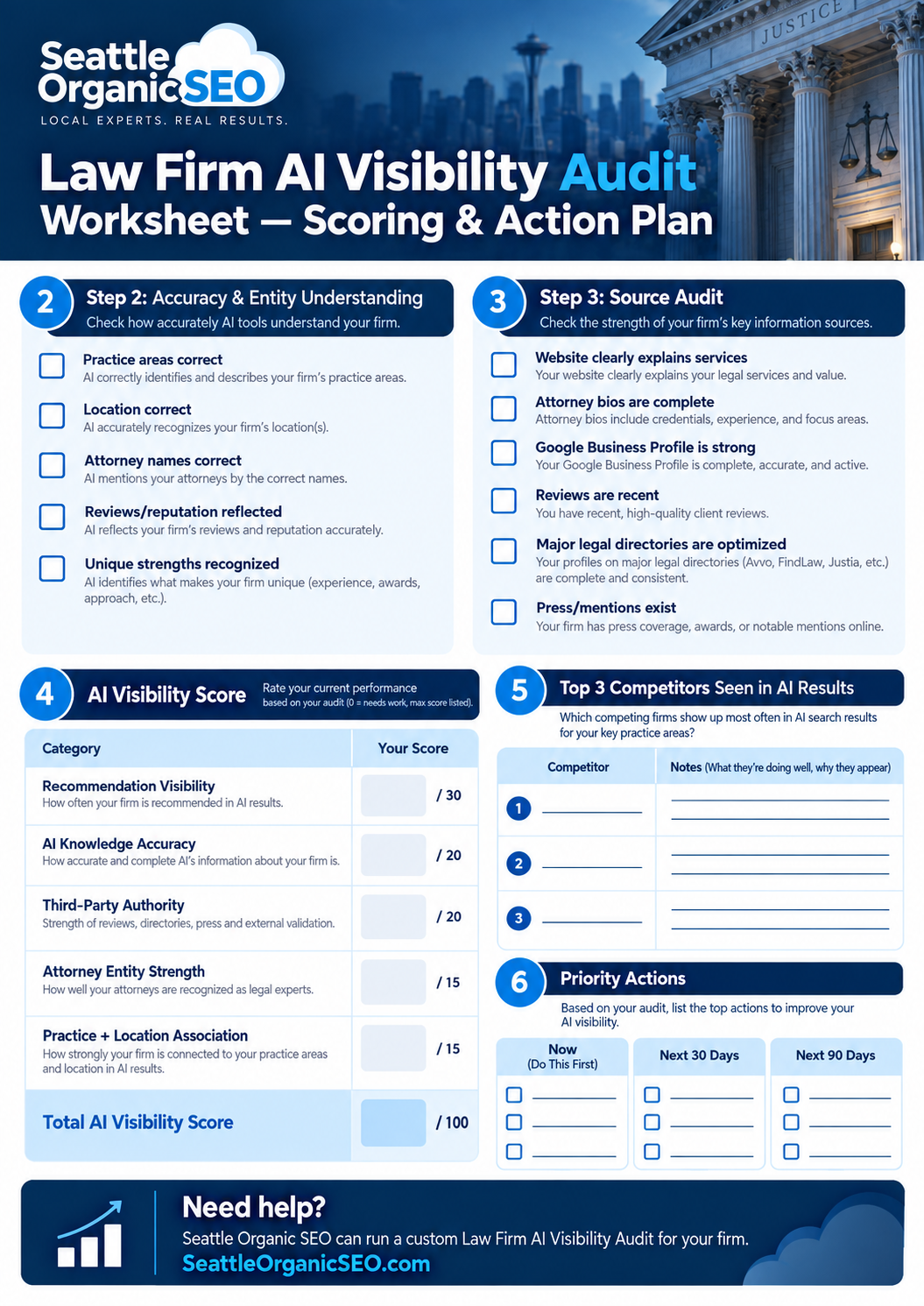
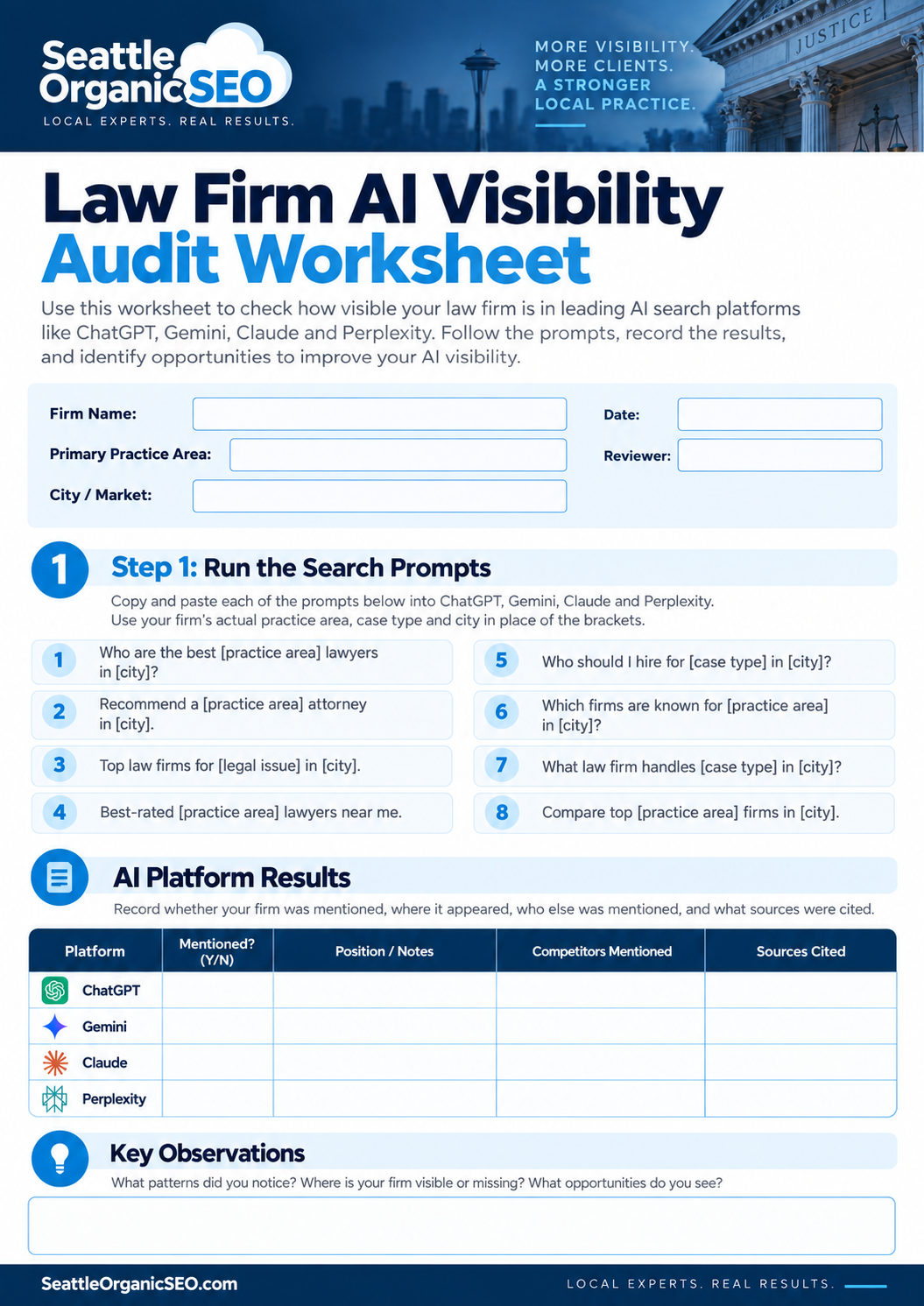
Print it, save it as a PDF, or use the same framework in a spreadsheet.
The Bottom Line
If your firm never appears when a prospective client asks an AI system who to hire, the problem is worth understanding now.
The good news is that the audit usually turns a vague problem into a concrete one.
You may discover that your firm needs stronger attorney entities, better location associations, clearer practice pages, more authoritative third-party mentions, stronger local proof, or simply more consistency across the web.
Those are fixable problems.
See Which Firms AI Recommends Instead of Yours
Our free AI visibility audit runs real Seattle client prompts for your practice area through ChatGPT, Claude, Gemini, Perplexity, and other AI-powered search experiences. You’ll see who gets named, which sources appear to influence the answers, and the specific gaps that may be keeping your firm out of the conversation.
Get my free AI visibility audit
Or reach Brandon or Shane directly: (206) 210-3398 | hello@seattleorganicseo.com
Written by
Brandon is the founder of Seattle Organic SEO, the agency he built into the top-ranking result for “SEO Seattle.” He helps small businesses and professional service firms, including law firms, get found in Google and in AI answers from ChatGPT, Claude, Gemini, and Perplexity. He brings 30+ years in C-suite roles across tech companies and startups, hosts the Startup Wins podcast, and writes about startups and education.
His focus is where local SEO meets generative engine optimization (GEO), explained in plain English for business owners.
brandonna.com | Contact Brandon | hello@seattleorganicseo.com