
Published April 16, 2026 | Local SEO | 7 min read
If your local SEO strategy is still built around two-word keyword phrases, you’re optimizing for a search behavior that fewer people are using every month.
There was a golden era of local SEO. You stuffed “Seattle” and “near me” into your service pages, optimized your Google Business Profile, collected reviews, and the map pack rewarded you with calls. It worked for years.
That era isn’t completely over. But the ground underneath it is shifting faster than most business owners realize — and the search behavior that’s replacing it looks almost nothing like what you’ve been optimizing for.
How people actually search now
Here’s the change in plain terms. Look at how the same customer intent sounds in 2019 versus today:
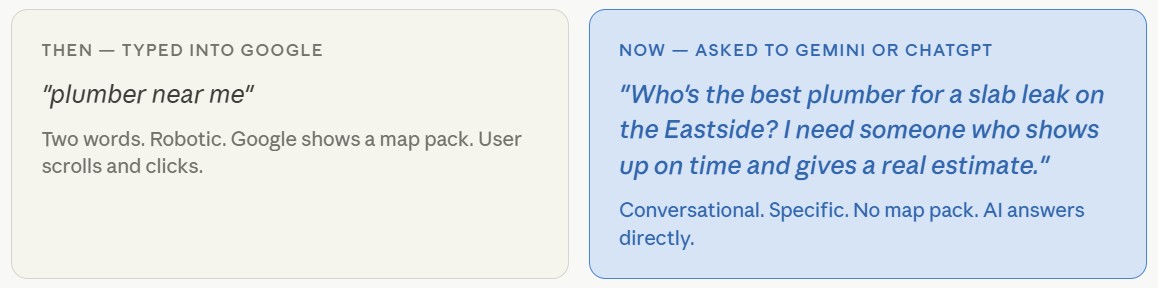
These are not slightly different versions of the same search. They’re a fundamentally different behavior — and they require a fundamentally different strategy to win.
Users aren’t just searching for keywords like “pizza near me” anymore. Instead they’re asking more conversational questions specific to their unique situation. That shift accelerated with voice search, and it’s now the default for a growing portion of the population that reaches for ChatGPT or Gemini before they ever open Google.
By late 2025, more than 60% of ChatGPT users were performing local searches, and AI Overviews now appear in up to 68% of local searches. If your content isn’t built to answer the kind of questions people are actually asking out loud, you’re invisible in more than half of all local search experiences.
Why your current content isn’t cutting it
Most local business websites were built to rank on Google, which historically rewarded pages that repeated target keywords and had a lot of backlinks. That game isn’t gone — but AI engines play by different rules entirely.
AI doesn’t match keywords. It reads for meaning, context, and clarity. When someone asks Gemini “who do I call if I have a burst pipe in Bellevue at 10pm,” the AI pulls from sources that directly and specifically answer that question — businesses whose content explains what they do, where, for whom, at what price range, and how to reach them.
Content should target conversational, question-based phrases rather than short keywords and provide direct, clear answers in the first paragraph before diving into details, as AI platforms prioritize quick, accurate responses for users.
A common mistake: businesses write service pages that describe what they do in vague, marketing-speak terms, and bury the practical details — service area, pricing range, who to call — three scrolls down the page. A common mistake businesses make when creating content is refusing to get to the point right out the gate, droning on for paragraph after paragraph without actually answering the question. AI engines skip those pages entirely and cite the competitor who just answered clearly.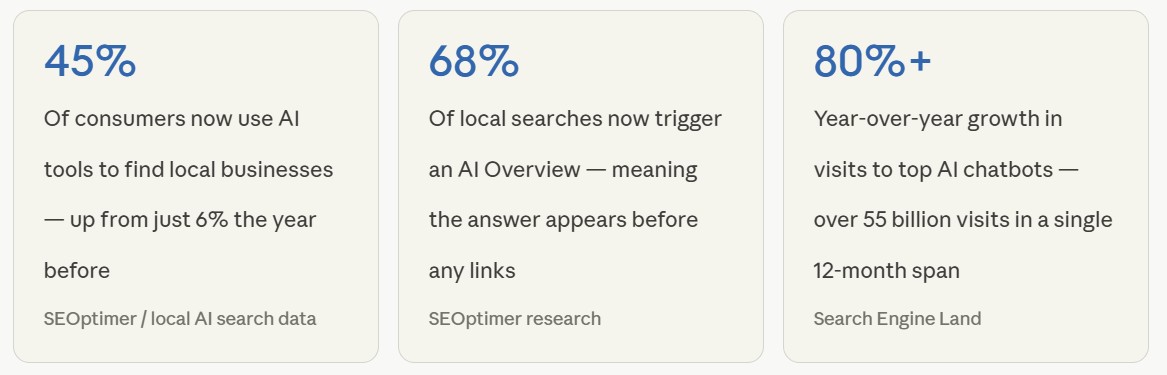
The two things your website needs to fix right now
If you do nothing else after reading this, fix these two things. They’re not glamorous, but they are the highest-leverage changes a local Seattle business can make for AI visibility today.
First: rewrite your service pages to answer the actual question within the first 200 words. Your page about drain cleaning shouldn’t start with a paragraph about how long you’ve been in business. It should open by answering: what service this is, which Seattle neighborhoods you cover, what a typical job costs (even a range), and how to book. That’s what AI engines extract. That’s what gets cited.
Build concise, direct answers into your site content and FAQ — the kind of quick, specific responses AI likes to surface. The goal isn’t to be comprehensive. It’s to be immediately useful.
Second: build out a real FAQ section, written in conversational language. Not “What are your hours?” — but “Do you do emergency plumbing calls on weekends in Kirkland?” Not “What services do you offer?” — but “Can you fix a slab leak without tearing up my whole floor?” These are the exact strings people speak into their phones or type into ChatGPT. Write direct questions your customers would ask and provide clear answers — this format aligns with how people interact with AI tools, which often generate responses based on conversational queries.
FAQ sections written this way are now, arguably, the most important local SEO content on your website. Not your homepage. Not your about page. Your FAQ — because it’s the section that most closely mirrors how AI search actually works.
The Seattle-specific angle
This matters more here than you might think. Seattle customers, particularly in neighborhoods like Capitol Hill, Fremont, and the Eastside suburbs, over-index on researching before they buy. They’re not calling the first result they see. They’re asking Perplexity to compare three options and explain the difference. They’re asking ChatGPT what to look for before hiring a contractor.
If your business shows up in those AI answers — even just mentioned in passing as “known for clear pricing and fast response in North Seattle” — you’ve already won before the phone rings. The customer arrives pre-sold.
And if you don’t show up? AI search platforms now pull local business recommendations directly into conversational answers instead of displaying clickable links, and platforms like ChatGPT and Google Gemini actively choose which brands to mention based on data consistency. Your competitor who optimized their content six months ago is already the default recommendation.
A quick self-audit for your website
Ask these questions about every service page you have
- Does the first paragraph answer what you do, where you do it, and who it’s for? If someone read only the first 200 words, would they know enough to call you?
- Do you mention specific Seattle neighborhoods and suburbs by name? “Serving the greater Seattle area” means nothing to an AI engine. Bellevue, Redmond, Ballard, and Shoreline do.
- Do you include a price range or starting-from cost?“Competitive pricing” is invisible. “$150–$300 for most diagnostic visits” is citable.
- Do you have a FAQ section written the way customers actually talk? If every question starts with “What is…” instead of “Can you…” or “Do you…”, rewrite it.
- Is your Google Business Profile complete and consistent with your website? Your business name, address, phone number, hours, and services should match across every platform — inconsistent listings confuse AI tools and lower trust signals.
None of this requires a website rebuild. Most of it is a content rewrite — the kind of work that takes a few hours per service page and pays dividends for months.
The businesses winning local AI search right now aren’t the biggest ones or the ones with the most backlinks. They’re the ones whose websites most clearly answer the questions their customers are already asking out loud. That’s a game any Seattle business can win — if they know what to fix.
We run AI visibility audits for Seattle businesses
Not sure if your service pages and FAQ content are structured for AI search? We’ll take a look and tell you exactly what’s costing you citations — and what to fix first.
Book your free AI visibility audit →