
Original research · November 2026 · Seattle Organic SEO
What is the most searched thing on the internet? We’ve been asking that question since before search data was easy to obtain—not just to learn what people type, but to understand what people want.
Before Google made search behavior visible at scale, businesses and publishers largely had to guess what people wanted. We relied on surveys, assumptions, intuition and scattered signals. Search data changed the equation: each query became another clue about human curiosity, anxiety, habits, entertainment and purchase intent. Rather than building something and hoping an audience would arrive, we could begin with demonstrated demand and build products, services and content around it.
In the fall of 2010, after nearly a decade watching the space develop, Seattle Organic SEO published what we regarded as our first-of-its-kind study of the internet’s most-searched terms. We took the data available to us, organized it into something people could actually understand, and used it to put evidence behind assumptions many readers already had. The response caught us by surprise: interest in the report surged behind the scenes and confirmed that people wanted more than a disconnected list of keywords. They wanted to know what those searches said about us.
Our research approach has evolved since then. Earlier work depended heavily on gathering and processing publicly available keyword information, including scraping. After years away from a full new edition, we have returned with a different foundation: the KW Discovery Project, which in November 2026 used the Google Ads Keyword Planner API to collect and examine search-volume information across nearly 100 million keywords.
This is our first edition built on that direct Google Ads API collection workflow. It is not a raw census of every Google search: Keyword Planner supplies modeled, rounded estimates, and our published top-100 table is a carefully labeled sample from a larger project. That distinction matters because the goal has not changed since 2010: understand what people are looking for, then make smarter decisions about what to build and how to serve them.
For historical context, explore our earlier top-100 searched topics analysis, our original top-25 topic coverage, and 2025 search-keyword report. The historical superlative above reflects our experience and is not an independently verified claim that no other publisher had released similar analysis.
At a glance: top Google searches and keyword demand in 2026
- YouTube and ChatGPT occupy the first two rows of this particular KW Discovery export, but not every independent provider ranks them in the same order.
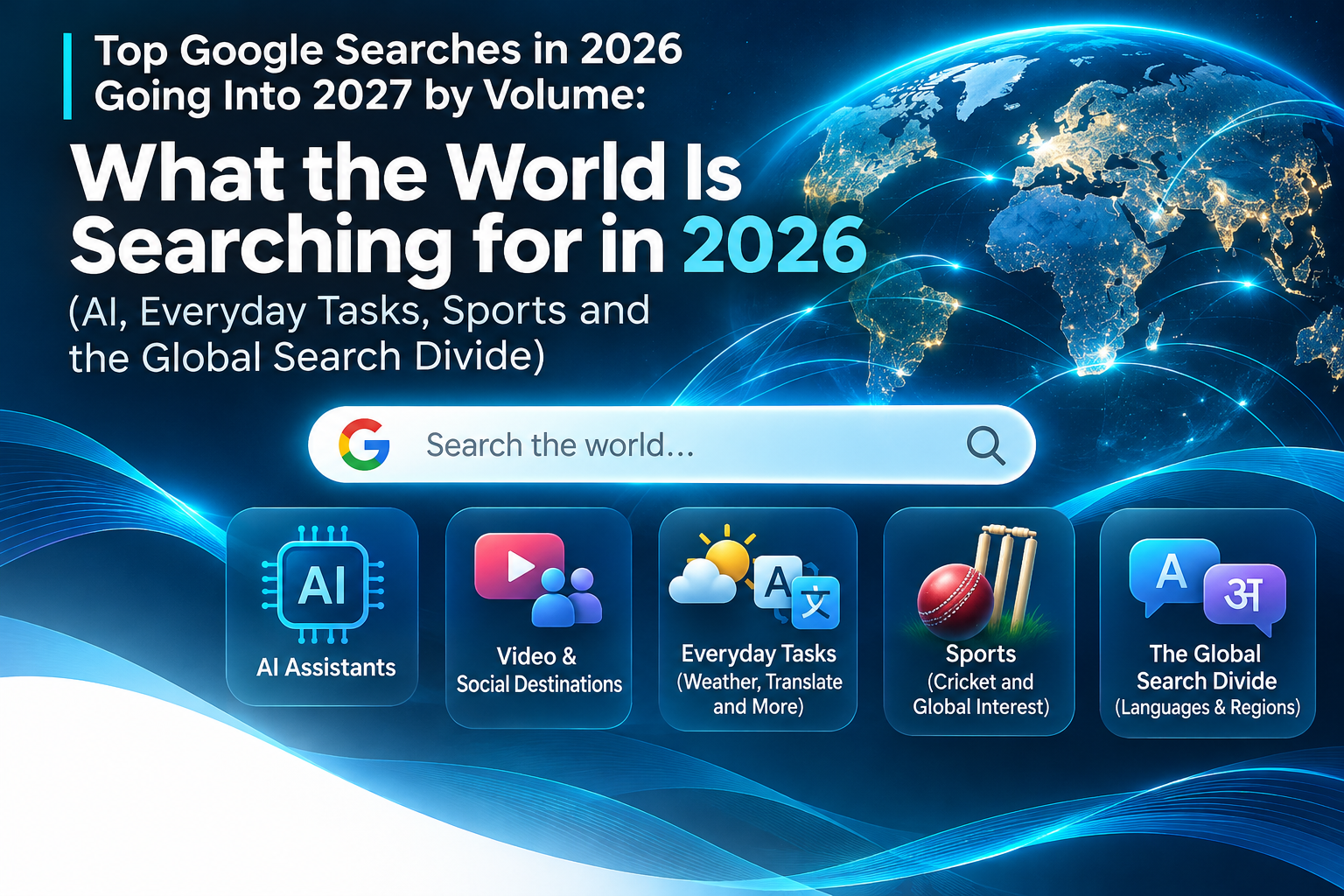
- Search reflects daily behavior: social sites, weather, translations, maps and immediate tasks sit alongside AI tools.
- Global demand is not just English-language demand: cricket, regional events and localized terms deserve their own classification.
- What this page publishes: 100 provisional distinct search topics, the original first 100 raw topic records, cross-source checks and transparent quality flags.
- What it does not claim: a verified census of Google’s actual worldwide search totals or a prediction that any single query will be #1 in 2027.
Why search-volume estimates need context
Rank positions below are taken from different datasets. They are useful for comparing patterns, not for treating each provider’s estimates as interchangeable measurements.
KW Discovery / Ahrefs / Semrush-based lists
KW Discovery / Ahrefs / Semrush-based lists
KW Discovery / Ahrefs / Semrush-based lists
DATA TABLE · 100 SEARCH TOPIC CANDIDATES
The Top 100 Search Topics in Our November 2026 Research Sample
Below are 100 distinct provisional concepts, derived from the first 136 records of the KW Discovery Project top-1,000 export. The first 100 original rows contain only 76 concept IDs after semantic grouping; for that reason, printing those rows unchanged would misleadingly repeat terms such as WhatsApp, Premier League, speed tests, and World Cup variations.
How to read this ranking: the numbered list is based on the earliest rank at which each corrected concept appears in the original export. It is not a newly calculated ranking of unique search volume, because overlapping Google Keyword Planner close variants cannot safely be summed. The source rank and original query wording are always shown so readers can distinguish genuine terms from inferred corrections.
* All figures are unverified historical volume signals from the source export and may reflect rounding, shared close-variant volume, or misattributed acronym expansion. Do not sum them. Rankings of different publishers use different geographies, date windows, filters, and estimation systems. Adult-content destinations are retained because they occur in the unfiltered KW Discovery source, while several public publishers exclude them.
Show the original top 100 raw search-topic records (before consolidation)
These are the exact first 100 records and rank positions supplied by the KW Discovery Project export. Several records point to the same concept; this is why the cleaned topic table above has different numbering.
The headline: AI is prominent, but the world’s searches are broader than AI
One of the clearest signals in 2026 is the visibility of AI tools. ChatGPT ranks second in KW Discovery Project’s raw export and first in Ahrefs’ November global list. Semrush-derived rankings published by Backlinko and Exploding Topics put the exact ChatGPT query twelfth globally. Those differences are large enough that any article calling ChatGPT definitively the world’s most-searched term would be overstating its evidence.
For perspective, KW Discovery Project assigns YouTube approximately 1.38 billion in representative monthly volume and ChatGPT 1.12 billion. Exploding Topics lists YouTube at approximately 1.3 billion and ChatGPT at 245 million; Ahrefs estimates 378 million for YouTube and 914 million for ChatGPT. These figures come from different estimation systems and are not interchangeable measurements. Their source settings, sampling, treatment of variants and reporting windows may differ.
What we can state confidently is that AI assistants now appear beside major social networks, video platforms and everyday utilities in leading search lists. Exploding Topics also reports growth for AI products: its October article says U.S. searches for ChatGPT increased from 45.5 million in January to 68 million in October 2026, while Gemini entered both its U.S. and global top-100 lists. This is a historical comparison reported by that publisher—not a trend calculated from our harvester. Source: Exploding Topics.
A revealing discovery gap: Gemini and Canva
Both Gemini and Canva are prominent in external lists. Yet neither has a clearly matching canonical record in our exported top 1,000. Our corpus does have canvases at rank 28, but it would be irresponsible to assume that generic plural term means Canva without the underlying query context. That is a coverage and normalization warning, not proof the harvester never collected those keywords elsewhere.
The big global-search categories, and what they mean
1. Search still functions as an address bar
YouTube, Facebook, WhatsApp Web, Instagram, Gmail, Amazon and Google appear prominently in all three available public lists and in our data. These searches often represent destination-seeking behavior: users already know where they want to go and use Google as a shortcut. High search volume is not automatically an opportunity for a new publisher to rank for an informational article.
Crucially, spelling variations must not become new topics. Our source includes was ap, which we interpret as WhatsApp, and wa web, which is best interpreted as WhatsApp Web. Ahrefs actually publishes wa web among its worldwide top queries, supporting the shorthand’s real use; that does not independently validate every typo’s own volume.
2. People search to complete immediate tasks
Weather, weather tomorrow, translation, Google Maps, speed tests, parcel tracking and currency or gold prices recur across the ranking lists. These represent utility intent: “give me the answer or tool now.” Weather is not identical to Weather Tomorrow, just as Translate is not always equivalent to the branded Google Translate service. Good topic classification preserves those meaningful distinctions.
The international dimension is unmistakable. Published lists contain clima (weather in Spanish or Portuguese), погода (weather in Russian), मौसम (weather in Hindi), traductor (translator in Spanish), and tradutor (translator in Portuguese). A list that only cleans English spellings could miss what is actually happening in global search. Sources: Ahrefs and Exploding Topics.
3. Sports search demand is regional, live and highly specific
Cricbuzz, the Indian Premier League, Premier League, NBA, World Cup and live-score destinations feature in the available rankings. Cricket is not a small anomaly in worldwide search: Cricbuzz is #10 in Backlinko’s public global list and #13 in Exploding Topics’. Ahrefs also lists multiple long-form international cricket match-scorecard searches in its top 100.
That has implications for SEO and data quality. A phrase such as our t20world cup schedule is a legitimate schedule-related intent, not random text. But it cannot safely be treated as the same intent as the broader T20 World Cup, and the year or gender should not be guessed. By contrast, an abbreviation such as IPL needs context: it can also stand for a cosmetic light treatment. We classified the standalone IPL record as cricket because surrounding data supports that interpretation, while keeping cosmetic uses separate.
4. Local and transactional searches remain major categories
Restaurants Near Me, Food Near Me and Hotels appear in the KW Discovery Project sample. Restaurants and food searches also appear in public lists. These queries imply a decision or action, but results are often intensely location-dependent. A worldwide total does not explain whether demand is available to a particular business in Austin, Mumbai or London. A proper opportunity analysis requires geography, actual search intent and local competition.
5. Regional terms are real global-search signals
Some of the most interesting terms in the corpus are easy to misread if you assume all searches are English or mainstream U.S. searches.
Our xo so mien bac refers to Xổ số miền Bắc, or Northern Vietnam lottery results, usually abbreviated XSMB. Exploding Topics explicitly lists XSMB and XSMN (Southern Vietnam lottery results) in its global top 100. lottery song bad is probably a broken rendering of Lottery Sambad, an Indian lottery-results term that appears in both Backlinko’s and Exploding Topics’ worldwide rankings. The underlying topics are corroborated, but the exact error-to-intent mapping remains an inference. Likewise, Satta King and Satta Matka are recognizable South Asian gambling-related concepts—not meaningless words—and appear in published worldwide rankings. Sources: Exploding Topics and Backlinko.
These searches do not imply that every audience shares the same interest. Rather, a large search concentration within a particular language or country can propel a term into a global ranking.
A transparent comparison of prominent topics
The cross-provider table below shows rank position, not directly comparable volumes. For the broader internal top-100 topic list, see the earlier table in this article. Backlinko and Exploding Topics use Semrush-based data, so they are not independent third-party confirmations of each other’s estimates.
A dash means no position was recorded for that source in this comparison—not zero searches. All source ranks are from publicly displayed worldwide lists. DataForSEO is omitted because its live table was down.
Which corrected search terms are actually verified?
The difference between a verified concept and a guessed query interpretation matters. Here are examples directly from the corpus:
The dataset also contains adult-content queries that are prominent in its raw rankings. Backlinko, Exploding Topics and Ahrefs explicitly remove adult or NSFW terms from their public top-100 lists. Their omission must not be interpreted as evidence that such searches are rare; these datasets have different editorial filtering rules. DataForSEO says its live tool includes NSFW queries, but the tool was unavailable when checked.
Popular is not the same as trending
A query can be searched hundreds of millions of times per month yet be flat or declining. Conversely, a much smaller query can be accelerating rapidly. Google’s Year in Search methodology explicitly distinguishes trending terms (those with unusually large year-over-year increases) from the most-searched terms (those with high totals).
Our export is a volume-ranked snapshot, not a longitudinal global-interest study. It does not have the full country-by-country, comparable monthly history needed to assert what changed during November 2026. We can report current prominence in the exported data; we can call something growing only when a separate dated source provides that comparison—such as Exploding Topics’ ChatGPT analysis.
Why the numbers disagree—and what comes next
Search volume is estimated, not a direct publicly released Google census. Google explains that Keyword Planner’s average monthly searches include close variants, are often rounded, and depend on location, search network and date settings. Google Ads methodology. Ahrefs and Semrush build their own keyword databases and estimates, so different inputs and aggregation methods can produce very different values.
Our internal file includes 1,000 topic records but only 28 distinct representative-volume values, as well as correction candidates, source-volume anomalies and ambiguous entries. Roughly 549 proposed concept groups appear in the latest internal audit, but this figure is provisional and should not be extrapolated to the broader harvester corpus. A particularly suspicious pattern is obscure acronym expansions inheriting search volumes comparable to giant global brands. Without the raw source keyword-to-topic lineage, that remains a quality-control hypothesis, not a proven cause.
There is still useful research here. A practical global-search intelligence system would retain the original phrase, publish its best-supported canonical meaning, record alternative meanings, identify search intent and geography, cite external corroboration, keep each volume estimate tied to its source, and calculate trends only from actual time comparisons.
Bottom line: The worldwide search landscape in 2026 is a combination of familiar digital destinations, increasingly visible AI tools, immediate everyday questions, live sports, and highly regional cultural interests. But the difference between a famous search, a rising search, and a credible business opportunity is crucial—and it starts with getting the underlying terms right.
Frequently asked questions about top Google searches
What is the most searched thing on Google in 2026?
It depends on the keyword database, location, date range and filtering. YouTube is #1 in our November 2026 sampled export, while Ahrefs’ global list places ChatGPT first. Neither is a direct public census of every Google search.
What are the top keywords in Google by search volume?
Our sample’s leading concepts include YouTube, ChatGPT and widely used platforms and utilities. The 100-topic table above reports provisional topic ranks and representative volume signals from our Google Ads Keyword Planner API research; use the provider comparison and quality labels before treating any figure as a precise global monthly total.
Does Google publish exact worldwide keyword search counts?
No comprehensive public count of every individual query is available. Google Ads Keyword Planner supplies estimated average monthly searches, typically rounded and including close variants. Other SEO vendors model their own estimates, so the numbers may differ materially.
Are the most searched keywords the same as trending searches?
No. The most searched terms have high estimated overall volume; trending searches are those showing unusual growth in a comparable time period. A snapshot of popular queries alone cannot establish year-over-year growth.
How can businesses use high-volume keywords?
First classify intent. Navigational searches for established brands are different from commercial searches by customers evaluating choices, or localized requests such as restaurants near me. Consider geographic demand, search-result features, competition and conversion value rather than optimizing for volume alone.
Sources and verification notes
- KW Discovery Project: In November 2026, the KW Discovery Project downloaded keyword ideas and monthly search-volume estimates using the Google Ads Keyword Planner API, examining close to 100,000,000 keywords and their volume. Rankings and figures shown here refer to the project’s sampled top-1,000 topic export unless otherwise noted; the full corpus is not presented as a validated global top-search ranking.
- Backlinko: Most Popular Google Searches. Page displays a last-updated date of May 12, 2026; its browser title says November 2026. Uses Semrush; removes adult terms and misspellings.
- Ahrefs: Top Google Searches, updated November 3, 2026, with a separate Ahrefs keyword database; public list filters NSFW terms.
- Exploding Topics: Top 100 Google Searches, updated October 12, 2026; uses Semrush volumes and separately reports selected historical growth trends; filters adult terms and variants.
- DataForSEO: Top 1000 Keywords; method says Google Ads-based metrics across 75 countries, updated during the second half of each month. The table displayed a temporary service error during this research, so no row-level cross-check was possible.
- Official methodology: Google Ads Keyword Planner and Google Year in Search methodology.
About the research, methodology and editorial accountability
Published by Seattle Organic SEO. This editorial research reviews search-volume estimates, keyword normalization and global differences in user intent. The underlying KW Discovery Project used Google Ads Keyword Planner API data collected in November 2026, examining close to 100 million keywords. This article draws its ranked records from a 1,000-topic export, not from every collected row.
How we checked the findings: prominent topics were compared with dated public rankings from Ahrefs, Backlinko and Exploding Topics. Comparisons distinguish shared ranking patterns from independent volume verification; Backlinko and Exploding Topics rely on Semrush-derived data and are not independent corroborations of each other. Ambiguous terms were marked as provisional rather than silently merged.
Limitations: Google Keyword Planner figures are estimated and rounded and may aggregate close variants. Country, language, network and date settings matter. The corpus and its normalization require further validation before claiming definitive worldwide keyword ranks. We do not present provider estimates as direct counts of actual searches.
Editorial review: November 19, 2026. For corrections, source questions or methodology clarifications, contact [email protected]. Learn more about Seattle Organic SEO and our organic search research and services.
