
Chunking, passage indexing, citations, answer density.
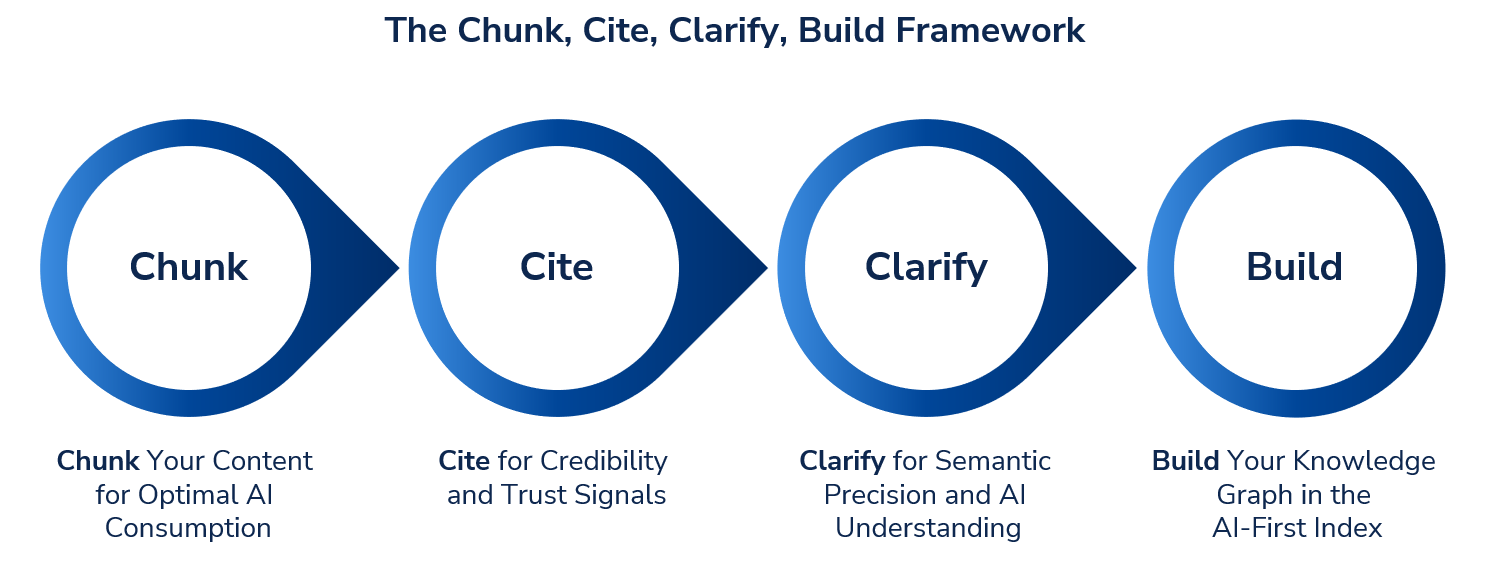
The rise of AI-powered search engines and retrieval-augmented generation (RAG) systems has fundamentally changed how content gets indexed, retrieved, and presented to users. Unlike traditional search engines that index and rank entire web pages, AI systems break content into chunks, index passages independently, and synthesize information from multiple sources to generate answers.
This shift means content optimization must extend beyond page-level thinking to chunk-level precision. How you structure paragraphs, where you place answers, how you cite sources, and how you maintain context across sections directly impacts whether AI systems can effectively retrieve and utilize your content.
This guide provides practical strategies for structuring content to maximize AI retrievability—ensuring your expertise gets found, cited, and synthesized into the AI-generated answers that increasingly define search experiences.
Understanding AI Content Retrieval Architecture
Before optimizing for AI retrieval, you need to understand how these systems process and index content.
The RAG Pipeline: From Content to Answer
Retrieval-Augmented Generation follows a consistent pattern:
Step 1: Content Ingestion AI systems crawl or access your content, converting web pages, PDFs, documents, and other formats into processable text.
Step 2: Chunking The full content gets divided into smaller segments—typically 200-1,000 tokens (roughly 150-750 words). Each chunk becomes an independent unit in the retrieval system.
Step 3: Embedding Generation Each chunk gets converted into a vector embedding—a mathematical representation capturing semantic meaning. These embeddings enable semantic search beyond keyword matching.
Step 4: Index Storage Chunks and their embeddings get stored in vector databases alongside metadata (source URL, publication date, author, section hierarchy).
Step 5: Query Processing When users query the system, their question gets converted into a query embedding using the same model.
Step 6: Similarity Search The system searches the vector database for chunks with embeddings most similar to the query embedding—typically retrieving 3-20 of the most relevant chunks.
Step 7: Context Assembly Retrieved chunks get assembled into context provided to the language model alongside the user’s query.
Step 8: Answer Generation The LLM generates an answer using both its trained knowledge and the retrieved context, ideally citing specific sources.
Implications for Content Strategy
This architecture reveals critical optimization opportunities:
Chunk Quality Matters: Each chunk must be semantically coherent and valuable independently, as it may be retrieved without surrounding content.
First Impressions Count: Opening sentences of chunks heavily influence semantic embeddings—leading with clear, direct statements improves retrieval.
Context Independence: Chunks should minimize dependencies on information from other chunks, as they may be retrieved in isolation.
Metadata Significance: Publication dates, authors, section headings, and other metadata help systems evaluate relevance and credibility.
Citation-Worthiness: Content structured to facilitate easy citation gets referenced more frequently in AI-generated answers.
Chunking Strategies: Optimizing the Fundamental Unit
Since chunks are the atomic units of AI retrieval, optimizing how your content chunks is foundational to AI SEO.
Understanding Chunk Boundaries
AI systems use various chunking strategies:
Fixed-Length Chunking: Dividing content every N tokens/characters regardless of semantic boundaries. Simple but often splits thoughts mid-sentence.
Sentence-Based Chunking: Chunking at sentence boundaries, ensuring chunks contain complete thoughts. Better than fixed-length but ignores larger semantic units.
Paragraph-Based Chunking: Using paragraph breaks as chunk boundaries. Works well when paragraphs are properly structured around single ideas.
Semantic Chunking: Advanced systems attempt to chunk at natural topic transitions, preserving semantic coherence. Still imperfect but represents best practice.
Hierarchical Chunking: Creating nested chunks at multiple levels (sentences, paragraphs, sections, full documents) for multi-granularity retrieval.
Most production systems use paragraph-based or semantic chunking with overlapping windows to prevent information loss at boundaries.
Optimal Chunk Size
Research and practice suggest optimal chunk sizes:
Token Count: 256-512 tokens (roughly 200-400 words) for most content types. This balances:
- Enough context to be meaningful
- Small enough to match specific queries
- Efficient for embedding models
- Manageable for LLM context windows
Too Small: Chunks under 100 tokens lack sufficient context and semantic richness. They retrieve poorly and provide limited value when cited.
Too Large: Chunks over 1,000 tokens dilute semantic focus, making them less likely to strongly match specific queries. They also consume more LLM context budget.
Varied by Content Type:
- FAQ content: 100-200 tokens per Q&A pair
- Technical documentation: 300-500 tokens per concept
- Long-form articles: 400-600 tokens per major point
- Product descriptions: 200-300 tokens
- News articles: 300-400 tokens per key development
Writing for Optimal Chunking
Structure content to chunk cleanly:
Paragraph Unity: Each paragraph should address a single idea, question, or concept. This creates semantically coherent chunks when paragraph-based chunking is applied.
Optimal Paragraph Length: Aim for 3-6 sentences (75-150 words) per paragraph for most content. This length chunks well and remains scannable for human readers.
Section Independence: Major sections should make sense with minimal reference to other sections. Use transitions that don’t require reading previous sections to understand.
Avoid Cross-Paragraph Dependencies: Don’t start paragraphs with “Furthermore,” “Additionally,” or “However” without re-establishing context. These connectors assume the previous paragraph was read.
Topic Sentences: Lead paragraphs with clear topic sentences that encapsulate the paragraph’s main point. When this paragraph chunks independently, the topic sentence helps AI understand its focus.
Self-Contained Examples: When providing examples, include enough context within the paragraph that the example makes sense if retrieved alone.
Overlap Strategies
Many systems implement chunk overlap to prevent information loss:
Sliding Window Chunking: Creating overlapping chunks where each new chunk includes the last 1-3 sentences from the previous chunk.
Benefits: Ensures no information gets lost at chunk boundaries; provides continuity; multiple entry points to the same information.
Optimization: When writing, recognize that final sentences of paragraphs may appear in multiple chunks. Make them semantically rich and valuable.
Content Implications: Avoid back-references in final sentences (“As mentioned above,” “This approach…”). Instead, make final sentences standalone summaries or transitions that work independently.
Passage Indexing: Thinking Beyond Pages
Traditional SEO optimized entire pages for specific queries. Passage indexing—used by Google and AI systems—indexes and ranks individual passages independently.
How Passage Indexing Changes Content Strategy
Multiple Retrieval Points Per Page: A single article might have 10-20 different passages indexed for different queries. Optimize each major section for different search intents.
Depth Over Breadth: Comprehensive coverage of multiple related topics in one article creates multiple strong passages, each optimized for different queries.
Internal Topical Diversity: Include varied perspectives, use cases, and framings within single articles to create passage diversity.
Section-Level Optimization: Optimize individual sections for specific queries, not just the page as a whole.
Passage-Level SEO Tactics
Descriptive Headings: Headings should clearly indicate passage content and include query-relevant terms. “How to Optimize Content for AI Retrieval” beats “Optimization Tactics.”
Answer-First Paragraphs: Lead sections with direct answers to likely queries before providing elaboration.
Query-Aligned Language: Use language that mirrors how users actually query. If users ask “why is X important,” use that phrasing in your heading or opening sentence.
Standalone Value: Each major section should deliver tangible value even if it’s the only passage a user sees.
Internal Section Linking: Use jump links and table of contents to help users navigate to specific passages directly—signals that also help AI systems understand content structure.
Measuring Passage Performance
Track which passages drive visibility:
Passage-Specific Rankings: Monitor which sections appear in featured snippets, AI citations, or passage-based rankings.
Jump Link Analytics: Track which table of contents links get clicked, indicating which passages users value most.
Scroll Depth Analysis: Understand which sections users actually read versus which they skip.
AI Citation Patterns: When AI systems cite your content, identify which specific passages get quoted or referenced most frequently.
Answer Density: Maximizing Information Value
Answer density refers to how much useful, citation-worthy information your content contains per unit of text. High answer density improves AI retrievability and citation likelihood.
What Constitutes High Answer Density
Specific Facts and Data: Concrete information that answers precise questions: “The optimal chunk size is 256-512 tokens” versus vague “chunk sizes vary.”
Clear Definitions: Explicit definitions of terms, concepts, and entities that AI can extract and cite.
Actionable Instructions: Step-by-step processes, procedures, or recommendations that provide practical value.
Quantifiable Claims: Statistics, percentages, dates, measurements—specific numbers that answer quantitative queries.
Attributed Insights: Expert opinions, research findings, and authoritative perspectives properly attributed to sources.
Comparative Analysis: Direct comparisons between options, approaches, or alternatives that help users make decisions.
Examples and Applications: Concrete examples illustrating abstract concepts, making them more retrievable and citable.
Low Answer Density Patterns to Avoid
Preamble Padding: Extensive introductory content before reaching substantive information. AI systems may retrieve the preamble instead of the valuable content that follows.
Vague Generalizations: Statements like “many experts believe” or “it’s important to consider” without specific information.
Excessive Qualification: Over-hedging every statement with “might,” “could,” “possibly,” “sometimes” dilutes answer clarity.
Redundant Repetition: Restating the same information multiple times in slightly different words without adding new details.
Fluff and Filler: Content that adds word count without adding information value—the enemy of both AI retrieval and user experience.
Improving Answer Density
Front-Load Information: Place the most important, specific information in the first 2-3 sentences of each section.
Use Precise Language: Replace vague terms with specific ones. “Increase conversion rates by 15-20%” instead of “significantly improve conversions.”
Include Numbers: Quantify whenever possible. Specific numbers make content more retrievable for data-seeking queries.
Cite Research: Reference specific studies, reports, or data sources. “According to a 2024 study by [Organization]…” provides citable, authoritative information.
Provide Concrete Examples: Abstract concepts become more retrievable when paired with specific, real-world examples.
Create Extractable Lists: Key points, steps, or recommendations in clear list format (when appropriate) create high-density, easily extracted information.
Citations and Source Attribution
How you cite sources and attribute information directly impacts how AI systems evaluate and use your content.
Why Citations Matter for AI Retrieval
Credibility Signals: Well-cited content signals expertise, thoroughness, and trustworthiness—factors AI systems use when selecting sources.
Verification Pathways: Citations enable AI systems to verify information accuracy by cross-referencing sources.
Authority Association: Citing authoritative sources creates co-citation relationships that strengthen your topical authority.
Completeness Indicators: Comprehensive citations suggest thorough research and complete coverage.
Attribution Modeling: AI learns attribution patterns—content with proper citations more likely gets cited itself.
Citation Best Practices for AI
Inline Source Attribution: Attribute information directly in text: “According to OpenAI’s 2024 technical report…” rather than just footnotes.
Link to Primary Sources: Whenever possible, link to original research, data sources, or official statements rather than secondary coverage.
Date Citations: Include publication or access dates: “Research published in March 2024 found…” This helps AI assess information currency.
Authoritative Sources: Cite recognized authorities, peer-reviewed research, official statistics, and reputable publications. AI systems weight sources by credibility.
Structured Citation Formats: Use consistent citation formats that AI can parse: APA, MLA, Chicago, or clear inline attribution.
Citation Schema Markup: Implement schema.org citation markup to explicitly signal quoted or referenced sources to search engines.
Balancing Original Insight with Source Attribution
While citations build credibility, original insights create unique value:
Original Analysis: After citing source data, provide your unique interpretation, implications, or applications.
Synthesis Across Sources: Combine insights from multiple sources in ways that create new understanding.
Expert Commentary: Add expert perspective, industry context, or practical application that sources don’t provide.
Updated Context: Place cited information in current context or explain how situations have evolved since publication.
The ideal balance: Cite authoritative sources for facts and data, then add original insights that make your content uniquely valuable and citation-worthy.
Context Preservation: Ensuring Chunks Make Sense
Since chunks get retrieved independently, preserving context within chunks is critical.
The Context Challenge
When AI retrieves a chunk from the middle of your article, users see only that chunk plus perhaps adjacent ones. If the chunk depends heavily on earlier content, it won’t make sense.
Pronoun Problems: “It enables better retrieval” is meaningless without knowing what “it” refers to.
Assumed Knowledge: “Using the approach described earlier” fails when “earlier” isn’t accessible.
Definitional Dependencies: Using specialized terminology without definition when the definition appeared in a previous chunk.
Contextual References: “This strategy” or “these methods” without clarifying what strategy or methods.
Context Preservation Strategies
Minimize Pronouns: Use specific nouns instead of pronouns, especially at chunk beginnings. “Vector search enables better retrieval” instead of “It enables better retrieval.”
Restate Key Context: Briefly restate essential context when introducing new sections: “Chunk-based retrieval systems, which divide content into segments…”
Define as You Go: Include brief definitions when using specialized terms, even if defined earlier. “RAG (Retrieval-Augmented Generation) systems…” even if RAG was defined previously.
Standalone Introductions: Begin major sections with context-setting introductions that work without reading prior sections.
Clear Entity References: Use full entity names on first mention in each major section, not just once at document start.
Section Summaries: Include brief summaries at section starts that orient readers arriving directly at that section.
Testing Context Independence
Audit content by reading individual sections in isolation:
- Select a random paragraph or section
- Read it without the preceding content
- Ask: “Does this make complete sense on its own?”
- Identify any unclear references, undefined terms, or missing context
- Revise to make the passage self-sufficient
Passages that make sense independently retrieve more effectively and provide better user experience when users arrive from AI-generated answers or deep links.
Structural Elements That Enhance AI Retrieval
Specific content structures improve AI retrievability and citation likelihood.
FAQ Sections
FAQs are AI-retrieval goldmines:
Question-Answer Pairs: Explicitly formatted Q&A creates perfect chunks for question-based queries.
Natural Language Questions: Use actual user questions, not keyword-stuffed variations.
Complete Answers: Each answer should be self-contained, requiring no reference to other FAQs.
Optimal Length: 75-150 words per answer—enough for completeness, short enough for focused retrieval.
Schema Markup: Implement FAQPage schema to explicitly signal question-answer structure.
Comparison Tables
Structured comparisons retrieve exceptionally well:
Clear Headers: Column and row headers that explicitly identify what’s being compared.
Consistent Criteria: Use the same evaluation criteria across all compared items.
Specific Values: Populate cells with specific information, not vague assessments.
Standalone Context: Table captions or introductory sentences that explain what’s being compared.
Accessible Format: Use semantic HTML tables or text-based formats that AI can parse, not just images.
Step-by-Step Instructions
Procedural content structures well for AI retrieval:
Numbered Steps: Clear sequential numbering for processes and procedures.
Action-Oriented Language: Begin each step with clear action verbs.
Complete Instructions: Each step should be understandable and actionable independently.
Expected Outcomes: Include what users should see or expect after each step.
Troubleshooting: Address common issues or variations for specific steps.
Definition Lists
Explicit definitions improve entity and concept retrieval:
Clear Term Identification: Bold or otherwise highlight the term being defined.
Concise Definitions: 20-50 word definitions that capture core meaning.
Context Placement: Define terms where they’re first used, not just in a glossary.
Related Concepts: Link definitions to related terms or broader categories.
Summary Boxes and Key Takeaways
Concentrated information chunks retrieve powerfully:
Lead Placement: Place summaries at article beginning or section starts, not just endings.
Bullet Point Format: Concise bullet points highlighting key information.
Action-Oriented: Frame takeaways as actionable insights or decisions.
Self-Sufficient: Summaries should make sense without reading the full content.
Technical Implementation for AI Retrieval
Beyond content structure, technical implementation affects AI retrievability.
HTML Structure and Semantic Markup
Semantic HTML5: Use appropriate elements (<article>, <section>, <aside>, <nav>) to signal content structure.
Heading Hierarchy: Proper H1-H6 nesting helps AI understand information architecture.
Lists and Tables: Use native HTML list and table elements, not styled divs pretending to be lists/tables.
Definition Lists: Use <dl>, <dt>, <dd> elements for definitions.
Quote Elements: Use <blockquote> and <cite> for quotations and citations.
Schema.org Structured Data
Implement comprehensive schema to explicitly signal content structure:
Article Schema: Basic article metadata including headline, author, publication date, sections.
FAQPage Schema: For FAQ sections:
{
  "@context": "https://schema.org",
  "@type": "FAQPage",
  "mainEntity": [{
    "@type": "Question",
    "name": "What is optimal chunk size for AI retrieval?",
    "acceptedAnswer": {
      "@type": "Answer",
      "text": "Optimal chunk size is 256-512 tokens (approximately 200-400 words)..."
    }
  }]
}
HowTo Schema: For instructional content:
{
  "@type": "HowTo",
  "name": "How to Optimize Content for AI Retrieval",
  "step": [{
    "@type": "HowToStep",
    "name": "Structure content in coherent chunks",
    "text": "Organize content into 200-400 word paragraphs..."
  }]
}
Speakable Schema: For content optimized for voice retrieval:
{
  "@type": "Article",
  "speakable": {
    "@type": "SpeakableSpecification",
    "cssSelector": ["#introduction", "#key-findings"]
  }
}
Meta Content and Headers
Meta Descriptions: Craft descriptions that summarize core content—these may be used as chunk context.
Open Graph Tags: Provide social meta tags that describe content clearly.
Canonical URLs: Ensure proper canonical tags to prevent duplicate content issues.
Last-Modified Headers: HTTP headers indicating content freshness.
Performance and Accessibility
Fast Load Times: AI crawlers may deprioritize slow-loading content.
Mobile Optimization: Many AI retrievals serve mobile users—ensure mobile accessibility.
Clean HTML: Minimize extraneous markup that obscures content structure.
Accessible Content: Alt text, ARIA labels, and semantic markup help AI understand content context.
Content Formats Optimized for AI Retrieval
Different content formats have different AI retrieval characteristics.
Long-Form Articles (2,000+ words)
Strengths: Multiple retrieval opportunities; comprehensive coverage; authority building Optimization: Strong section structure; clear headings; varied passage focus; strategic answer density
Listicles and Rankings
Strengths: High answer density; clear structure; easy extraction Optimization: Descriptive list item headers; substantial explanation per item; comparison elements
How-To Guides
Strengths: Procedural clarity; step-by-step retrieval; practical value Optimization: Numbered steps; expected outcomes; troubleshooting sections; HowTo schema
Product Reviews and Comparisons
Strengths: Decision-support value; structured comparison; specific attributes Optimization: Comparison tables; clear criteria; specific measurements; Review schema
Research Reports and Whitepapers
Strengths: Authoritative data; citable statistics; original research Optimization: Executive summaries; data tables; methodology transparency; proper citations
News and Updates
Strengths: Timeliness; specific events; factual information Optimization: Front-loaded facts; clear dates; source attribution; NewsArticle schema
Measuring and Improving AI Retrieval Performance
Develop systematic approaches to measuring and enhancing AI retrieval:
Retrieval Testing
Manual Query Testing: Regularly test target queries in AI platforms to see if your content gets retrieved and cited.
Passage Identification: Track which specific passages from your content get cited or referenced.
Competitor Analysis: Compare your retrieval performance to competitors for target queries.
Platform Diversity: Test across multiple AI platforms (ChatGPT, Perplexity, Claude, Google SGE) as retrieval algorithms differ.
Content Auditing
Chunk Simulation: Break content into likely chunks and evaluate each chunk’s standalone quality.
Context Independence Check: Read passages in isolation to identify context dependencies.
Answer Density Scoring: Evaluate information value per 100 words across content.
Citation Quality Assessment: Review comprehensiveness and authority of your source citations.
Performance Metrics
AI Citation Frequency: How often AI platforms cite your content as a source.
Passage Diversity: Number of different passages from your content that get retrieved across queries.
Citation Prominence: Whether you’re the primary source or one among many when cited.
Retrieval Consistency: Whether content consistently retrieves for target queries or performance is sporadic.
Iterative Optimization
Identify Low-Performing Content: Find content that should retrieve well but doesn’t.
Diagnose Issues: Analyze whether problems stem from chunking, context, answer density, or structural issues.
Implement Fixes: Restructure content applying retrieval optimization principles.
Re-Test: Verify improvements through query testing and citation monitoring.
Document Patterns: Build institutional knowledge about what structures and approaches work best.
Common AI Retrieval Mistakes to Avoid
Mistake 1: Burying Important Information
Problem: Placing key information deep in content after extensive preamble.
Solution: Front-load answers and important information in the first 2-3 sentences of sections.
Mistake 2: Excessive Cross-Referencing
Problem: Heavy reliance on phrases like “as mentioned above” or “see the previous section.”
Solution: Make each section self-contained with necessary context restated briefly.
Mistake 3: Vague, Non-Specific Content
Problem: General statements without specific facts, data, or actionable information.
Solution: Include specific numbers, dates, steps, and concrete examples throughout.
Mistake 4: Poor Section Boundaries
Problem: Rambling paragraphs that cover multiple topics or extremely long sections.
Solution: Structure content in focused 200-400 word sections addressing single topics.
Mistake 5: Ignoring Technical Structure
Problem: Using visual formatting without proper semantic HTML or schema markup.
Solution: Implement proper HTML5 semantic elements and comprehensive schema.org markup.
Mistake 6: No Source Attribution
Problem: Stating facts and data without citing sources.
Solution: Include inline citations with links to authoritative sources.
Engineering Content for AI Retrieval
The shift to AI-powered search and retrieval systems requires rethinking content structure from the ground up. Success in AI retrieval isn’t about manipulating algorithms—it’s about engineering content that genuinely works well in chunk-based, passage-indexed, AI-synthesized contexts.
The fundamental principles are:
Think in Chunks: Structure content as coherent, self-contained units of 200-400 words that deliver value independently.
Answer First: Lead with direct answers and key information before providing elaboration and context.
Preserve Context: Minimize dependencies on surrounding content; make passages understandable in isolation.
Maximize Density: Pack content with specific, citable, actionable information; eliminate fluff.
Cite Properly: Reference authoritative sources; build credibility and verification pathways.
Structure Explicitly: Use semantic HTML, schema markup, and clear formatting that helps AI parse content.
By optimizing content structure for AI retrieval, you ensure your expertise gets discovered, cited, and integrated into the AI-generated answers that increasingly mediate how users access information. The content that thrives in the AI era won’t be the content that games retrieval systems—it will be the content that’s genuinely structured to deliver maximum value in minimum, independently retrievable units.
Start auditing your content today through the lens of chunk-level quality. Every paragraph should justify its existence by delivering specific, valuable, properly contextualized information. Content structured this way serves both AI retrieval systems and human readers—the ultimate win-win in modern content optimization.
Further Reading for the Future of Marketing in the AI Age:
- 🚀 AEO PLAYBOOK 2026
- ✅ AEO (Answer Engine Optimization) & Every AI SEO Concept (2025 Master List)
- AI & Marketing in 2026: How Artificial Intelligence Is Redefining Strategy, Tools, and Results
- Should We Use AI in Content Marketing?
- How AI Search Engines Rank Content (Beyond Keywords & Backlinks)
- Vector Search Explained for SEO Teams (And How to Optimize for It)
- Entity-First SEO: Optimizing for Knowledge Graphs & AI Memory
- Search Without SERPs: How Zero-Click & Answer-Only Results Change SEO